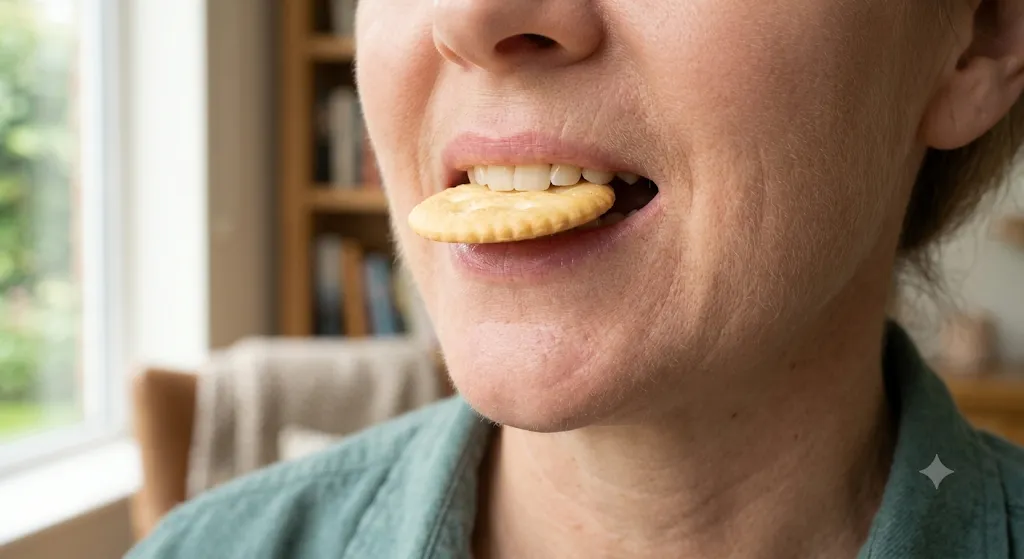
The cheek muscle still expects to press a real bolus back onto the teeth. Soft meals and one-sided chewing leave a white cheek line, easy bites, and a quieter face.

You bite the inside of your cheek on a soft sandwich and wonder how a mouth that has done this for decades still misses. Later you notice a pale line along the inner cheek, exactly where the teeth meet. Neither moment feels like an injury. Both are the buccinator doing an old job in a mouth that mostly sips, grazes, and chews on one favorite side.
The buccinator is the thin sheet of muscle in the cheek wall. It is not the jaw closer. That work belongs to the masseter, the temporalis, and the medial pterygoid, the same system described in why your masseter still expects a tough chew. The buccinator’s older assignment is simpler and easier to forget: keep the food on the teeth.
What This Muscle Still Does
The buccinator runs from the outer surfaces of the upper and lower jaws, and from the pterygomandibular raphe behind the last molars, forward into the corner of the mouth. There it blends with the muscles that shape the lips, at a knot of fibers called the modiolus. The buccal branch of the facial nerve drives it. When it contracts, the cheek presses inward against the teeth and gums.
During a chew, that inward press is a food-control move. A bolus that slips into the vestibule, the pocket between cheek and teeth, is pushed back onto the grinding surface. Infants use the same wall to suck. Adults use it to whistle, to blow out a candle, and to keep air from ballooning the cheeks. Electromyography studies of the face, in the tradition of John V. Basmajian’s muscle recordings, show the buccinator active on both the working and the balancing side during mastication, and again during swallowing.
Anatomists Charles E. Perkins and Roland L. Blanton described this as the muscle that maintains the bolus on the occlusal table. Harry Sicher and E. Lloyd DuBrul treated it the same way in classic oral anatomy: a cheek wall, not a power muscle. William Hylander’s work on primate chewing made the functional point sharper. Tough, fibrous food does not stay put. It has to be repositioned, cycle after cycle, by tongue and cheek together.
Why a Soft Modern Meal Leaves It Quiet
Ancestral meals were chewier than a yogurt, a shake, or a crustless sandwich. Roots, meat with connective tissue, seeds, and raw plants needed many closing cycles and many cheek corrections. The jaw closers did the force. The buccinator did the housekeeping. That pairing is the same mismatch traced in why your mouth was built for chewing tough food.
Stavros Kiliaridis showed, in growing animals, that a soft diet reduces the size and activity of the masticatory muscles and changes how the jaws develop. William Proffit made the parallel argument in humans: less chewing demand, less stimulus for the face and dental arches that grew up around chewing. The buccinator is not the bone-building muscle in those studies, but it sits in the same under-used circuit. A day of sipping and soft bites barely asks the cheek to retrieve a bolus.
One-sided chewing makes the imbalance local. The preferred side still gets a little press. The other cheek mostly rests against the teeth. Over months, the resting cheek can feel clumsier when you finally use it, and the working side collects the pale friction line.
The White Line and the Accidental Bite
A linea alba is the thin white ridge on the buccal mucosa, level with the biting edges of the teeth. It is keratin, the same tough protein skin uses, laid down where cheek and teeth meet all day. Dentists treat it as a normal finding, not a disease. It is more obvious in people who clench, who chew on one side, or who hold the cheek in against the teeth while they think.
An accidental bite is the other familiar version. The cheek is supposed to stay just clear of the cusps while the jaw closes, then press in between closures to corral the food. Fatigue, a numb lip after dental work, a hurried bite, or a tooth edge that sits a little proud can close that gap. The muscle has not failed. The timing was tight, and the food was not giving the tongue and cheek much to work with.
Chronic cheek chewing, sometimes called morsicatio buccarum, is a habit rather than a one-off miss. The mucosa looks shredded or white and ragged along the bite line. It is annoying, and it keeps the buccinator in a clench it was not built to hold for hours. It is still usually benign. A single raw patch that does not settle is a different question, covered below.
Less Common but Serious Lookalikes
Food pocketing in one cheek, with a crooked smile or a mouth that will not hold air, can be facial-nerve weakness. Bell’s palsy and, less often, a stroke both interrupt the nerve that drives the buccinator. The cheek then balloons on the weak side, and food collects there because nothing presses it back onto the teeth. Sudden one-sided face droop, trouble speaking, or arm weakness needs emergency care, not a chewing exercise.
A swelling in the cheek that grows, a numb patch, or an ulcer that is still there after two weeks is not a linea alba. Those need a dental or medical look. So does cheek pain with fever, a bad taste, and facial swelling, which can be a dental infection tracking into the buccal space. A white line that wipes off, leaving a red base, is more often debris or thrush than keratin.
Hidden Triggers
- Chewing only on the side that “feels right,” often after an old tender tooth.
- Daylong clenching, which pins the cheek against the bite line.
- A sharp filling edge or a new aligner that changes where the cheek sits.
- Numbness after dental anesthesia, when the cheek cannot feel the approaching tooth.
- Very soft meals that never ask the tongue and cheek to pass a bolus back and forth.
- Holding a pen, nail, or cheek between the teeth while concentrating.
When to Worry
Ordinary cheek bites heal in a few days. A pale line at the bite level, with no pain, is common. Seek care sooner for a one-sided weak face, food trapped in the cheek with drooling, an ulcer still open after two weeks, a lump, unexplained numbness, or swelling with fever. Bleeding that will not stop after a bite, or a cheek wound from a fall, also deserves a look. None of that is the everyday friction line.
Myths vs Facts
- Myth: The white line means you are low on a vitamin. Fact: A linea alba is friction keratin where cheek meets teeth. It is not a nutrition test.
- Myth: Cheek bites mean the jaw joint is failing. Fact: Most are a timing miss, a sharp edge, or a numb lip. Joint pain is a separate symptom.
- Myth: Blowing up balloons trains the chewing muscles. Fact: It uses the buccinator as an air seal. It does not replace chewing load on the masseter or the gums. The gum side of that load is covered in why your gums still expect a real chew.
- Myth: You should scrape or peel the white line off. Fact: Leave it. Scraping turns a normal ridge into a sore.
How to Give the Cheek Its Old Job Back
If your teeth and gums allow it, put one firmer texture on the plate most days: an apple, a carrot, a piece of crusty bread, meat that actually needs chewing. Chew on both sides on purpose for a week and notice which side you abandon. Slowing the first few bites gives the tongue and buccinator time to place the bolus before the teeth close.
Skip the habit of parking the cheek between the teeth. If a filling edge keeps catching, a dentist can smooth it. After dental numbness, wait until feeling returns before you eat anything you could miss. A raw bite heals faster if you leave it alone and keep the area clean with ordinary brushing. Wind instruments and whistling use the muscle, but they are optional. The daily stimulus it still expects is food that will not stay on the teeth by itself.
When to See a Doctor or Dentist
See a dentist for a repeated bite at the same tooth, a sharp edge, or a white patch you are unsure about. See a doctor promptly for face weakness, trouble holding food or air on one side, or neurologic symptoms. A patch that has not healed in two weeks should be examined rather than watched indefinitely. Bring a note of which side you chew on. It often explains the line better than a blood test does.
FAQs
Is the white line inside my cheek cancer?
A thin, even, pale ridge exactly at the bite line is usually a linea alba, from cheek pressed against teeth. Cancer and other lesions tend to be a patch, a lump, or an ulcer that does not heal. Anything still there after two weeks, or anything that looks different from a simple ridge, should be checked.
Why do I bite my cheek more when I am tired?
Fatigue and rushing shrink the margin between cheek and cusps. The buccinator is supposed to clear, then press. A fast close catches the lining before it moves. Numbness, a new tooth edge, and one-sided chewing do the same thing.
Does chewing gum count as the old job?
Sugar-free gum gives the cheek and jaw a little repetitive work, and it can be useful if firmer food is uncomfortable. It is not the same as repositioning a real bolus. If your jaw already aches, long gum sessions can irritate the joint more than they train the cheek.
Can a weak buccinator change my smile?
A true weak buccinator, from facial-nerve injury, can flatten the cheek and let food pocket. Ordinary under-use from a soft diet does not paralyze the muscle or collapse the face. Asymmetry you can see at rest, especially if it appeared suddenly, needs a medical exam.
Why does the cheek click or feel tight near the back teeth?
Sometimes the mucosa catches on a last molar, or the cheek is pinched as the jaw opens wide. Less often, a small salivary duct stone or a biting habit is involved. A click with locking of the jaw itself is a joint story, not a buccinator story.
Should I train it with facial exercises?
You can, but chewing real food on both sides is the stimulus the muscle was built around. Exaggerated cheek pulls are optional and easy to overdo if the joint is already sore. Start with texture and both sides before you add drills.
Conclusion
The buccinator still expects a bolus that tries to escape. Soft meals, one-sided chewing, and a day of clenching leave it either idle or pinned against the teeth, which is why the white line and the stray bite feel so ordinary. Give it food that needs placing, and use both cheeks. The pale ridge can stay. A weak face, a pocketed meal on one side, or a sore that will not heal should not.