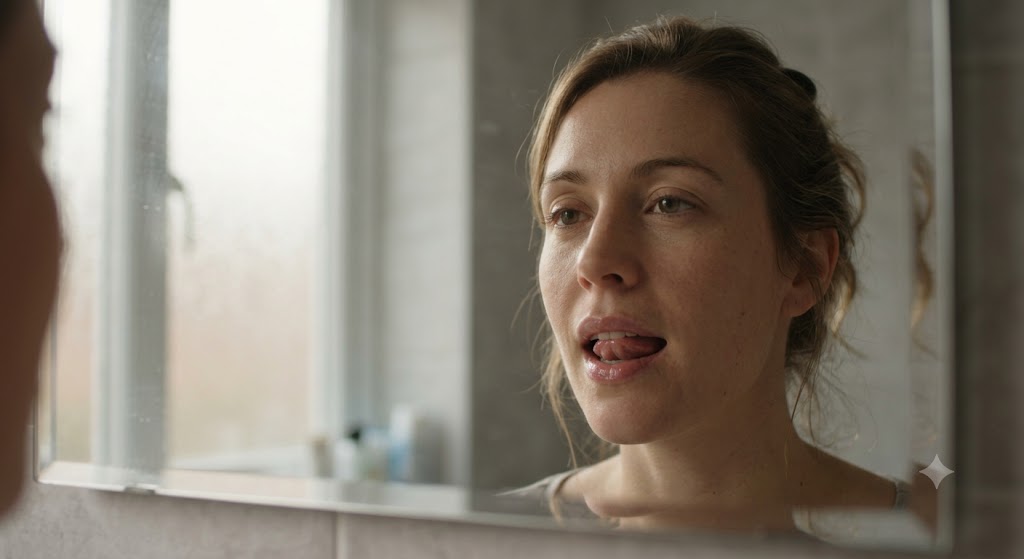
A mouth that waters at the smell of food is a cephalic saliva reflex, stronger when you are hungry. Chewing still makes more saliva than smell alone.

You walk past a bakery and your mouth fills before you have taken a bite. A neighbor grills, and you swallow twice on the sidewalk. It feels almost embarrassing, as if your body announced the craving out loud. It did not. It started the meal early.
A wet mouth at the smell of food is a normal cephalic reflex: the brain briefing the salivary glands that something worth digesting is nearby. It is stronger when you are hungry, and stronger for sour or savory cues than for a bland smell. Most adults do not actually drool. They notice a sudden pool under the tongue and swallow it. That is the reflex working, not a gland that has lost control.
What This Watering Feels Like
The usual version is brief. Smell, sight, or even a clear memory of a favorite dish brings a warm rush under the tongue and along the cheeks. You swallow. The feeling fades if you walk away, and it returns if you step back into the smell. Hunger makes it obvious. Right after a large meal, the same bakery often does very little.
Some people get it from a picture or from someone describing food. Others only notice it with lemon, vinegar, grilled meat, or fresh bread. A few never feel a flood at all and still digest normally. Visible drool down the chin is uncommon in healthy adults, because the swallow reflex usually keeps up with the extra flow.
Why Smell Can Start Saliva
Saliva is not one tap. Resting flow in a healthy adult is roughly a third of a milliliter a minute, enough to keep the mouth wet. Chewing can raise that several-fold. Smell sits in between, and it does not work equally in everyone. Colin Dawes mapped those rates over decades and showed that flow depends on the stimulus, the time of day, and how hydrated you are. Leo Sreebny’s clinical work used the same idea: unstimulated flow and stimulated flow answer different questions.
The wiring is parasympathetic. Smell and taste signals reach salivatory nuclei in the brainstem. From there, fibers travel with the facial nerve to the submandibular and sublingual glands, and with the glossopharyngeal nerve to the parotid glands. The glands do not wait for food to land on the tongue. They get a preview.
Ivan Pavlov made the preview famous in dogs: a cue paired with feeding eventually produced saliva by itself. Humans do a quieter version. Irving Shannon and colleagues measured parotid flow during olfactory stimuli and found real increases, especially with stronger food odors, though chewing and sour taste still outran smell. Richard Mattes reviewed cephalic-phase responses and argued that sight, smell, and expectation prime digestion before the first swallow. Michael Power and Jay Schulkin described the same anticipatory loop as a feature of feeding, not a glitch. Chantal Nederkoorn’s cue studies found that people who react more strongly to food smells also tend to notice more craving. The water is physiology. The craving is the same circuit talking to attention.
Hunger amplifies it. An empty stomach and a falling supply of recent calories make food cues louder. A full stomach and a recent meal turn the volume down. That is why the same smell can drench your mouth at noon and barely register after dinner.
This preview is part of a wider briefing. The stomach also expects acid before the meal, and the pancreas expects chewing and time. Saliva is the part you can feel. The stomach’s pre-meal acid briefing and the pancreas’s chewing signal are the quieter partners.
Why Chewing Still Matters More Than the Smell
Smell starts the glands. Chewing runs them. Mechanoreceptors in the gums and teeth, plus taste, drive a much larger flow than odor alone. Dawes showed that saliva also needs time and a real oral stimulus to buffer acid and clear sugar. A pastry smelled through a window does not replace a meal you actually chew.
That is the modern mismatch in miniature. Packaged food is often soft, sweet, and eaten fast, so the smell may be strong while the chew is weak. The mouth waters, then the bite disappears before the glands have done their longer job. The saliva system still expects real chewing, not only a scent.
Less Common but Serious Causes
Watering at a food smell is almost never the warning sign. The patterns that deserve attention look different.
A new inability to water, plus a dry mouth and dry eyes, can point to reduced gland function, including Sjögren’s pattern, some medications, or dehydration severe enough to cut resting flow. Anticholinergic drugs, some antidepressants, and dehydration are far more common than gland disease.
Constant pooling of saliva, new trouble swallowing, or drooling from one corner of the mouth is not a bakery reflex. One-sided facial weakness with drooling needs urgent care. So does watering with chest pain, severe headache, or confusion, which would be about the accompanying symptom, not the saliva.
Nausea with extra saliva is common in early pregnancy, migraine, and acid reflux, because the body prepares to protect the mouth and teeth if vomiting follows. A metallic taste with sudden heavy flow is worth mentioning if it is new and persistent. Rarely, a salivary stone or infection causes swelling and odd flow, usually with pain at a meal rather than a reaction to smell alone.
Hidden Triggers That Make It Stronger
Skipping meals turns ordinary smells into floods. So does a very sour or umami cue: lemon, vinegar, tomato, grilled fat, coffee. Looking at food while hungry adds the visual channel. Talking about a meal can be enough for some people. Dehydration makes the rush feel larger because the mouth was dry a moment earlier. Alcohol the night before, a stuffy nose that forces mouth breathing, and a morning of coffee without water all set that stage.
Anxiety can increase swallowing and make you notice saliva you would have ignored. It can also dry the mouth through sympathetic tone, so the same person may water at lunch and feel parched in a meeting. Neither version means the glands are broken.
When to Worry
Get urgent help if drooling comes with face droop, trouble speaking, trouble swallowing, chest pain, or a sudden severe headache. Book a routine visit if your mouth has stopped responding to food and stays dry, if one gland swells when you eat, if you wake choking on saliva, or if a new metallic taste and heavy flow last more than a couple of weeks. A single bakery moment needs nothing but a swallow.
Myths vs Facts
Myth: A watering mouth means you are low in a vitamin or “too acidic.”
Fact: It means a food cue reached the salivatory nuclei. It is not a nutrient test.
Myth: If your mouth does not water, you cannot digest the meal.
Fact: Smell is a weak stimulus for many people. Chewing and taste still drive plenty of saliva.
Myth: Adults should never feel this. It is only for children.
Fact: The reflex stays. Adults just swallow faster, so it rarely becomes a drip.
Myth: Swallowing the extra saliva makes you hungrier in a harmful way.
Fact: The saliva is mostly water, mucus, and enzymes. Hunger is the brain’s response to the cue and to how long it has been since you ate.
How to Live With It
You do not need to stop it. If the rush is annoying, swallow, sip water, and step out of the smell. Eating a real meal, with enough chewing, usually quiets the cue better than grazing on the scent. A short walk after you notice the craving can separate “I smelled food” from “I must eat this now.”
If the mouth is dry the rest of the day, treat that separately: water across the day, less all-day sipping of acidic drinks, and a check of medicines that dry secretions. Gum or a crunchy bite can raise flow when you want it, which is a better test of the glands than waiting for a passing smell.
When to See a Doctor
See a clinician for dry mouth that meals do not fix, gland swelling, one-sided drooling, pain on swallowing, or unintentional weight loss with a changed sense of taste. Mention pregnancy if nausea and watering arrived together. For the ordinary sidewalk version, no test is required.
FAQs
Why does thinking about a lemon work even without a lemon nearby?
Memory and imagery can recruit the same salivary pathway as a real smell. Sour foods are especially effective cues. The flow is usually smaller than biting the lemon.
Is it the same as drooling in sleep?
No. Sleep drooling is mostly a slower swallow and an open mouth. Food-smell watering happens while you are awake and usually ends when you swallow or leave the cue.
Can a stuffed nose make it worse?
A blocked nose pushes you toward mouth breathing, so the mouth starts drier and the rush feels bigger. The smell itself may also be weaker until the nose clears.
Does everyone water at the same smells?
No. Hunger, habit, and how strongly you like the food change the response. Some people mainly react to sour cues. A flat response to smell alone is still normal if chewing produces saliva.
Should I worry if only one side waters?
A slight side-to-side difference is common. A new one-sided flood with swelling, pain, or facial weakness should be checked.
Conclusion
A mouth that waters when you smell food is the meal starting on time. Smell and expectation brief the glands. Chewing still does the heavier work. Hunger turns the reflex up. A recent meal turns it down. Swallow, eat when you are actually ready, and save the visit for dryness that meals cannot fix or drooling that arrives with weakness or trouble swallowing.