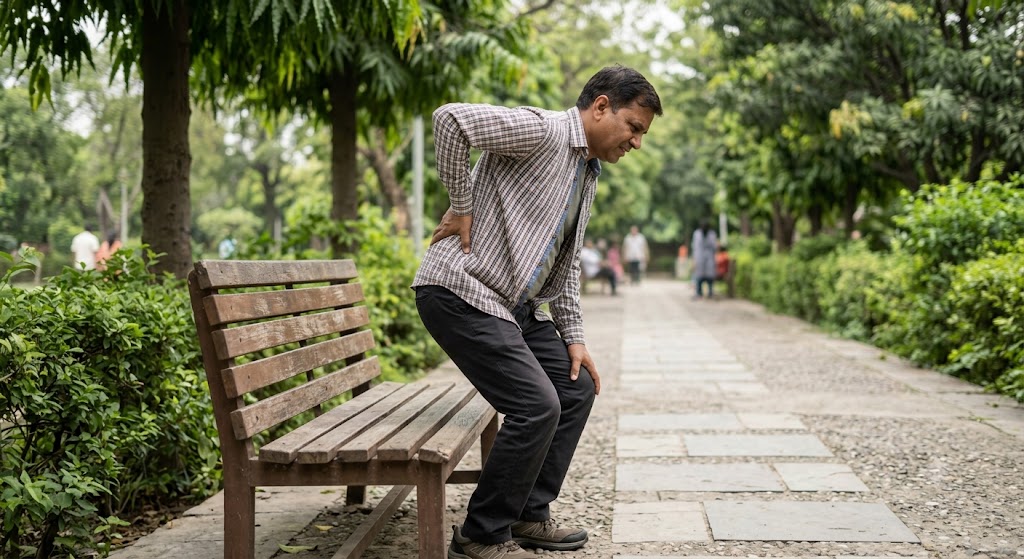
A stiff or aching knee after a movie, a flight or a long desk block is often theater sign — the patellofemoral joint after stillness — not automatically worn-out cartilage. Dye, Insall and Fulkerson mapped the envelope.
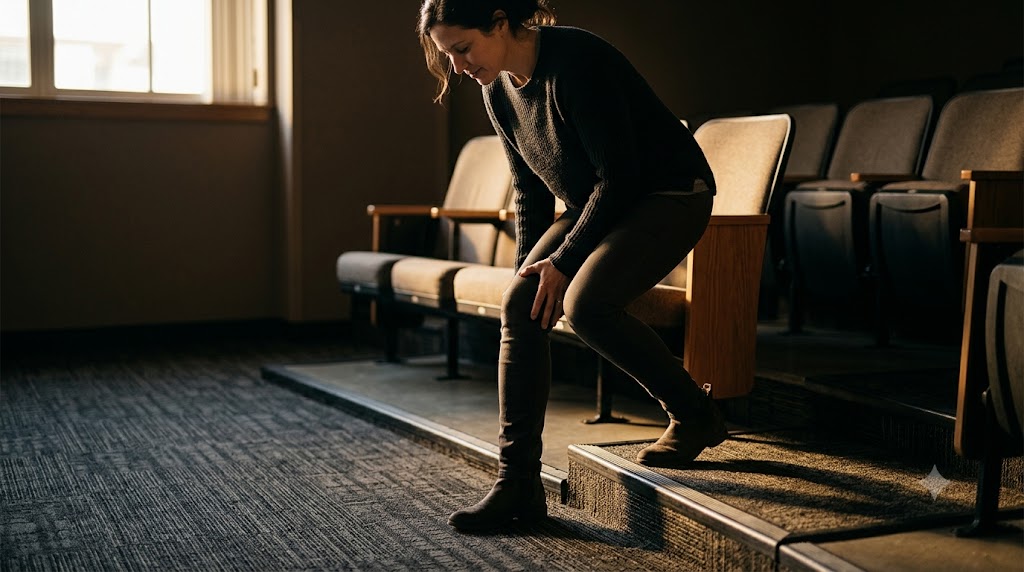
The movie ends. You stand. One knee does not want to straighten. For a few steps it feels thick, tight or vaguely bruised under the kneecap. Then the walk to the lobby loosens it.
That pattern has a clinic nickname: theater sign, or movie-goer’s knee. It is one of the most common ways a kneecap joint complains. It is not automatically bone-on-bone. It is often a joint that spent ninety minutes still, slightly bent, with fluid pooling and a small contact patch under load it was built to share across motion.
Scott F. Dye described an “envelope of function” for the knee: a zone of load, frequency and duration the joint can accept without a pain flare. Sitting too long in one angle can leave that envelope just as a sudden downhill can. John Insall and John Fulkerson spent decades mapping how the patella tracks in the groove of the femur, and why a quiet, flexed sit is a surprisingly hard job for that interface.
This is not a diagnosis from a blog. It is a map of why a painless knee can bark after stillness, what usually drives it, and when the ache is asking for a real exam.
What This Ache Feels Like
Typical theater-sign knee is:
- A dull ache under or around the kneecap after sitting with the knee bent
- Stiffness on the first stand, sometimes a brief catch
- Easing over the first minutes of walking
- Worse after planes, cars, desks, pews and cinema seats
- Often worse on stairs, squats or rising from a low chair later the same day
- Not usually a sharp twist-and-lock of a torn meniscus
Some people feel it more after a long sit than after a run. That surprises them. It should not. Running cycles the joint. Sitting parks it.
The same joint can feel fine on a walk and unhappy after a meeting because the demand changed: from shared, moving contact to a small, still patch.
What the Kneecap Joint Is Doing While You Sit
The patellofemoral joint is the kneecap sliding in the femoral groove. In a straight knee the contact force is low. As you bend, the patella sinks into the groove and the contact force rises. A ninety-degree sit is not rest for that surface. It is a sustained, mid-range press.
Cartilage has no blood supply. It eats from synovial fluid pumped by motion. A long sit lets that fluid pool and thicken. The first stand then asks a still, slightly starved surface to take body weight. Synovial fluid still expects a warm-up for exactly this reason. The lobby walk is the pump restarting.
The fat pad under the tendon, the synovium around the edges, and the bone under thinning cartilage are all richly innervated. Dye showed that probing those tissues in awake patients can reproduce the familiar ache. “Worn cartilage” is not required. Irritated lining and a loaded fat pad can be enough.
Tracking matters. If the kneecap sits a little laterally in the groove — from a strong outer retinaculum, a quiet vastus medialis, a wide Q-angle, or a hip that collapses inward — the contact patch shrinks. Fulkerson’s work on the lateral retinaculum and Insall’s work on alignment made that geometry clinical, not theoretical. A small patch under a long sit is a long minute for a small area.
Common Causes
Sustained flexion. Cinema, flights, floor seating, deep sofas and desk chairs that leave the knee at 80–100 degrees keep the patella pressed in the groove without the unload of a straightening cycle.
First-stand demand. Standing from that angle is a squat. The contact force spikes before the fluid film and the quadriceps timing have caught up.
A day of sitting plus a burst. Desk all afternoon, then stairs, a lunge for a bag, or a sudden walk. The envelope Dye described is about frequency as well as peak load.
Recent increase in hills, stairs or deep squats. The joint can be quiet at rest and loud after sitting because the week already used the budget.
Hip and foot mechanics. A knee that falls inward on stairs, a stiff ankle, or a hip that does not control the femur can crowd the lateral facet. The sit is the last straw, not the only one.
Swelling after a twist or overload. Even a small effusion raises pressure in flexion. Sitting then feels tight rather than just stiff.
Why Stillness Is a Load
People treat sitting as the opposite of injury. For the kneecap, it is a different injury pattern: low speed, long duration, small contact.
Ancestral sitting was usually a squat with fidget, a stand, a walk, a change of angle. Modern sitting is a locked mid-range for an entire act of a film. Joints still expect motion rather than rest. Morning stiffness is the overnight version of the same pump pause.
The meniscus and the tibiofemoral joint have their own sitting story. A locked twist under a bent knee is a different red flag. Theater sign is usually the front of the knee, not the joint line after a pivot.
Less Common but Serious
See a clinician promptly if the post-sit ache comes with:
- A knee that locks and will not straighten
- Sudden swelling after a twist, pop or give-way
- Fever, redness and heat suggesting infection
- Night pain that does not care about position
- A joint that gives way on level ground
- Calf swelling and breathlessness after a long sit or flight (that is a vein problem, not a kneecap problem)
- A young person with a limp and groin or thigh pain — hip problems can speak at the knee
Anterior knee pain is common. Infection, fracture, tumor and true locking are not. They are the reason “it always aches after a film” is not the same sentence as “it locked after a twist.”
Hidden Triggers
- Low seats and soft sofas that park the knee deeper than a firm chair
- Crossing the same leg for an entire meeting
- Heels that change ankle and femur position for hours
- A sudden return to lunges or box jumps after a quiet month
- Kneeling work that loads the same fat pad the sit already irritated
- Weight change that raises contact force in the same groove
- Training only the quad in a machine and never the hip that aims the femur
None of these require a moral verdict. They change the envelope.
When to Worry
Worry less when the ache is bilateral or familiar, eases with a few minutes of walking, and has no lock, fever or sudden swelling.
Worry more when one knee suddenly changed after a twist, when stairs become unsafe, when swelling stays, or when the pain is waking you regardless of position.
Age does not decide the story by itself. Teenagers get theater sign. Older knees get it. Imaging can show cartilage change that does not match the pain, and a painful knee can look quiet on a scan. The history still leads.
Myths vs Facts
Myth: If it aches after sitting, the cartilage is gone.
Fact: Irritated synovium, fat pad and a small contact patch can ache with intact cartilage. Dye’s mapping made that painfully clear.
Myth: You should never bend the knee past 90 degrees.
Fact: Knees were built to fold. They were not built to freeze at one fold for two hours.
Myth: Strengthening only the inner quad will recenter every kneecap.
Fact: Vastus medialis matters. Hip control, ankle motion and how often you change position often matter more than one muscle’s isolation.
Myth: A click on standing means the meniscus is torn.
Fact: Painless clicks are common. Locking, swelling and joint-line pain after a twist are the meniscus script. A sit-to-stand pop is often cavitation.
Myth: Rest until it is silent, then return to full stairs.
Fact: Complete rest shrinks the envelope. Easy cyclic motion, then graded load, is closer to what the joint was built for.
How to Manage It
Change the angle before the ache peaks. On a flight or in a film, straighten and bend the knee a few times each half hour. A short aisle walk beats a perfect stretch you never take.
Stand with a strategy. Unweight slightly, straighten gradually, take ten easy steps before a stair. That is the warm-up the fluid asked for.
Raise the seat when you can. A higher perch reduces flexion angle and first-stand demand. A footstool that lets you change knee angle is more useful than a heroic posture.
Walk before you demand. After a long sit, a flat walk is treatment. A first heavy squat is a test.
Load the hip that aims the knee. Split-stance work, step-downs done slowly, and lateral control often calm a kneecap more than endless seated extensions.
Keep some squat in the week. Avoiding all flexion makes the next cinema worse. Graded depth, not zero depth, is the usual path.
Ice after a flare, motion after the ice. Numbness is not a plan. A quieter joint still needs cycles.
This is general education, not a personal rehab program. A knee that stays loud deserves a clinician who can tell fat-pad irritation from a meniscus tear from referred hip pain.
When to See a Doctor
Book an exam if theater sign is new and worsening, if one knee swells, if stairs feel unsafe, if you cannot fully straighten, or if pain after sitting is now pain at night. A sports-medicine or musculoskeletal clinician can use history, a squat, a step-down and selective imaging. Surgery is not the default for a movie knee. Ignoring a locked knee is not wisdom either.
FAQs
Why does my knee hurt after sitting but not after walking?
Walking cycles fluid and shares contact. Sitting parks a small patch under load. Different jobs, different complaints.
Is theater sign the same as arthritis?
No. Osteoarthritis can include it. Plenty of people with theater sign have no advanced arthritis on imaging.
Should I wear a brace in the cinema?
A simple sleeve can remind you not to lock into one angle. It does not fix tracking by itself. Changing position still does more.
Does cracking mean I should not stand?
A painless pop on the first stand is often gas or a tendon sliding. Pain plus swelling plus lock is a different visit.
Will losing weight fix it?
Lower body weight lowers contact force. It is not the only lever. Hip control and sit-breaks still matter at any size.
Can teenagers get this?
Yes. Anterior knee pain is common in growing athletes. They still need an exam if there is a limp, swelling or night pain.
Is a deep squat dangerous after this?
A sudden deep squat after two hours of stillness is a spike. A trained squat with a warm-up is a different dose.
Why stairs after a meeting feel worse than the meeting?
Stairs raise patellofemoral force. The meeting used the budget. The stair collects it.
Does stretching the IT band fix movie knee?
The IT band is a thick tendon, not a rubber band. Hip control and position change usually beat aggressive side-of-thigh stretching.
When is this an emergency?
Hot swollen knee, inability to bear weight after trauma, calf swelling with breathlessness after a flight, or a knee that will not move. Those are same-day problems.
Conclusion
A knee that aches after a film is often telling the truth about stillness, not announcing the end of cartilage. The patella spent an hour pressed in a groove with a quiet pump. Dye’s envelope, Insall and Fulkerson’s tracking work, and the simple physics of a first stand explain most of the lobby limp.
Change the angle. Walk before you demand. Keep some motion in the week. Let a clinician sort the cases that do not ease. The joint was built to fold. It was also built to keep folding — not to freeze in the dark until the credits.