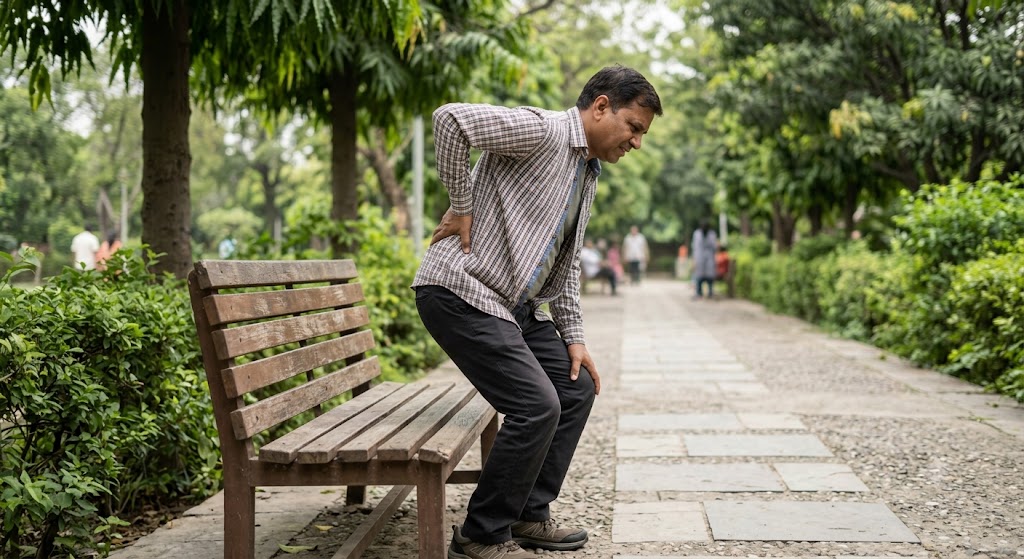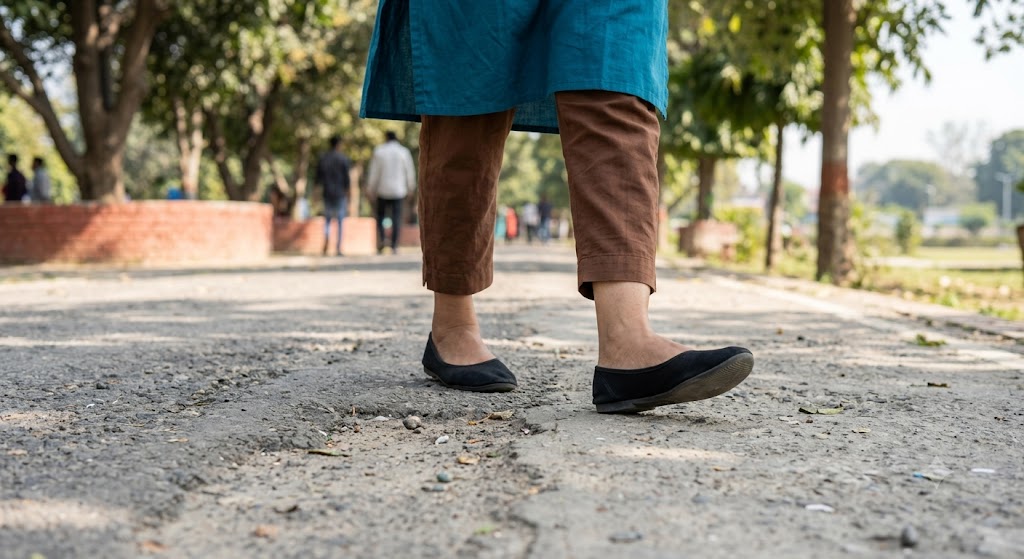
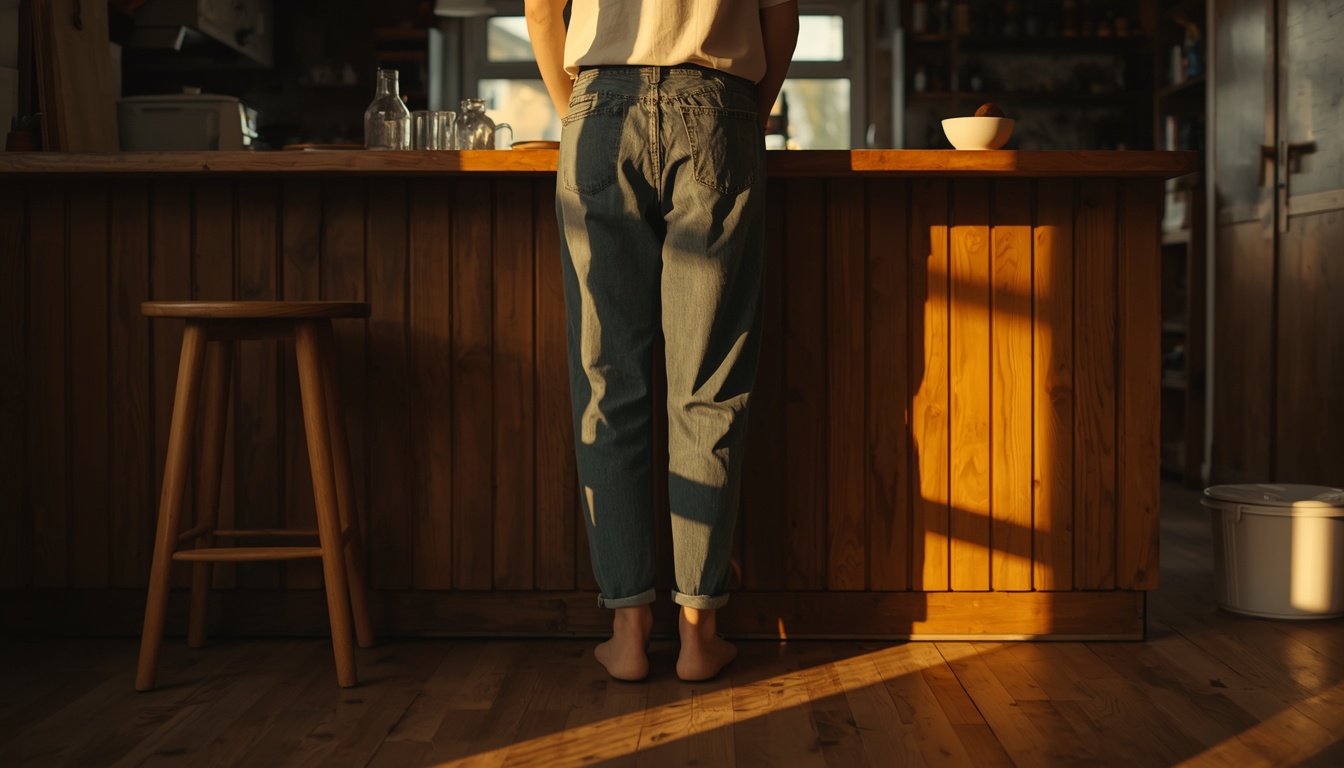
You finish a shift at a counter, a kitchen, a classroom, or a checkout line and your calves feel cooked. Not the sharp snap of a pulled muscle. A dull, heavy ache that starts in the lower leg and sometimes climbs behind the knee. Shoes come off and the relief is incomplete. By the next morning the tightness is usually better — until the next long day on the same spot of floor.
Aching calves after standing all day are extremely common. They are usually a mix of a postural muscle that never got to cycle, veins that never got a proper pump, and a floor that never asked your ankle to move. They are not automatically a blood clot, a potassium emergency, or proof that standing desks are a scam. Static standing and walking are not the same job.
What This Symptom Feels Like
Typical end-of-shift calf ache is:
- A bilateral, dull tightness in the lower half of the calf, often worse in the soleus — the deeper, flatter muscle under the more famous gastrocnemius
- A heavy or “full” feeling that eases a little when you walk to the car and returns when you stand still again
- Mild ankle puffiness by evening, socks leaving a faint ring
- Onset after two to four hours of mostly still standing, not after the first ten minutes
- Improvement overnight with the legs up, or after an easy walk later in the evening
Less typical — and not something to file under “retail legs” — is sudden one-sided swelling and tightness, pain that wakes you at night, redness and heat, shortness of breath, or calf pain that started during a sprint rather than a shift.
Why Standing Still Is Harder Than Walking
Walking looks like more work. For the calf it is often kinder.
The soleus is a slow-twitch postural muscle. In quiet standing it fires almost continuously to keep you from falling forward over the ankle. Electromyography work that began with John Basmajian and later occupational studies by David Antle and Julie Côté show that the calf does not rest during “just standing.” It holds a low-level isometric contraction for minutes at a time. Isometric hold is expensive. Blood flow inside the muscle is squeezed. Metabolites collect. The motor units that were recruited first stay on because the task never changes.
Walking interrupts that. Each step shortens and lengthens the calf, opens intramuscular vessels, and — crucially — uses the calf as a pump. Veins in the lower leg have one-way valves. When the soleus and gastrocnemius contract, they empty the deep veins toward the heart. When they relax, the veins refill from the foot. That cycle is why your veins still expect the calf pump. Standing on one painted square of tile removes the cycle. The muscle works. The pump barely does.
The same quiet pooling is why feet swell after sitting. Sitting and static standing look opposite. Hydraulically they are cousins: both starve the calf of the squeeze-and-release it was built for.
The Venous Half of the Ache
By late afternoon the veins of a standing worker hold more blood than they did at 9 a.m. Hydrostatic pressure at the ankle in a 170-centimeter adult is on the order of 80–90 mmHg if the column from heart to foot is uninterrupted. Muscle pumping normally knocks that number down with every step. Without steps, capillary filtration wins a slow argument with reabsorption. Fluid leaves the vessels. The calf feels tight from the inside as well as from the muscle.
Occupational research has treated this as more than comfort. Finn Tüchsen and colleagues linked prolonged standing at work with later venous disease. Dutch and German standing-work studies (including work associated with W. P. M. Krijnen on floor staff) found more evening edema and more reported heaviness in people who stood still than in people who walked a comparable number of hours. The difference was motion, not total time on the feet.
Hard floors make the isometric hold worse. Soft anti-fatigue mats help some people by inviting tiny ankle oscillations — a micro-version of walking. They do not replace walking.
Why Your Calves Also Miss Hills
There is a second, slower mismatch. Human calves evolved as springs for walking and gentle climbing, not as pillars. An article on this site maps that spring in detail: your calves still expect hills and stairs. A day of level standing gives the Achilles and soleus load without the lengthening they get on a descent or the shortening they get on a rise. The tendon stays in a narrow range. The muscle stays in a narrow range. Variety is what those tissues use as maintenance. A shift on flat concrete is load without the variety.
People who stand all week and then take a hard weekend hike often feel this as a delayed calf tightness that is easy to blame on “being out of shape.” Part of it is simply that the standing week never trained the spring.
Common Triggers That Make It Worse
- Shifts longer than four hours with few chances to walk ten meters
- Concrete, tile, or steel floors with thin-soled shoes
- A static standing desk used as a statue pose rather than a perch you leave
- Heat: vasodilation adds to evening edema
- High-sodium lunch plus little water, which can increase the fluid shift
- Pregnancy, which raises venous pressure and relaxes vessel walls
- Varicose veins or a prior clot, which make the pump less efficient
- Compression socks that are the wrong size or rolled at the top
- Locking the knees and parking the weight on the heels for an entire hour
People with migraine or fibromyalgia sometimes report the ache more vividly. The tissue event is still mechanical. The volume knob on the pain is higher.
Less Common but Serious
Most bilateral evening tightness is fatigue plus dependent fluid. A few patterns should not wait for “see how you feel Monday”:
- Sudden swelling, tightness, and pain in one calf, especially after travel, surgery, or a week of unusual sitting
- Calf that is clearly warmer, redder, or more tender than the other
- Shortness of breath, chest pain, or coughing blood — emergency care, not a foam roller
- Night pain that does not care whether you stood that day
- Progressive weakness, foot drop, or numbness in a nerve pattern
- Rapidly worsening swelling in both legs with breathlessness (heart or kidney, not “retail legs”)
Deep-vein thrombosis can ache. It is usually one-sided and does not politely match your shift schedule. When the story is bilateral, end-of-day, and better by morning, the odds favor the ordinary pump-and-fatigue pattern. When the story is new, one-sided, and hot, skip the internet and get examined.
Hidden Triggers
A standing desk can reproduce the same ache if you treat it as a place to freeze. The research that praises standing usually praises alternation — sit, stand, walk — not a second statue.
Calf tightness after standing is also worse in people who never load the calf through its full range the rest of the week. No hills, no stairs, no slow heel-lowering off a step. The muscle that held you up all day is the same muscle that never got an eccentric dose. The Monday-to-Friday isometric and the Saturday zero is a poor combination.
Dehydration is over-blamed and under-measured. A dry day can make the ache feel sharper. It is rarely the only cause. More often the person also stood still, ate a salty meal, and wore unsupportive shoes.
Myths vs Facts
Myth: Aching calves after standing mean you are about to get a clot.
Fact: Clots are usually one-sided and not tied so neatly to the end of a shift. Bilateral evening heaviness is a different mechanism.
Myth: If standing hurts, sitting all day is safer.
Fact: Sitting removes the isometric but also removes the pump. The healthier pattern is interruption: walk, then stand, then sit.
Myth: Compression socks fix standing work.
Fact: Well-fitted below-knee compression can reduce evening edema. They do not replace walking, and a tourniquet at the calf from a rolled sock can worsen pooling below the roll.
Myth: The gastrocnemius is the whole calf.
Fact: Quiet standing is largely a soleus job. Stretching only the upper calf with a straight knee misses the muscle that did the day’s work. A bent-knee soleus stretch is the one that often feels relevant.
Myth: Anti-fatigue mats are a gimmick.
Fact: They help when they invite small sway. A mat you plant on like a podium does little.
How to Manage It
You do not need a new personality. You need a pump and a little variety.
- Break stillness on a timer you will actually obey: every 20–30 minutes, walk even ten meters or rise onto your toes ten times.
- When you must stay put, shift weight, unlock the knees, and make small ankle circles. Those oscillations are cheap pumping.
- Finish the shift with a five-to-ten-minute easy walk, not a collapse onto the sofa. The walk empties the veins you filled.
- Elevate the lower legs for fifteen minutes in the evening if they feel full. Elevation is gravity doing the pump’s leftover job.
- Train the spring on days you are not standing: slow heel drops off a step, both straight-knee and bent-knee, and an occasional hill or flight of stairs.
- Choose shoes you can roll through, not a completely rigid clog unless your workplace requires it. A little forefoot flex invites the calf to change length.
- If you use compression, measure for it. 15–20 mmHg below-knee is the usual starting class for evening heaviness without diagnosed venous disease.
- Drink through the day and go easy on the high-salt lunch if your ankles balloon by 6 p.m. That is a volume tweak, not a cure.
People who stand for work often do better with a planned “on-the-clock” walk than with a heroic evening workout that lands on already cooked soleus fibers.
When to See a Doctor
See a clinician promptly for one-sided swelling, heat, or sudden calf tightness, especially after travel or surgery. See someone soon if both legs swell rapidly, if you become short of breath, or if the ache is paired with skin color change, ulcers, or veins that have become painful cords.
For the ordinary bilateral pattern, a primary-care visit is still reasonable if the ache is new, if it is getting worse month after month, or if evening swelling no longer settles overnight. Chronic venous insufficiency, medication effects (including some calcium-channel blockers), and heart or kidney issues can wear a standing-day costume. A short exam and, when needed, a duplex ultrasound answer more than another pair of insoles.
FAQs
Why do my calves hurt more from standing than from a long walk?
Standing holds the soleus in a narrow isometric range and barely runs the venous pump. Walking uses the same muscle as a spring and a pump. The walk is more movement and often less stagnation.
Is a standing desk going to do this to me?
It can, if you freeze. Alternate sitting and standing and take short walks. The desk is a tool for changing posture, not a second place to statue.
Do I need electrolytes?
Not as a first move. If you sweat heavily in a hot kitchen and eat almost no potassium-containing food, a normal meal usually covers it. Cramping that is sudden, severe, and one-sided is a different problem from end-of-shift dull ache.
Will this turn into varicose veins?
Prolonged static standing is associated with more venous symptoms over years in occupational studies. Walking breaks, weight management, and treating obvious venous disease matter more than guilt about a job you cannot leave.
Why is one calf worse?
A small side-to-side difference is common if you park more weight on one leg. A large new difference with swelling deserves a clot-and-vein check, not another stretch.
Does stretching at the end of the day fix it?
A gentle bent-knee soleus stretch can feel good. It does not empty the veins the way a short walk does. Stretch after you walk, not instead of walking.
Conclusion
Your calves were built to hold you up in short bursts and then to spring and pump. A modern shift often asks them only to hold. The dull evening ache is the honest receipt: isometric fatigue plus a column of blood that never got its squeeze. Walk the floor you stood on. Change the length of the muscle on purpose a few times a week. Treat sudden one-sided swelling as a medical question. Treat the ordinary bilateral tightness as a design brief your job forgot — and that a few minutes of real steps can still answer.