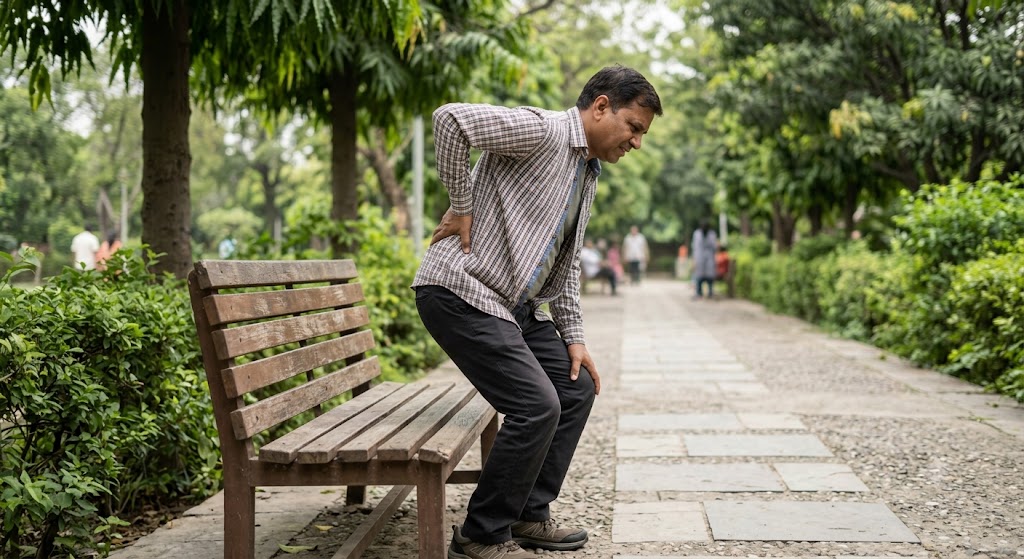
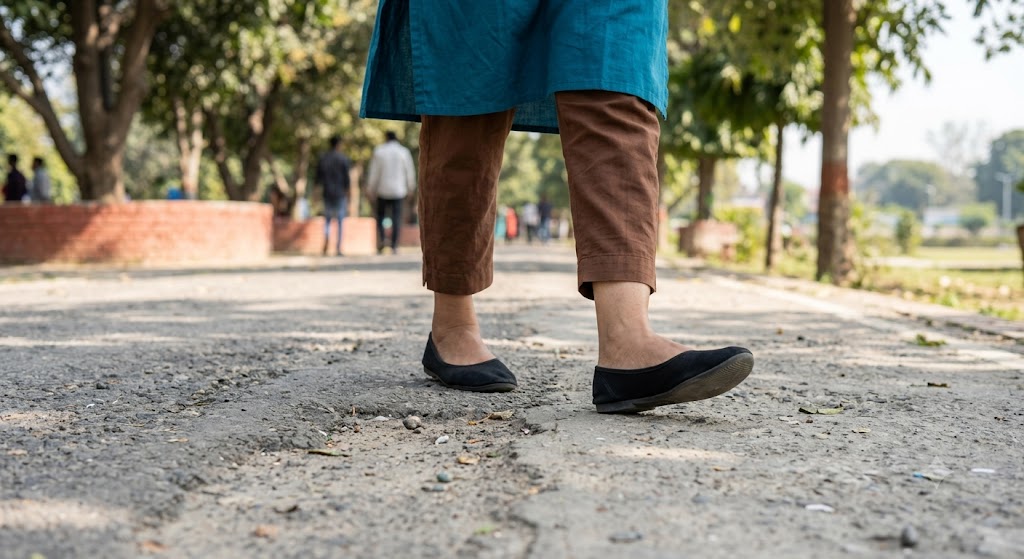
The walk felt fine for the first few blocks. Then the balls of the feet started to burn. The arch felt like a tight band. By the time you sat down, slipping the shoes off was the best part of the afternoon.
Completely flat shoes — ballet flats, thin fashion sneakers, flip-flops, some “barefoot-style” slip-ons worn all day on pavement — look harmless because they have no heel. A high heel is an obvious mechanical insult. A pancake sole is not. Yet many people discover that zero drop plus a skinny midsole plus a narrow toe box is its own kind of load.
That ache is usually the foot telling you how it was asked to work, not a verdict that you have “bad arches.”
What This Symptom Feels Like
The complaint after flat shoes is rarely one pinpoint. It clusters.
The ball of the foot can feel bruised or hot, especially under the second and third metatarsal heads. The medial arch can ache as if someone pulled a strap too tight. The heel may feel tender on the first step after sitting. The big-toe joint can throb after a long paved walk. Some people feel the tightness climb into the shin or the inside of the ankle, where the posterior tibial tendon is working overtime to hold the midfoot.
It is typically worse after a longer bout on hard ground than after a short indoor errand. It eases when you sit, change into a shoe with a little structure, or walk barefoot on a softer surface. It is not the same as a sudden pop, a sharp stab that will not let you bear weight, or numbness that does not fade.
Why “Flat” Is Not the Same as “Natural”
A human foot is not a board. It is a stacked set of twenty-six bones, a springy plantar fascia, a windlass under the big toe, and layers of small muscles that stiffen the arch when you push off.
Daniel Lieberman and colleagues who compared habitually shod and habitually barefoot walkers and runners showed that footwear changes how the foot meets the ground. Barefoot on yielding earth, people often land more softly and let the midfoot share load. Modern pavement is not yielding earth. A fashion flat on concrete is not a trained barefoot gait. It is a thin, often narrow, often flexible platform that lets the arch collapse toward the ground on every step without giving the sole much time or texture to adapt.
Benno Nigg’s work on preferred movement path is useful here. A shoe that forces the foot far from the path it wants — too much heel, too little toe room, a midsole that bends in the wrong place — costs extra muscle work. Many ballet flats bend right through the midfoot instead of at the ball of the foot, which is where a healthy shoe should crease. That midfoot fold asks the plantar fascia and the posterior tibial tendon to act as the missing structure.
Thomas McPoil and colleagues who measured navicular drop showed how much the midfoot can sag when support and muscle timing are not enough. A little motion is normal and healthy. A long day of sag on a hard surface is what leaves the arch complaining at dinner.
The Forefoot Problem Hidden in Pretty Shoes
A surprising amount of “flat shoe pain” is not the arch. It is the ball of the foot.
When there is almost no heel-to-toe drop and almost no cushion, more of each step’s peak force arrives under the metatarsal heads. A tight toe box then squeezes those heads together. The fat pad that should sit under the bones can migrate forward. The result is a bruised, burning forefoot — metatarsalgia in clinic language — that people often blame on “standing too long” when the shoe shape did half the work.
The windlass mechanism John Hicks described still matters. The plantar fascia tightens when the big toe extends at push-off and shortens the distance from heel to forefoot, raising the arch. A stiff, pointed flat that will not let the big toe extend steals that free lift. The small muscles and the fascia then do the job as a grind instead of a snap.
That is why a wide, flexible toe box on a still-minimal shoe often feels better than a pretty pointed flat with the same sole thickness. The sole was never the whole story. The toes needed room to do their job, the same job described in work on how toes still expect to spread and grip.
Why the First Weeks in Minimal Shoes Can Hurt
Some people switch from cushioned trainers to thin flats or “zero-drop” shoes because they have heard that less shoe makes a stronger foot. The direction can be useful. The dose is where it goes wrong.
Patrick McKeon and others who study the “foot core” — the four layers of plantar muscles that stiffen the arch — have shown that those muscles do respond to more demand. They do not respond well to an eight-hour first day on city sidewalks. Intrinsic foot muscles fatigue. When they fatigue, the fascia and the tendons take more of the tensile load. That is a classic setup for the next-morning arch ache people call “my flats wrecked me.”
Irene Davis’s running-form work is not about ballet flats, but the principle transfers: sudden changes in how the foot hits the ground raise injury risk even when the new pattern is, in theory, more “natural.” Pavement plus distance plus novelty is the combination, not flatness alone.
A related mismatch lives in how feet still expect uneven ground. A thin sole on varied dirt can be information. A thin sole on a flat sidewalk is mostly impact.
Hidden Triggers That Make Flat-Shoe Days Worse
A few ordinary details turn a tolerable pair into a sore evening.
Hard indoor floors — tile, concrete retail, airport terminals — are less forgiving than they look. A long museum day in flats is a classic story.
Yesterday’s long walk already used up some of the foot’s spare capacity. Today’s thin sole then feels suddenly intolerable.
A very flexible shoe that folds in the midfoot instead of at the toes.
A narrow last that crowds the fifth toe and the ball of the foot.
A backless slip-on that makes you grip with the toes to keep the shoe on. That extra toe-flexor work is a hidden load.
A recent jump in daily steps after a quieter month.
An already irritable plantar fascia, which still expects a springy first step rather than a long, sagging one.
Calf tightness. If the ankle cannot dorsiflex freely, more of the step dumps onto the forefoot. Flat shoes do not create that stiffness, but they expose it.
When to Worry
See a clinician promptly if any of these show up:
Sudden inability to push off or rise on the toes after a pop in the midfoot or the back of the heel.
A hot, swollen joint, especially the first metatarsal-phalangeal joint, that does not ease overnight.
Numbness, burning or electric pain into the toes that is worse in tight shoes and may be a neuroma or nerve entrapment rather than simple bruise.
Pain that is worse at the first step out of bed every morning for weeks and does not ease as you walk — classic for an irritable plantar fascia that needs a plan, not just a different flat.
Redness, warmth and swelling in one foot with fever or after a break in the skin.
A foot that is changing shape — a midfoot that is flattening fast, a toe that is drifting — deserves an exam rather than another pair of ballet flats.
One sore evening after a long paved day is common. A foot that is remodeling itself around a shoe is not something to wait out indefinitely.
Myths vs Facts
Myth: Flat shoes are automatically healthier than heels.
Fact: A high heel shifts load forward and shortens the calf. A flimsy flat can under-support the midfoot and over-load the metatarsal heads. “No heel” is not the same as “good shoe.”
Myth: Arch pain means you need a rigid orthotic for life.
Fact: Some people do well with temporary support while they rebuild capacity. Many do better by changing the last, the bend point, the surface and the daily dose, then strengthening the foot core.
Myth: If a shoe is marketed as barefoot, your feet are ready for all-day pavement.
Fact: Barefoot-style can be a training tool. It is a poor surprise for an eight-hour city day if the last month was spent in cushioned trainers.
Myth: Tight calves are unrelated to sore balls of the feet.
Fact: Limited ankle dorsiflexion is a common reason the forefoot takes extra load in a zero-drop shoe.
Myth: The ache means your arches have “fallen” permanently.
Fact: Fatigue and a long day of midfoot sag can feel dramatic and still reverse with rest, better geometry and gradual loading.
How to Make Flat Shoes Less Punishing
You do not have to retire every pair. You have to stop asking a napkin of a sole to do an all-day job on concrete.
Choose flats that bend at the ball of the foot, not through the arch. Press the shoe in your hands. If it folds in the middle like a taco, it will ask your fascia to be the midsole.
Look for a toe box that lets the toes sit side by side. Pointed fashion flats crowd the exact bones that already take peak pressure.
Use thin flats for shorter outings. Keep a shoe with a modest drop, a bit of midsole and a wider forefoot for the long paved days.
Build the foot instead of only cushioning it. Short-foot holds, towel curls done gently, barefoot standing on one leg, and calf raises with the toes spread are unglamorous and useful. McKeon’s foot-core idea is gradual demand, not a weekend of maximalism.
Give the calf some length if the ankle feels stiff — not aggressive stretching on an angry fascia, just regular ankle motion and later a measured calf load.
Alternate surfaces when you can. A park path is kinder than a supermarket aisle.
If you are moving toward thinner shoes on purpose, treat it like training. Add time on hard ground in tens of minutes, not in a full workday.
A small metatarsal pad or a thin prefabricated insole can buy comfort while the dose changes. It is a tool, not a moral failure.
When to See a Doctor or a Foot Specialist
Book care if the ache lasts more than a couple of weeks despite easier shoes and shorter walks, if one foot is clearly changing shape, if numbness is marching into the toes, or if you cannot rise onto the ball of the foot. A sports-medicine clinician, podiatrist or physical therapist who looks at the shoe, the gait and the calf — not only an X-ray — is usually the right first stop. Imaging matters when a stress injury, a tendon tear or an inflammatory arthritis is on the list. Most tired-from-flats feet never need that step.
FAQs
Why do my feet hurt more in flats than in sneakers?
Sneakers usually add a little drop, a midsole that does not fold through the arch, and a wider forefoot. Many flats remove all three at once.
Are flip-flops worse than ballet flats?
Often. You grip with the toes to keep them on, the midfoot has no structure, and the heel slaps. Short pool-side use is different from a city afternoon.
Can I train my feet to tolerate thin shoes?
Many people can, if the last is wide enough and the time on hard ground rises slowly. The adaptation is real. It is not instant.
Should I buy rigid arch supports?
If a day is already painful, a temporary support can calm the tissue. Long-term, most feet do better when the shoe shape and the weekly load also change, rather than hiding a bad last under a hard plastic insert.
Why does the pain show up the next morning?
Plantar fascia and small-muscle irritation often peak after rest, the same delayed pattern people notice with first-step heel pain. Overnight unloading lets the tissue stiffen; the first loads of the day remind you.
Is this a sign of plantar fasciitis?
It can be the early version of that overload story. It can also be simple forefoot bruising or a tired posterior tibial tendon. Location and first-step behavior help sort it; a lasting morning stab at the heel deserves a proper look.
Conclusion
Aching after a day in flat shoes is a common, explainable complaint. The foot is a spring and a sensor. A pretty, completely flat, narrow shoe on hard ground asks the spring to sag and the forefoot to take a peak it did not train for. That is not proof your arches have failed. It is proof the geometry and the dose were a mismatch.
Give the toes room. Let the shoe bend where a foot bends. Treat thin soles as a training stimulus, not a personality. The walk should leave you tired in a useful way — not hunting for the first chair so you can peel the shoes off.