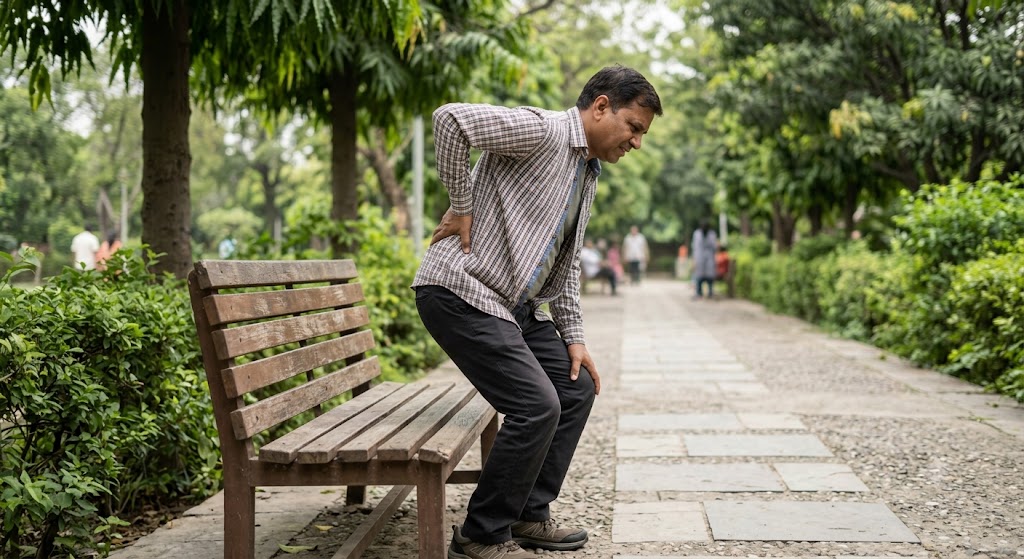
Joint fluid is not motor oil sitting in a sump. It still expects a few minutes of cyclic motion to thin, spread and feed cartilage — the briefing Dowson, Wright, Balazs and McCutchen mapped — not a cold first squat.
The first squat of the morning can feel like sand. The first reach overhead can click. The first downhill step after a long drive can make a knee announce itself. Then, a few minutes later, the same joint is quieter.
That is not willpower arriving. It is synovial fluid doing the job it was built for — and doing it on a delay.
Synovial fluid is not a can of oil poured into a joint and left there. It is a living, hyaluronan-rich filtrate that changes thickness with speed, temperature and time. Charles McCutchen, Duncan Dowson, Verna Wright and Endre Balazs spent careers showing that cartilage stays slippery only when that fluid is moving, thinning and being squeezed in and out of the surface. A cold, still joint has the ingredients. It does not yet have the film.
This is not an excuse to skip a warm-up because “you are not an athlete.” It is a map of why joints still expect a few minutes of easy cyclic motion before a hard first load, and what a sit-then-sprint day does to that film.
What This Fluid Was Built to Do
A synovial joint is a sealed pouch. The lining — synovium — makes a fluid that is mostly water, with hyaluronan, lubricin (PRG4), proteins and a few cells. Hyaluronan is a long sugar chain. In still fluid it tangles. The mix is thick. When you start to move, shear lines those chains up. The fluid thins. That is shear-thinning, the property that lets the same joint be sticky at rest and slick at a walk.
Balazs isolated and described hyaluronan as the molecule that gives synovial fluid its strange viscosity. Later work showed that lubricin, a glycoprotein mapped by Swann and later Jay and others, is the boundary lubricant that keeps cartilage from welding when the fluid film is thinnest. You need both: a viscous bulk fluid that can form a film, and a surface molecule that survives the last microns.
McCutchen proposed weeping lubrication: load squeezes fluid out of the porous cartilage itself, so the surface is fed from below as well as from the joint space. Dowson, Wright and Walker at Leeds described boosted lubrication: as two cartilage faces approach, large hyaluronan molecules are trapped and concentrated in the closing gap, raising local viscosity exactly where you need it. Neither story works if the joint has been still for hours. Stillness lets fluid pool, cool and thicken. The first compression then meets a film that has not been rebuilt.
Cartilage has no blood supply. It eats by convection and diffusion from that same fluid. A few cycles of load and unload pump solutes in and waste out. Joints still expect motion rather than rest for that reason. The warm-up is the first page of that pump.
Why a Warm-Up Was the Original Cue
Ancestral days did not start with a cold max lift. They started with:
- Standing from the ground
- A walk to water or work
- Easy reaching, carrying and turning
- Minutes of low load before a sprint, a lift or a long descent
- Varied speeds, so shear-thinning had time to happen
- Outdoor temperature, so the joint was not coming out of a cold room into a sudden demand
That pattern is almost a textbook tribology protocol. Cyclic motion first. Rising speed. Rising load. A pause now and then so fluid can be drawn back into cartilage.
Menisci still expect twist under load because the same first minutes that spread fluid also seat the meniscus as a hoop. Tendons still expect gradual loading; the fluid film is the joint’s version of that same rule. Morning stiffness is often the night’s stillness plus a fluid that has not been sheared yet.
Temperature matters. Synovial viscosity drops as the joint warms a few degrees. A cold garage, an air-conditioned office, a winter first step — all of them meet a thicker starting fluid. The walk is the heater.
What Modern Life Quietly Removes
Chairs and cars are not poisons. They are missing first minutes.
Sit, then demand. Eight hours of mid-range stillness, then a sudden lunge for a dropped bag, a first heavy squat, a sprint for a bus. The fluid has not thinned. The surface film is incomplete. The cartilage sees a spike it was built to meet after a briefing.
Cold rooms and cold starts. Indoor climate control keeps skin comfortable and joints cooler than an outdoor walk would. The first outdoor effort then asks a thick fluid to become a film on contact.
One static stretch as a warm-up. Holding a joint at end-range does not shear the fluid the way walking does. Stretch has a place. It is not the pump.
Long drives, then a hike. The knee that felt fine in the seat can bark on the first downhill. Fluid and meniscus both needed cycles, not a seatbelt.
Inflamed or thinned fluid. In osteoarthritis the hyaluronan is often shorter and less concentrated. The shear-thinning curve is flatter. Warm-up still helps. It cannot fully replace what the lining no longer makes. That is a medical problem, not a character flaw.
The early result is not a ruined joint. It is a first-minute protest: stiffness that eases, a click that fades, a knee that needs a block of walking before it trusts a cut.
Less Common but Serious
Not every first-step grind is “you skipped the warm-up.”
Locking that will not unlock, a joint that swells hot after one flight of stairs, night pain that wakes you, a fever with a red joint, a sudden inability to bear weight after a twist — those are not viscosity stories. They can be crystal arthritis, infection, a loose body, an inflammatory arthritis or a fracture. Warm-up does not treat those. A clinician does.
True locking, giving-way that dumps you, or a joint that is hot and tight by evening after modest use needs an exam, not another mobility video.
Hidden Triggers
A few modern habits make the first minutes worse than they need to be.
The cold garage workout. Bar first, walk never. The joint is asked for peak shear before the fluid has thinned.
Heels-to-hamstrings static stretching as the entire prep. Useful later. Poor as the only cue for a viscous fluid.
Dehydration plus a long sit. Synovial fluid is water-rich. A dry day does not empty the joint, but a poorly hydrated person plus hours of stillness is a thicker start.
Very high-repetition novelty on a cold joint. A first class of jumping or cutting after a desk week is a film problem and a tendon problem at once.
Assuming “I used to skip warm-up in my twenties.” Hyaluronan quality and cartilage surface change with decades. The briefing that was optional at 22 is courtesy at 52.
When to Worry
Treat first-minute stiffness that eases with easy walking as ordinary. Get help if:
- Stiffness lasts more than an hour every morning and several joints are involved
- One joint is hot, red or feverish
- The joint locks and stays locked
- Swelling appears the same day after modest use
- Pain is night-waking or steadily worse over weeks
- You cannot take the first step without a catch that feels mechanical
Those patterns are not a missing walk. They are a joint asking for a diagnosis.
Myths vs Facts
Myth: Joints need oil like an engine, so supplements will pour some in.
Fact: Oral “joint oil” stories outrun the evidence. What the joint actually needs is cyclic motion, time and a lining that can still make hyaluronan and lubricin.
Myth: If it hurts at the start, you should push through the first heavy set.
Fact: Pain that eases with easy cycles is often the film arriving. Pain that sharpens with load is a different letter. Warm the joint. Do not test it first.
Myth: Cracking the joint is the warm-up.
Fact: A cavitation pop is a pressure change in the fluid. It is not the shear-thinning and weeping cycle cartilage lives on.
Myth: Warm-up is only for athletes.
Fact: Every synovial joint runs the same physics. A first garden squat and a first clean both meet the same fluid.
Myth: Once you are warm you can sit for two hours and stay warm.
Fact: Fluid thickens again with stillness. The briefing expires. Another few minutes of easy cycles reset it.
How to Manage
You do not need a 40-minute ritual. You need the physics.
Walk before you ask. Five to ten minutes of easy walking, stairs or cycling before a lift, a run or a long hike. That is shear-thinning plus a cartilage pump.
Raise speed, then load. Easy range first. Then a little faster. Then the work set. Dowson’s and Wright’s film stories are stories about time and velocity, not grit.
Unload overnight, reload in the morning. Discs still expect a night unload and a day of walking. Joints want a similar rhythm: stillness for fluid return, then cycles before demand.
Keep the day from being one sit and one gym. A few minutes of motion every hour keeps the film from having to be rebuilt from zero at 6 p.m.
Warm the room or the walk, not only the muscle. A cold joint is a thicker fluid. Outdoor easy movement is a heater that static indoor stretching is not.
After a long drive, walk the first parking-lot loop. Do not start the trail with a downhill.
This is courtesy for a tissue that cannot blush or bleed to tell you it is unready. The first minutes are the letter.
When to See a Doctor
See a clinician if morning stiffness is long and widespread, if one joint is hot or locked, if swelling follows ordinary use, or if first-step pain is getting worse across weeks rather than easing after a walk. Ask specifically about osteoarthritis, inflammatory arthritis, crystal disease and mechanical locking. Bring the pattern: which joint, how long until it eases, what the first load of the day is.
Imaging and fluid analysis exist for a reason. A warm-up plan is not a substitute for a red, locked or feverish joint.
FAQs
Why do my knees feel worse for the first block of a walk and then fine?
Overnight stillness lets fluid thicken and pool. Easy cycles shear hyaluronan, warm the joint a few degrees and restart weeping and boosted lubrication. The change in the first ten minutes is often that film, not a personality shift.
Is cracking my knuckles or knees a warm-up?
No. A pop can be cavitation. Warm-up is repeated low-load cycles that thin fluid and feed cartilage. One crack does not replace that.
Do I need to stretch for 20 minutes?
Not as the main event. Walking or easy cycling does more for synovial viscosity than a long static hold. Stretch after the fluid is moving if you like the range.
Why is the first squat in a cold gym so loud?
Lower temperature raises viscosity. No prior cycles means no shear-thinning yet. The joint is asked for a film it has not built. A short walk or unloaded cycle set is the missing sentence.
Does glucosamine replace a warm-up?
No. Whatever one thinks of supplement evidence, it does not shear fluid or pump cartilage on a Tuesday morning. Motion does.
Why do I stiffen again after sitting at lunch?
The briefing expires. Fluid thickens with stillness. A few minutes of walking after the meal rebuilds the film the morning already taught you exists.
Is this the same as arthritis?
Ordinary first-minute stiffness that eases is common with and without arthritis. Arthritis changes the quality of the fluid and the surface. Warm-up still helps. Persistent swelling, night pain or long morning stiffness needs a diagnosis.
Can I warm up sitting in the car with the heater?
Heat helps viscosity a little. Cycles help more. A parking-lot walk still beats a hot seat as the only prep.
Why do downhill first steps feel worse than flats?
Higher compression, a little extra shear, and often a joint that has been still in a car. The film and the meniscus both wanted minutes on flat ground first.
Is there a point where warm-up stops mattering?
If the lining is badly inflamed or the cartilage surface is gone, physics still applies but the ceiling is lower. That is when a clinician and a sensible load plan matter more than another mobility drill.
Conclusion
Synovial fluid is a smart, shear-thinning, hyaluronan-rich briefing system. McCutchen, Dowson, Wright and Balazs described how it weeps, concentrates and slips only after motion has started. A modern day often skips those first minutes: a chair, a cold room, then a sudden ask.
You do not need to become a different person. You need the original order of operations. Easy cycles. Rising speed. Then load. The joint you have is still waiting for that letter. Give it the walk before the work, and the first squat of the day has a chance to feel like a joint instead of like sand.