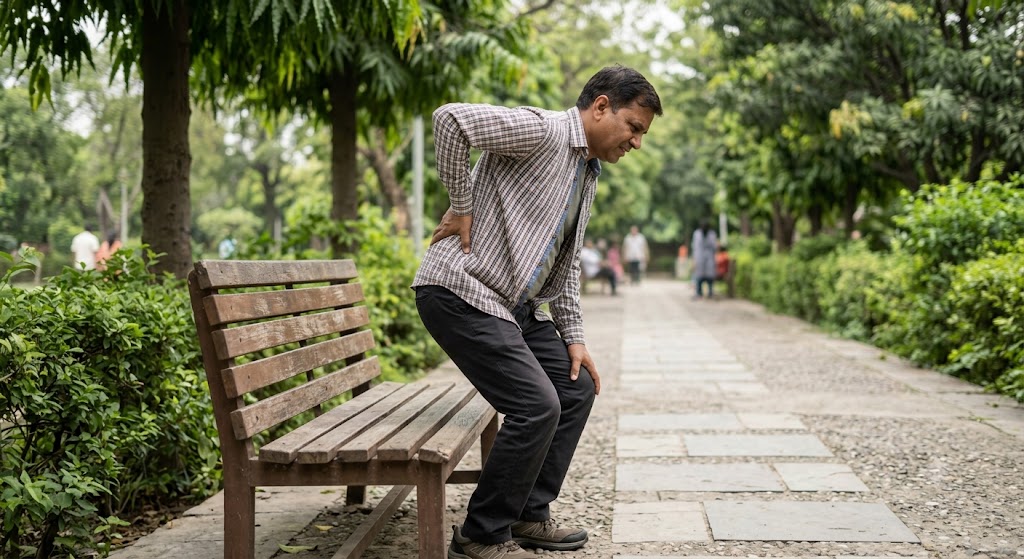
The meeting ends. You push the chair back and the lower back announces itself — a dull band across the belt line, a stiff catch when you straighten, sometimes a tired pull that walks with you to the kitchen.
It is one of the most common complaints of modern work. It is also one of the most misunderstood. A spine that aches after sitting is rarely “worn out.” It is usually a structure that spent hours under a load it was built to share with walking, and then asked to stand up while the hips were still folded.
What This Symptom Feels Like
Post-sit back pain is usually a low, broad ache rather than a sharp stab. It sits in the lumbar hollow or across the top of the pelvis. Standing up can feel like unfolding a hinge that rusted shut. The first few steps may be shorter and slower. After a short walk the complaint often fades.
Some people feel more tightness than pain — a sense that the back will not fully extend. Others notice the ache more on one side, or a referral into the buttock that eases once they move. A true electric zap down the leg with numbness or weakness is a different pattern and belongs in the “when to worry” column, not in the everyday sit-stiff story.
The timing is a clue. Pain that builds through a long sit and eases with walking points toward load and stillness. Pain that is worst with the first morning step and eases after a few minutes is more often a disc or facet that stiffened overnight. Pain that only appears after a heavy lift is a different script again.
What Sitting Actually Does to the Spine
The lumbar discs are living, water-rich pads. They have almost no direct blood supply. They eat and clear waste by being loaded and unloaded — a pump Alf Nachemson measured with intradiscal pressure sensors, and that Hans-Joachim Wilke, Michael Adams, and Jill Urban later mapped in living and cadaver spines.
Sitting is not “no load.” In a slouched or even a neatly upright chair, pressure inside a lumbar disc is often as high as, or higher than, standing. The hips are flexed. The pelvis often rolls backward. The lumbar curve flattens. The disc is held in a flexed, compressed state for hours instead of being cycled by steps.
Nachemson’s classic figures put relaxed standing near 100 percent of a reference pressure, unsupported sitting higher, and slouched sitting higher still. Wilke’s later live measurements confirmed the same direction: sitting is not rest for a disc. It is a sustained, slightly flexed squeeze.
Meanwhile the hip flexors stay short. The glutes stay quiet. The multifidus and deep abdominal wall, which Stuart McGill and Jack Callaghan have shown work as a coordinated brace during gait and load, get almost nothing to do. When you finally stand, the back is asked to extend through tissues that have been parked in flexion. That first straighten is the moment many people notice.
A related story lives in why your discs still expect walking and a night unload: discs need a day of varied load and a night of decompression. An eight-hour chair gives them neither.
Why Chairs Make an Old Design Feel New
Human lumbar spines evolved for walking, carrying, squatting, and lying on the ground — not for a 90-degree hip angle held from nine to five. The deep fold of a squat uses the hips. The chair uses the spine as a folded prop. That mismatch is the same family of problems described in why your lower back still expects you to hinge and walk and in the posture your skeleton was designed for.
Sitting also steals the calf pump, the thoracic rotation of a turning walk, and the small sideways loads that keep facets and ligaments from settling into one groove. By late afternoon the back has done a long isometric hold. Isometric holds fatigue. Fatigued muscles recruit larger, more superficial ones. Those muscles ache. The ache is real. It is not proof of a herniation.
Videman and colleagues, looking at occupational sitting and disc findings, have repeatedly shown that sitting alone is a weak predictor of structural “damage” on a scan. Scans of pain-free people are full of bulges and worn discs. The everyday post-sit ache tracks more closely with time spent still, hip stiffness, and how you stand up than with a single MRI slice.
Common Everyday Triggers
A few patterns reliably turn a long sit into a loud stand.
A chair that lets the pelvis tuck and the low back round. A laptop that pulls the chest forward. A wallet or phone in a back pocket that tilts one side of the pelvis. Crossing one leg for an hour. A car commute after the workday, so the spine never gets its walk. Soft couches that look kind and keep the hips lower than the knees.
Cold rooms make the same hold feel tighter. A long sit after a hard gym session can surprise people: the tissues are already a little swollen from training, then they are parked flexed. Weekend “catch-up sitting” after a week of more movement can feel worse than the week itself, because the back lost its recent practice at changing position.
Hidden Triggers People Miss
The first stand is often the problem, not the last hour of the sit. People shove the chair back, lock the knees, and yank the lumbar spine into extension while the hips are still closed. The back does the job the hips should share. A slower stand — scoot forward, uncross, plant both feet, hinge the hips open, then rise — changes the complaint for a surprising number of desks.
Shoes matter more than they get credit for. A hard, flat sole on a hard floor after a long sit gives the lumbar spine no ankle or midfoot give. Very high heels pitch the pelvis and can make the same stand feel jammed.
Breathing is another quiet factor. Shallow chest breathing in a slumped sit keeps the diaphragm from helping the deep abdominal wall. The back then braces more than it needs to. A few easy nasal breaths before standing is not a miracle. It is a way to stop holding the ribcage like a clenched fist.
Dehydration and a long gap since the last walk both thicken the “stuck” feeling. Discs lose a little height through the day anyway. A still, dry afternoon just makes the afternoon taller in the wrong direction.
Less Common but More Serious Patterns
Most post-sit aches are mechanical and movable. A smaller set needs a lower threshold for care.
Pain that wakes you every night, is worse lying down, or comes with unexplained fever or weight loss. New bowel or bladder change, saddle numbness, or rapidly worsening leg weakness — those are urgent, not “desk posture.” Pain that shoots below the knee with clear numbness or foot drop. Pain after a fall, a crash, or in someone with known osteoporosis or cancer history. An ache that is steadily worse over weeks and no longer eases with walking.
Inflammatory back pain — stiffness that is worse in the second half of the night and eases with movement, especially in younger adults — is a different pattern from “I sat for six hours.” It deserves a clinician who knows the difference, not another lumbar cushion.
None of those cancel the common story. They sit beside it so a rare case is not stretched into a chair-adjustment problem.
Myths vs Facts
Myth: A hurting back after sitting means the discs are degenerating and you should rest more. Fact: Discs need cyclic load. More rest in a chair usually feeds the same complaint. Short walks are the closer match to how the tissue eats.
Myth: A perfectly upright “ideal posture” will prevent the ache. Fact: No single angle is magic. McGill and others have argued for variation — change position often — more than for a sacred 90-degree sit. The spine likes a movie, not a still.
Myth: If an MRI shows a bulge, the bulge is why the chair hurts. Fact: Bulges are common in people with no pain. Treat the pattern (sits, stands, walks, sleeps) first. Image when red flags or persistent nerve signs appear.
Myth: A standing desk fixes sitting pain by itself. Fact: Standing still is another isometric hold. It helps some people and bothers others. The useful ingredient is change, not a new frozen pose.
Myth: Core exercises that flex the spine for hundreds of reps will “strengthen you out of it.” Fact: The back already spent the day flexed. It usually needs hip extension, walking, and a few minutes of varied load more than another crunch.
How to Make Sitting Kinder
You do not need a perfect chair. You need interruptions and a better stand.
Set a cheap timer or use natural breaks — a call, a kettle, a printer — to stand and walk two or three minutes each half hour if you can. Even 60 seconds of walking changes disc fluid movement and wakes the hip extensors.
When you do sit, let both feet reach the floor. Uncross the legs. Scoot the hips back so the pelvis is not dangling in a tuck. A small rolled towel at the belt line is enough support for many people; a giant lordosis pillow is not required.
Stand up as a hip task. Slide forward. Feel the feet. Hinge, then rise. Take ten easy steps before you decide the back is “bad today.” Many aches are the sound of a first extension, not the forecast for the evening.
Walk after work before you collapse into the same angle on the sofa. A short outdoor loop is more specific than a late abs video. If you lift, practice the hinge with light objects off the floor so the hips remember their job — the same job described in why the lower back still expects a hinge and a walk.
At night, a side-lie with a pillow between the knees or a back-lie with a pillow under the knees can take the leftover flexion out of the first morning. The goal is not a rigid “correct” sleep pose. It is a spine that gets some unload after a day of sit-load.
When to See a Doctor
See someone promptly if the pain is after trauma, if a leg is weak or numb in a clear patch, if the saddle area is numb, or if bowel or bladder control changes. See someone soon if night pain, fever, or weight loss travel with the ache, or if six weeks of walking, varied sitting, and a calmer stand have not moved the story at all.
A good visit is pattern-based: when it starts, what eases it, what the legs do, which medicines and which chair hours you live in. Imaging is a tool for specific questions, not a default portrait of a tired Tuesday.
FAQs
Why does my back hurt more after sitting than after walking?
Walking cycles load through the discs and uses the hips. Sitting holds a flexed squeeze. The ache is often the first request to extend after that hold, not proof that walking is dangerous.
Is a standing desk the answer?
It is an option, not a cure. Standing still can fatigue the same tissues. Alternate sit, stand, and short walks. The change is the treatment.
Should I stretch my hamstrings every hour?
Gentle movement helps. Aggressive long holds on already flexed tissues can irritate some backs. Hip extension, glute wake-ups, and walking usually return more than a forced toe-touch at the desk.
Does this mean I have a slipped disc?
Not by itself. A disc can bulge without pain, and pain can exist with a quiet scan. Nerve pain below the knee, progressive weakness, or red flags change the question. Everyday post-sit stiffness does not.
Why is the first hour after work the worst?
You often add a car seat or a sofa to a full day of the same hip angle. The spine never gets its unload walk. Ten minutes on your feet before the commute home is a small, specific fix.
Can I keep lifting weights if sitting bothers my back?
Usually yes, if you use a hip hinge, keep loads gradual, and do not treat the gym as the only movement of the day. A back that only extends under a barbell after eight quiet hours is being asked a large first question.
Conclusion
A back that complains after a long sit is giving you a mechanical report, not a verdict. Chairs hold discs in a flexed load they were built to share with steps. Hips stay folded. The first stand asks the lumbar spine to undo hours in one motion.
Change the day more than you change the diagnosis. Interrupt the sit. Stand with the hips. Walk before you fold again. The ache that follows a chair is common, explainable, and, for most people, reversible without treating the spine as fragile.