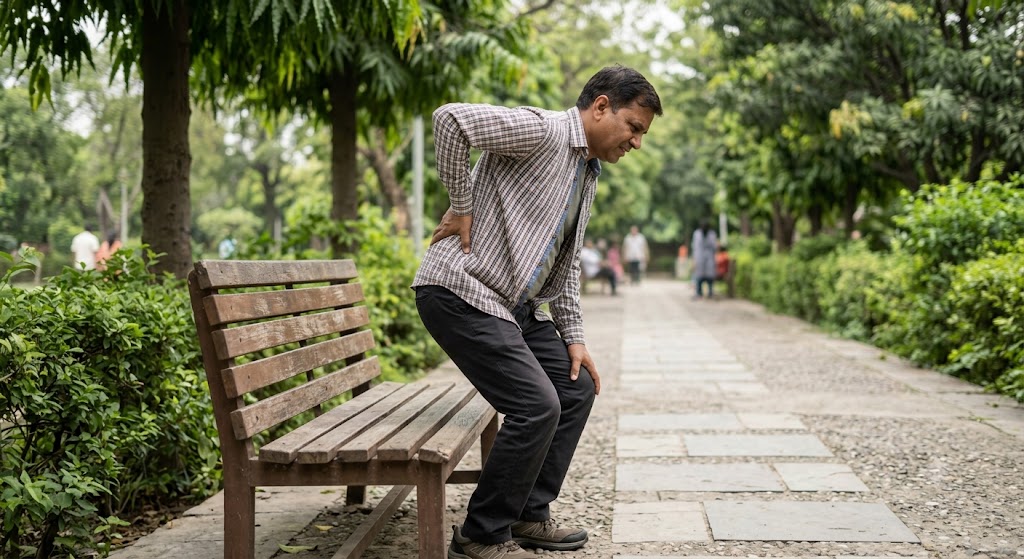
A painless pop when you stand from a chair is usually gas cavitation or tendon snap, not grinding cartilage. How crepitus works, what Jamon Couch and Adam Culvenor’s review actually found, and when noisy knees need an exam.
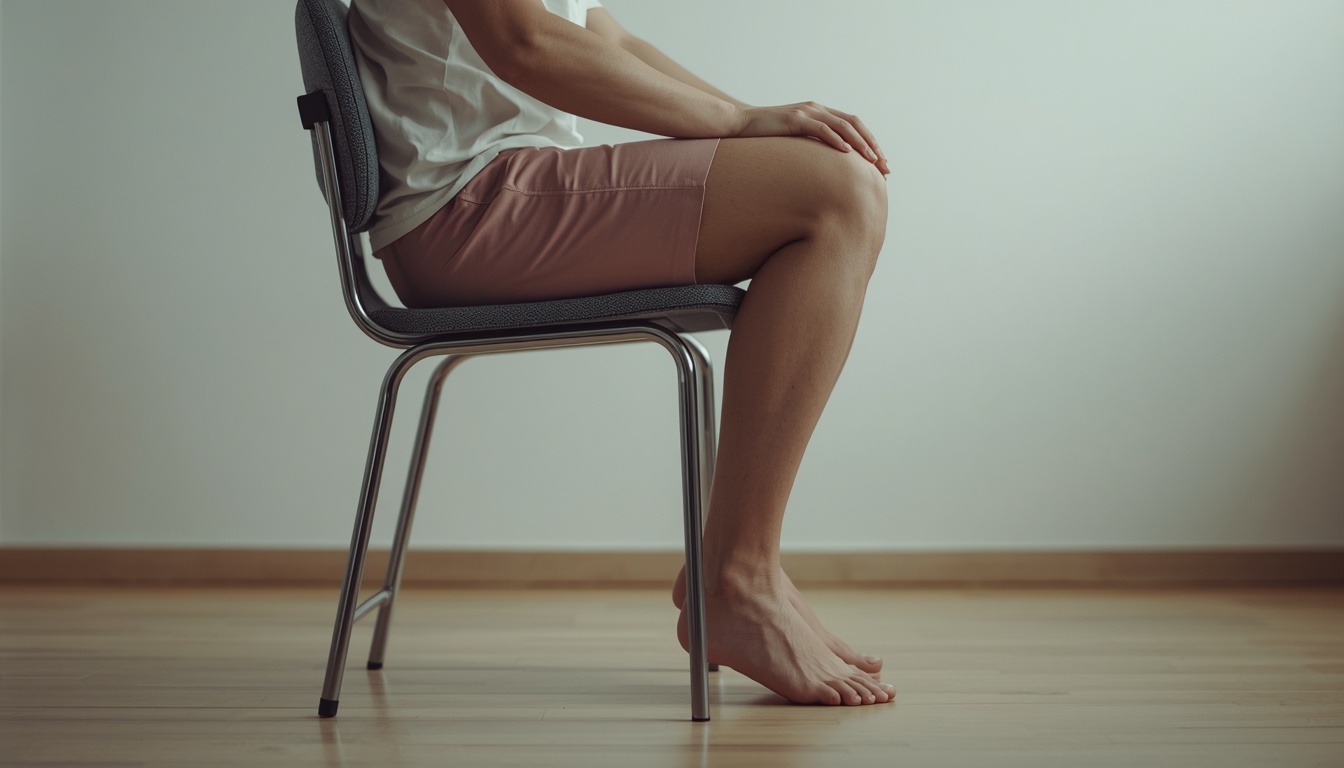
You push up from the sofa. Halfway through the rise, one knee announces itself with a clean pop. Sometimes it is a single crack. Sometimes it is a handful of smaller clicks as the joint unfolds. There is no stab of pain. The knee does not swell. You keep walking to the kettle and forget the sound until the next sit-to-stand.
That noise is one of the most common joint sounds in adult life, and one of the most over-interpreted. A painless pop on standing is usually not bone grinding on bone. It is usually a brief pressure event in joint fluid, a tendon or band flicking over a bony ridge, or the kneecap tracking across a groove that has never been perfectly silent. Noise is information. Pain, swelling, locking, and giving way are different information. Mixing those two categories is how a normal sit-to-stand becomes a private diagnosis of “early arthritis.”
What This Symptom Feels Like
People rarely describe the same sound the same way. The useful distinctions are mechanical, not poetic:
- A single loud pop as you leave the chair, often after sitting still, then a quiet stretch of walking.
- A cluster of smaller clicks through mid-range as the kneecap slides in the femoral groove.
- A soft, sandpaper quality under the hand if you rest a palm on the kneecap while you squat — crepitus in the original Latin sense of a crackle.
- A snap at the side of the knee that you can almost point to with a finger, more tendon than joint space.
- No pain, no warmth, no morning stiffness that lasts more than a few minutes, and no sense that the joint is about to buckle.
A useful rule from clinicians who study joint noise: a crack that needs a rest before it can happen again is often cavitation — a gas event. A grind that repeats on every repetition, especially with a hand on the kneecap, is more often surfaces or a tracking tendon talking to each other. Neither pattern, by itself, tells you the cartilage is doomed.
Common Causes
The first and most ordinary cause is cavitation in synovial fluid. The knee is a pressurized, fluid-filled space. When you sit, the joint is flexed and the fluid’s dissolved gases — mostly carbon dioxide — sit in solution. When you stand, the joint surfaces separate a little, pressure drops, and a gas cavity forms and collapses in a few milliseconds. That collapse is loud out of proportion to its size. A. Unsworth, D. Dowson and V. Wright described this physics in knuckle joints in 1971; later imaging work by Gregory Kawchuk and colleagues showed the sound lining up with cavity formation rather than with a bone “cracking.” The same fluid physics applies in the knee. After one good pop, the gases need time to redissolve, which is why you usually cannot reproduce the identical crack on the next squat.
The second common cause is soft-tissue snap. The iliotibial band, the hamstring tendons on the inner side, or a plica — a leftover synovial fold — can flick over a femoral condyle as the knee extends. You hear it at the side more than under the kneecap. It can be dramatic and still painless.
The third is patellofemoral tracking noise. The kneecap is a sesamoid bone riding in a groove. Cartilage is not glass. Small surface irregularities, a slightly lateral tracking path after years of sitting, or a dry morning joint can produce clicks through the middle of the rise. This is the sound many people mean when they say their knees “crackle like Rice Krispies.”
None of these three is the same as the coarse, painful grind of advanced osteoarthritis, in which thinned cartilage and osteophytes change how load is shared. That grind tends to come with stiffness, swelling after use, and a smaller comfortable range — not with a single pop on the way to the kitchen.
Why This Happens When You Stand
Sit-to-stand is a high-demand task wearing ordinary clothes. The knee goes from deep flexion toward extension while the quadriceps pull the kneecap into the groove and the joint surfaces take rapidly rising load. Vibroarthrography work — microphones on the patella and tibial plateau — has shown that louder joint sounds travel with higher load. Standing up from a low chair is not a passive swing. It is a loaded extension. If a gas cavity or a tendon is waiting at a particular angle, that is the angle at which you hear it.
Sitting also changes the joint’s starting chemistry. Motion stirs synovial fluid and helps cartilage drink by compression and release. Stillness lets fluid settle and gases accumulate. That is why the first stand after a long meeting is noisier than the twentieth step down the corridor. The same logic sits behind morning joint stiffness: the overnight pause is a fluid pause, not a sudden aging event. There is a longer discussion of why joints prefer motion over rest in why your joints still expect motion, not rest.
Modern chairs add a specific geometry. A deep sofa parks the knee in more flexion than a squat-to-stand from the floor, then asks the joint to open against body weight in a straight sagittal plane. Varied terrain — slopes, turns, uneven ground — loads the knee through more angles and more of the cartilage map. Flat indoor floors and chair-height sitting concentrate the same few degrees. That mismatch is the subject of why your knees still expect varied terrain.
What Large Studies Actually Show
Fear of noisy knees is older than good prevalence numbers. In 2024, Jamon L. Couch, Matthew G. King, Danilo De Oliveira Silva, Jackie L. Whittaker, Andrea M. Bruder and Adam G. Culvenor, working from La Trobe’s sport and exercise medicine group, published a systematic review and meta-analysis of 103 studies and more than 36,000 people in the British Journal of Sports Medicine. Pooled crepitus prevalence was about 41 percent in the general population and about 36 percent in pain-free people. In diagnosed knee osteoarthritis it rose to about 81 percent. Across other knee conditions it ranged from the mid-thirties after ligament injury to about 61 percent when cartilage pathology was already known.
Crepitus was associated with higher odds of radiographic osteoarthritis and with MRI features such as osteophytes, cartilage defects and bone-marrow lesions. The authors were careful about the grade of that evidence: low to very low certainty, with messy definitions of “crepitus” across studies. Their practical sentence is the one worth keeping. Patients should be told the sign is common in the general population, and that even when it tracks with some structural findings it is not, by itself, a reason to stop moving.
That last point matters because avoidance is the harm pathway. A person hears a pop, decides the cartilage is “bone on bone,” sits more, loses quadriceps capacity, and then the next stand is harder and noisier. The sound did not cause the decline. The story about the sound did.
Other groups have made related observations. Michel D. Crema and colleagues linked some patterns of crepitus to structural features on imaging. Dieuwke Schiphof’s work suggested crepitus can be an early clinical clue to patellofemoral osteoarthritis in some cohorts — a reason to take a noisy, aching front of knee seriously, not a reason to treat every sofa pop as disease. After ACL reconstruction, self-reported crepitus has been tied cross-sectionally to full-thickness patellofemoral cartilage lesions at one year in work associated with Culvenor’s group, without a clear extra risk of faster structural worsening over the next few years. Association is not a stop sign.
Less Common but Serious
Some noises are not cavitation and not a harmless snap.
- A sudden loud pop at the moment of injury, with immediate swelling and inability to keep playing, is a different event — often a ligament or a piece of cartilage or meniscus failing under load.
- True locking, where the knee will not fully straighten or bend and you have to jiggle it, raises the possibility of a displaced meniscal fragment or a loose body.
- A coarse grind plus a warm, swollen joint after modest use can be inflammatory arthritis or an irritable osteoarthritic flare, not a gas bubble.
- A clunk with giving way after a twist is instability until proven otherwise.
Those stories start with pain, swelling, or a mechanical block. They do not start with a painless click on the way out of a meeting.
Hidden Triggers
A few ordinary habits make sit-to-stand noisier without damaging the joint:
- Long stillness — flights, desk blocks, binge watching — lets gas accumulate and synovial fluid sit.
- A very low, soft sofa. The last degrees of flexion raise contact demand when you finally stand.
- Dehydration and a dry indoor room. Synovial fluid is not immune to a low-water day, even if “drink more” is not a cartilage cure.
- A sudden return to deep squats or lunges after weeks of only sitting. Novel range plus load is a classic recipe for louder tracking sounds and delayed soreness.
- Quadriceps that have been under-used. The kneecap is guided in part by vastus medialis timing. Quiet thighs make for a noisier groove.
When to Worry
Worry less about volume and more about company:
- Pain that lives with the sound, especially under the kneecap or along the joint line, and that lasts after the movement.
- Swelling that you can see or feel, or a knee that feels warm.
- Locking, catching that stops motion, or repeated giving way.
- A night-and-morning stiffness that lasts more than half an hour and eases only after movement.
- A new noise after a twist, fall, or awkward landing.
- Fever, redness, or a knee that will not bear weight.
A painless pop that has sounded the same for years, with full motion and no swelling, is usually a mechanical habit, not an emergency.
Myths vs Facts
Myth: If it cracks, the cartilage is wearing away with every stand.
Fact: Cavitation and tendon snap do not shave cartilage. Wear is a load-and-biology problem over years, not a decibel problem over breakfast. The same distinction is true for knuckles; cracking them does not cause arthritis, which is why the older myth is unpacked in myths vs facts about cracking your knuckles.
Myth: Noisy knees mean you should rest them.
Fact: Cartilage is nourished by cyclic load. Quiet sitting is not a joint holiday. Graded strength and regular walking are closer to what the tissue expects.
Myth: Crepitus equals osteoarthritis.
Fact: Couch and Culvenor’s pooled numbers show crepitus in more than a third of pain-free people. It is more common in osteoarthritis. It is not a stand-alone diagnosis.
Myth: Oil supplements or a “joint lube” drink will silence the pop.
Fact: Synovial fluid is made by the lining, not poured in from a bottle. Some people feel better with exercise, weight change if relevant, and time. No drink has been shown to delete cavitation.
How to Manage Noisy but Painless Knees
You do not need to treat a sound. You can treat the context that makes the sound louder and the joint less confident.
- Stand up more often. A two-minute walk every half hour keeps fluid moving and gases from pooling.
- Raise the first stand. If the sofa is a hole, perch on the front edge or choose a higher chair for long sitting.
- Load the thighs on purpose. Slow sit-to-stands from a chair, split squats to a comfortable depth, and step-ups train the same task that makes the noise. Start with a height you control.
- Add terrain you can find. A gentle hill, a flight of stairs, a slightly uneven path gives the cartilage map more than one paragraph of load.
- Warm the first repetitions. A minute of easy marching before a deep squat session is not superstition. It is fluid and tendon temperature.
- Do not chase silence. Chasing a zero-noise knee is how people drop useful training.
If the knee is sore as well as noisy, the first-line package is still the unfashionable one: quadriceps and hip strength, a bit less sitting, weight management when it is relevant, and a plan you can repeat. There is no specific, evidence-based “crepitus treatment” separate from treating the joint as a loaded organ.
When to See a Doctor
See a clinician if the sound arrived with an injury, if the knee swells, locks, or gives way, if pain limits stairs or sleep, or if one knee has changed personality over a few weeks. A good exam still outperforms an early MRI for most painless clicks. Imaging is for a mechanical story that does not match simple crepitus, or for a joint that is failing the ordinary tests of motion, swelling and strength.
FAQs
Is a loud pop once a day worse than many small clicks?
Not by volume. A single pop after sitting is classic cavitation. Repeated fine crackle under the kneecap is more often tracking. Pain and swelling decide whether either pattern needs workup.
Can I keep running if my knees crack?
If there is no pain, swelling or loss of function, noise alone is a poor reason to retire. Build volume gradually. Sudden spikes in downhill or very deep squat work are more likely to irritate a tracking kneecap than the sound itself.
Why is one knee noisier than the other?
Joints are not mirrored machines. A prior twist, a slightly different Q-angle, a preferred sitting leg, or a quieter vastus medialis on one side can all bias tracking. Asymmetry without pain is common.
Does cracking my knee on purpose wear it out?
Deliberately forcing a pop is unnecessary. It has not been shown to sand the cartilage. It also has not been shown to help. Move the joint through useful ranges instead of hunting the sound.
Should I get an X-ray because I heard a crack?
Not for an isolated, long-standing, painless sit-to-stand pop. X-rays show bone and joint-space width, not cavitation. They become useful when pain, stiffness or swelling suggest osteoarthritis or another structural problem.
Will losing weight silence my knees?
Lower body weight lowers load on the tibiofemoral and patellofemoral joints and can ease pain in people who already have symptomatic osteoarthritis. It may not delete a gas pop. It is still one of the highest-value levers if the knee is both noisy and sore.
Conclusion
A knee that speaks when you stand up is usually announcing a pressure change or a tendon’s path, not a collapse of the joint. Couch, Culvenor and colleagues put numbers on what clinicians had long seen in rooms: crepitus is common in people with no pain, more common when osteoarthritis is already present, and a weak reason, on its own, to stop using the leg. Listen for pain, swelling, lock and give-way. Keep the quadriceps honest. Give the joint more than a chair and a flat floor. The sound can stay. The story about the sound does not have to.