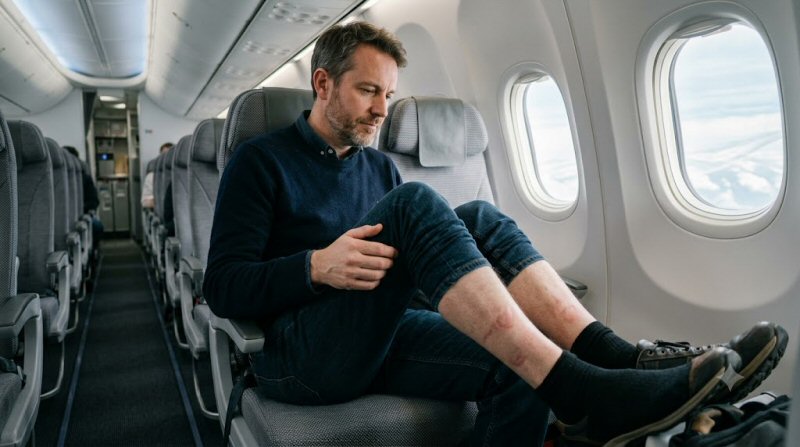
Puffy ankles after a flight are usually cabin sitting, lower pressure, and a quiet calf pump—not an automatic clot. Here is when plane-ankle swelling is ordinary and when it is not.
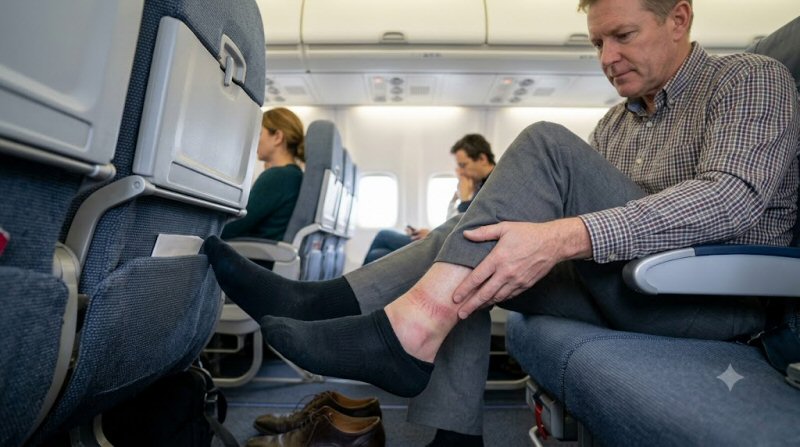
You boarded with socks that slid. After a few hours they leave a ridge. The skin over your ankle bones looks shiny. Shoes that were easy at the gate feel snug. You press a thumb into the inner ankle and a brief dent stays. Nothing throbs. The seatbelt still fits. It still looks like something went wrong below the knee.
For most healthy adults, swollen ankles on a plane are a temporary fluid-shift problem. Cabin air is drier and slightly lower in pressure than the ground. Sitting still turns off the calf muscle pump that usually sends blood and lymph back up the legs. The same physics that can puff fingers and tighten rings in flight can pool fluid at the ankles—often more obviously, because gravity favors the lowest point in the seat.
What This Symptom Feels Like
Typical plane-ankle swelling is:
- Mild puffiness around both inner and outer ankle bones
- Socks that leave a temporary groove
- Skin that looks a little shiny and may pit briefly when pressed
- Shoes that feel tighter at landing than at takeoff
- A heavy, full sensation rather than a sharp pain
- Often both sides, or worse on the side that stayed still against the seat
It usually builds over hours, not minutes. It is more noticeable after a long-haul night flight, a salty meal, alcohol, or a window seat that never quite lets you stand. It should ease over the rest of the arrival day once you walk, elevate, and drink ordinary water. A little residual sock mark the next morning is common. Persistent one-sided swelling that keeps growing is a different story.
Common Causes
The usual recipe is cabin physics plus sitting, not a sudden vein failure.
A quiet calf pump. Veins in the lower leg have one-way valves. The soleus and gastrocnemius squeeze those veins with every step. Vascular researchers including John Homans and later Andrew Nicolaides described how that pump empties dependent veins. In a cramped seat the pump almost stops. Blood and tissue fluid linger at the ankles. The same sitting pattern explains puffy feet after a long day in a chair and heavy legs when you finally stand.
Cabin altitude and lower pressure. Most commercial cabins are pressurized to the equivalent of roughly 6,000 to 8,000 feet. John B. West and others who studied high-altitude physiology showed that this modest drop in barometric pressure and oxygen tension can shift fluid toward tissues. Combined with immobility, ankles are an easy place for that fluid to collect.
Dry cabin air and extra salt. Recirculated cabin air is dry. Salty snacks, tomato juice, and alcohol pull water into the vascular space and then into dependent tissue. You may drink less than you think because the drink cart is slow or the bathroom line is long.
Seat geometry. A seat edge that presses the back of the thigh can slow venous return the way a tight band would. Crossing your legs or tucking one foot under you adds extra squeeze at the knee or ankle.
Warm cabin clothing. Compression from tight socks that are not medical stockings, plus a warm cabin after boarding, dilates skin vessels in the lower legs and makes pooling more visible.
Why This Happens
Gravity is constant. The return system is not.
Capillaries in the feet and ankles already work against a tall column of blood when you sit upright. Starling forces—the balance of blood pressure pushing fluid out of capillaries and protein pulling it back in—tilt toward a little extra tissue fluid whenever venous pressure rises. Sitting raises that pressure. The lymphatic system can clear a modest extra load, but it also depends on muscle movement.
John Scurr and colleagues who measured passengers in flight found that lower-leg volume often increases over a few hours even in healthy travelers. The increase is usually mild edema, not a clot. Flight studies associated with Gianni Belcaro, Maria Rosaria Cesarone, and related groups likewise documented measurable ankle swelling that improved with movement and, in higher-risk travelers, with properly fitted compression stockings.
A clot in a deep vein is a different process. It can coexist with flight and sitting, which is why long-haul travel is a recognized risk factor in people who already have other risks. Swelling from ordinary cabin edema is typically two-sided, painless or only tight, and better after walking. Clot-related swelling is more often one-sided, persistent, and paired with unusual firmness or calf pain.
Less Common but Serious
Most plane-ankle puffiness is fluid, not thrombosis. Still, flight is one setting where a deep-vein clot is more likely than on an ordinary afternoon at a desk.
Seek urgent care rather than waiting for the next connection if:
- Only one calf or ankle swells and keeps swelling after you walk
- The calf is painful, warm, red, or hard compared with the other side
- Swelling appears with shortness of breath, chest pain, or coughing blood
- You have a recent fracture, surgery, active cancer, prior clot, pregnancy, or a known clotting disorder
- Swelling does not ease by the next day and is clearly one-sided
Those signs do not prove a clot. They are the pattern that should not be treated as “just the flight.”
Hidden Triggers
A few extras make ordinary cabin edema look dramatic:
- Overnight flights, when you sleep in one position for hours
- Window seats and middle seats that discourage aisle walks
- Alcohol plus a salty meal
- Tight fashion socks or skinny jeans that act like a tourniquet at the calf
- Hormonal contraception or recent long sitting before the flight
- Very warm cabins after boarding, then cool sleep, then warm again
- A long layover spent sitting in another chair
None of these automatically means disease. They stack the same fluid-shift deck.
When to Worry
Worry less when both ankles puff a little, shoes feel snug, and walking the terminal starts to shrink the dent.
Worry more when swelling is sudden and one-sided, the calf hurts to squeeze, the skin is hot, or breathing changes. Also take new swelling seriously if you already have heart, kidney, or liver disease and both legs blow up far beyond a sock mark—that pattern can reflect more than cabin sitting.
Myths vs Facts
Myth: Swollen ankles on a plane mean you have a clot.
Fact: Most travelers get some dependent edema. A clot is less common and usually more focal and persistent.
Myth: Drinking extra water will stop the swelling.
Fact: Ordinary hydration helps comfort and dryness. Flooding yourself does not empty ankle capillaries. Movement does more.
Myth: You should take an aspirin before every flight for ankle swelling.
Fact: Aspirin is not a general anti-edema pill and is not automatically recommended for low-risk travelers. Clot-prevention decisions belong with a clinician who knows your history.
Myth: Compression socks are only for elderly passengers.
Fact: Properly fitted below-knee stockings can reduce measured flight edema in studies. Ill-fitting fashion compression can pinch and backfire.
Myth: If your hands also swell, something systemic is failing.
Fact: Hands and ankles can both puff from sitting, cabin pressure, and salt. Shared mild swelling is common. Shared severe swelling with breathlessness is not something to self-diagnose on the jetway.
How to Manage
You cannot repressurize the cabin. You can restart the pump.
- Stand and walk the aisle every hour or two when the seatbelt sign allows
- Point and flex both feet, circle the ankles, and press the balls of your feet into the floor while seated
- Keep bags out from under the seat in front if that lets you stretch your legs
- Choose an aisle seat when swelling has been a problem before
- Drink water through the flight; go easy on alcohol and extra salt
- Wear shoes you can loosen, and socks that are not tight at the top
- Consider properly measured travel compression stockings for flights of several hours if a clinician agrees they fit your risk
- After landing, walk the terminal before you sit in another vehicle
- Elevate your feet that evening if they still look puffy
These steps overlap with how you treat ordinary sitting edema. The cabin just adds dryness and a little altitude.
When to See a Doctor
See a clinician promptly after a flight if one leg stays swollen, painful, or discolored, or if breathing feels new and wrong. See someone in clinic days later if mild two-sided puffiness never returns to your usual baseline, if swelling now happens on short car rides too, or if you have risk factors for clots and want a prevention plan before the next long trip. Emergency care is for one-sided painful swelling plus chest symptoms, not for a sock groove that fades after a walk.
FAQs
Why do my ankles swell more than my hands on a plane?
Gravity. In a seated cabin the ankles are the lowest point. Hands can puff from the same fluid shift, but they are closer to heart level on the armrest.
How long should plane-ankle swelling last?
Hours to the rest of the day is typical. A faint sock mark the next morning can linger. Swelling that is still clearly one-sided and larger after 24 hours deserves a look.
Do compression socks prevent clots or just swelling?
They reduce measured edema and can lower clot risk in higher-risk travelers when they fit well. They are not a complete substitute for walking or for medical advice in people with prior clots.
Is it safer to sleep the whole flight so I do not move?
Sleep is fine in short stretches. Unbroken hours with bent knees and a quiet calf pump is the pattern that lets fluid pool. Set a reminder to flex and stand when you can.
Can children get this too?
Yes, especially on long flights, but their shorter venous columns and more fidgeting often make it milder. One-sided painful swelling is still not “just the plane” at any age.
Should I take off my shoes for the whole flight?
Loosening them helps. Walking through the airport in socks alone is a separate comfort choice. The useful part is room for the foot to swell a little without a tight collar at the ankle.
Conclusion
Puffy ankles after a flight are usually the calf pump on pause in a dry, slightly high cabin—not proof that a vein has failed. Walk when you can, flex when you cannot, go easy on salt and alcohol, and treat a fading sock groove as ordinary travel physics. Save the alarm for swelling that picks one leg, hurts, or arrives with chest or breathing changes. Your veins still expect steps. A jetway is a good place to give them some.