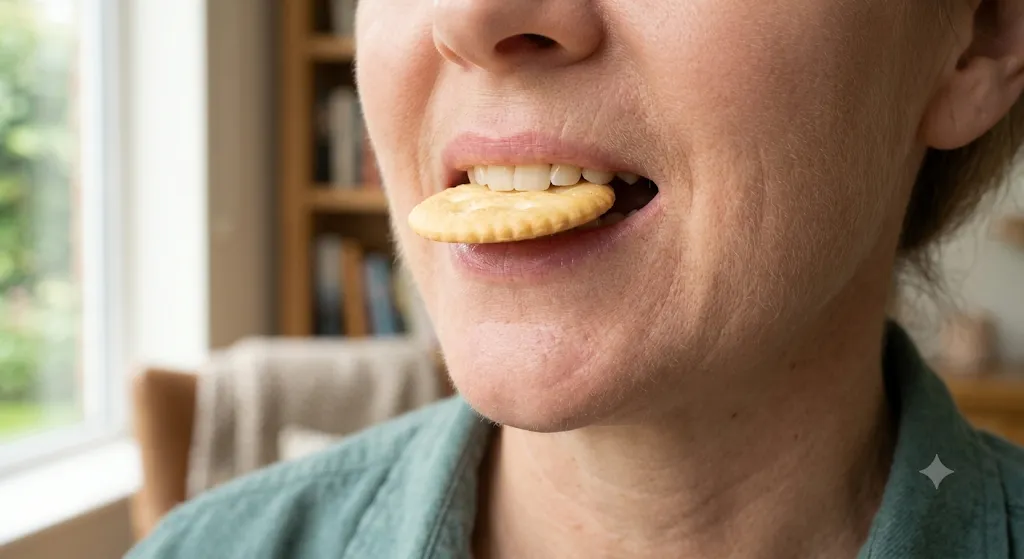
The throat still expects saliva boluses and chewed swallows to clear the pharynx. All-day sipping and mouth breathing leave a dry tickle instead.

The tickle shows up in the late afternoon. You have been talking, sipping, and glancing at a screen, and the back of the throat feels coated, dry, or slightly stuck. A small cough does not finish the job. A tiny sip wets the tongue and leaves the same feeling a minute later. Nothing is swollen. Swallowing food still works. The throat is simply waiting for a swallow it used to get without a reminder.
That swallow was never a rare event. It was the cleanup crew for saliva, crumbs, and the thin film that keeps the pharynx from drying out. Modern days replace it with mouth breathing, soft snacks, and a bottle you nurse for hours. The reflex is still there. The cue is not.
What This Mismatch Feels Like
The usual report is a dry or scratchy patch that water only briefly fixes, a need to clear the throat between sentences, or a sense that mucus is sitting just out of reach. Some people swallow on purpose every few minutes and still feel unfinished. Others notice a soft click, a glob of saliva they keep chasing, or a voice that tires faster on call-heavy days.
It is often worse in heated rooms, on long drives, and after a morning of coffee without a real breakfast. Chewing a piece of fruit or bread can settle it for a while, which is a clue. The throat was not asking for more liquid on the tongue. It was asking for a bolus big enough to clear.
What the Throat Was Built to Do
Swallowing is a patterned sequence, not a simple gulp. Sensory signals from the mouth and pharynx reach a brainstem network often called the swallowing central pattern generator. Robert Doty mapped the reflex circuitry in classic animal work. André Jean and Arthur J. Miller later described how that network times the tongue, the soft palate, the larynx, and the upper esophageal sphincter so that breathing pauses for a fraction of a second and the airway stays protected.
Cumhur Ertekin separated two versions of the same pattern. A voluntary swallow is the one you start when you decide to eat or drink. A spontaneous swallow is the cleanup you barely notice, triggered when saliva or food residue reaches a sensory threshold. Both use the brainstem pattern. Only the voluntary one reliably recruits a full oral phase.
Jeri A. Logemann’s clinical descriptions split the sequence into oral, pharyngeal, and esophageal stages. The tongue gathers a bolus, the hyoid and larynx lift, the upper sphincter opens, and a pharyngeal wave clears the valleculae and piriform sinuses. Wylie J. Dodds and Peter J. Kahrilas showed with manometry and videofluoroscopy that opening of that sphincter depends on the lift plus pressure from the bolus. A trace of saliva does not push the same way a chewed mouthful does.
How often did that happen? C. S. C. Lear, J. B. Flanagan Jr., and C. F. A. Moorrees recorded healthy adults across full days in 1965 and found a mean of about 585 swallows in 24 hours, with a wide range from roughly 200 to about 1,000. Swallowing was most frequent during meals, intermediate during other waking time, and least during sleep, with gaps of 20 minutes or more overnight. Later sleep recordings by Kiminori Sato and Tadashi Nakashima found only about three swallows an hour across the night, clustered around brief arousals. The system expects most of its work while you are awake, and a large share of that work at meals.
Why Modern Days Skip the Cue
A chewed meal is a swallow factory. Taste, jaw motion, and bolus size all raise salivary flow, and each mouthful forces a complete pharyngeal clear. A smoothie, a protein bar eaten in four bites, or a day of grazing never builds that sequence. The glands still answer chewing, which is why a real bite often feels more clearing than another sip. The same mismatch shows up in why saliva still expects real chewing.
All-day sipping creates a different problem. Tiny volumes wet the mouth and may trigger a small spontaneous swallow, but they rarely match the bolus volume Logemann and Kahrilas studied when they described efficient clearance. People who are anxious about a dry throat often sip more and swallow less completely. The film never quite resets.
Mouth breathing removes the other half of the cue. Nasal airflow keeps the pharynx from direct drying and leaves the tongue against the palate, where saliva can pool until it is worth swallowing. A low tongue and an open mouth thin that pool. The tickle then gets misread as a cold or as “postnasal drip,” and throat clearing starts. Each clear slams dry mucosa. Bonnie Martin-Harris’s work on swallow timing also shows that head and neck posture changes hyoid travel. A chin poked toward a screen shortens the lift the pharynx was counting on.
Speech adds load without cleanup. Ancestral talking happened between bites, walks, and swallows. A two-hour call can mean long stretches of dry airflow across the folds with only occasional tiny swallows. The larynx was built to be cleared, not rinsed by habit.
Less Common but Serious Causes
A dry tickle that eases with a meal and a real swallow is usually this mismatch. Food that sticks, liquids that make you cough, pain on swallowing, or a voice that stays hoarse for weeks are not the same story. Reflux can irritate the larynx without much heartburn. A Zenker diverticulum, a stricture, or eosinophilic esophagitis can make solids stall. Neurological disease can drop the spontaneous swallow rate and raise choking risk. One-sided throat pain, a neck lump, blood, or unexplained weight loss needs a clinician, not a humidity trick.
The esophagus has its own expectation of an upright, finished meal. Late reclining after dinner is a different problem, covered in why the esophagus still expects an upright meal.
Hidden Triggers
Antihistamines, some antidepressants, and anticholinergic drugs cut salivary flow, so the spontaneous swallow loses its cue. Chronic nasal blockage pushes mouth breathing even when you intend to use the nose. Very cold dry offices, fan-facing desks, and long flights thin the pharyngeal film. Caffeine and alcohol add mild drying. Habitual throat clearing, often started after one real cold, keeps the cycle going after the virus is gone. A tongue that rests low, described in why the tongue still expects the roof of the mouth, leaves the palate seal unused and the swallow less automatic.
When to Worry
Get urgent care for trouble breathing, drooling because you cannot swallow saliva, swelling of the tongue or throat, or chest pain. Book a clinician if solids stick and the feeling is getting worse, if you cough or choke on thin liquids, if one-sided pain lasts more than a couple of weeks, if your voice stays rough, or if you are losing weight without trying. A tickle that is symmetrical, worse in dry rooms, and better after chewing is the everyday pattern.
Myths vs Facts
Myth: Constant small sips are the same as swallowing properly.
Fact: Volume and a gathered bolus matter. Lear’s recordings tied the highest swallow rates to eating, not to sipping between tasks.
Myth: Throat clearing removes mucus, so more clearing is better.
Fact: A hard clear often scrapes dry tissue and invites the next clear. A sip followed by a full swallow is the cleaner reset.
Myth: If you can swallow food, the spontaneous swallows do not matter.
Fact: Spontaneous swallows are the daytime airway sweep. They drop in sleep, which is why a dry morning throat is common, and they drop further if saliva never pools.
Myth: A swallow click means something is dislocated.
Fact: A painless click is usually cartilage glide. Pain, locking, or food sticking is the part worth checking.
How to Give the Throat the Swallow It Expects
Eat at least one meal a day that requires chewing. Pause, gather the bite, and swallow before the next sentence. That single habit restores bolus size, saliva, and the hyoid lift in a way a bottle cannot.
Use water in real swallows rather than micro-sips. A few deliberate mouthfuls across the hour clear residue better than wetting the lips all afternoon. If you are on a long call, build a swallow into the pause before you answer.
Keep the nose in the circuit when you can. A tongue resting lightly on the palate lets saliva collect until a spontaneous swallow is worth firing. Room humidity in the comfortable middle range, and not sitting in a direct vent, protects the film those swallows are trying to renew.
Replace throat clearing with a sip-and-swallow or a gentle hum. Reza Shaker’s clinical work on effortful and volitional swallows is aimed at people with true impairment, but the everyday version is simpler: one complete swallow beats five scrapes. Stay upright for a while after larger meals so the esophageal clear can finish.
If medicines are drying your mouth, ask the prescriber whether timing or an alternative is reasonable. Do not stop a prescribed drug on your own.
When to See a Doctor
See a clinician if the stuck feeling is progressive, if liquids provoke cough, if hoarseness outlasts two or three weeks, or if reflux symptoms are new and frequent. A speech-language pathologist who evaluates swallowing can watch timing if the problem is mechanical rather than dry air. Most afternoon tickles do not need that visit. They need a bolus.
FAQs
Is it normal to feel like I have mucus I cannot swallow?
A mild, shifting coat that eases after a chewed meal or a full water swallow is common in dry air and mouth breathing. Thick mucus with fever, one-sided pain, or blood is a different problem.
How often should a healthy adult swallow?
Lear, Flanagan, and Moorrees found a mean near 585 swallows a day, mostly while awake and especially while eating. There is a wide normal range. The useful signal is a drop from your own baseline, not a target count.
Why does talking all day make my throat drier than walking does?
Speech sends dry air across the folds and delays swallows. Walking with the mouth closed lets saliva pool and the nose condition the air, so spontaneous swallows keep up.
Do throat lozenges fix the mismatch?
They can coat the surface for a few minutes. They do not restore bolus clearance or nasal breathing. A real swallow after the lozenge still does the mechanical job.
Can anxiety cause the stuck feeling?
Yes. Tension raises awareness of normal saliva, and fast mouth breathing dries the pharynx. The sensation is real. It is still usually a clearance problem, not a blocked airway, if breathing and eating are otherwise normal.
Should I worry if I rarely notice myself swallowing?
No. Spontaneous swallows are supposed to be automatic. You notice them when the film is thin or when you start checking. Pain, choking, or food sticking is the reason to get checked, not the fact that the reflex is quiet.
Conclusion
The throat still expects a gathered swallow, the kind meals and pooled saliva used to provide hundreds of times on a waking day. Sipping, screen posture, and an open mouth leave the pattern under-triggered and the lining dry. Chew one real meal, swallow on purpose between stretches of talking, and let the nose do the breathing. The tickle is often the cleanup crew asking for a job it already knows how to finish.