
Feeling nauseous in the back seat but fine behind the wheel is a classic sensory-conflict pattern. How Reason, Oman, Golding and Stoffregen mapped why passengers get sick and drivers usually do not.
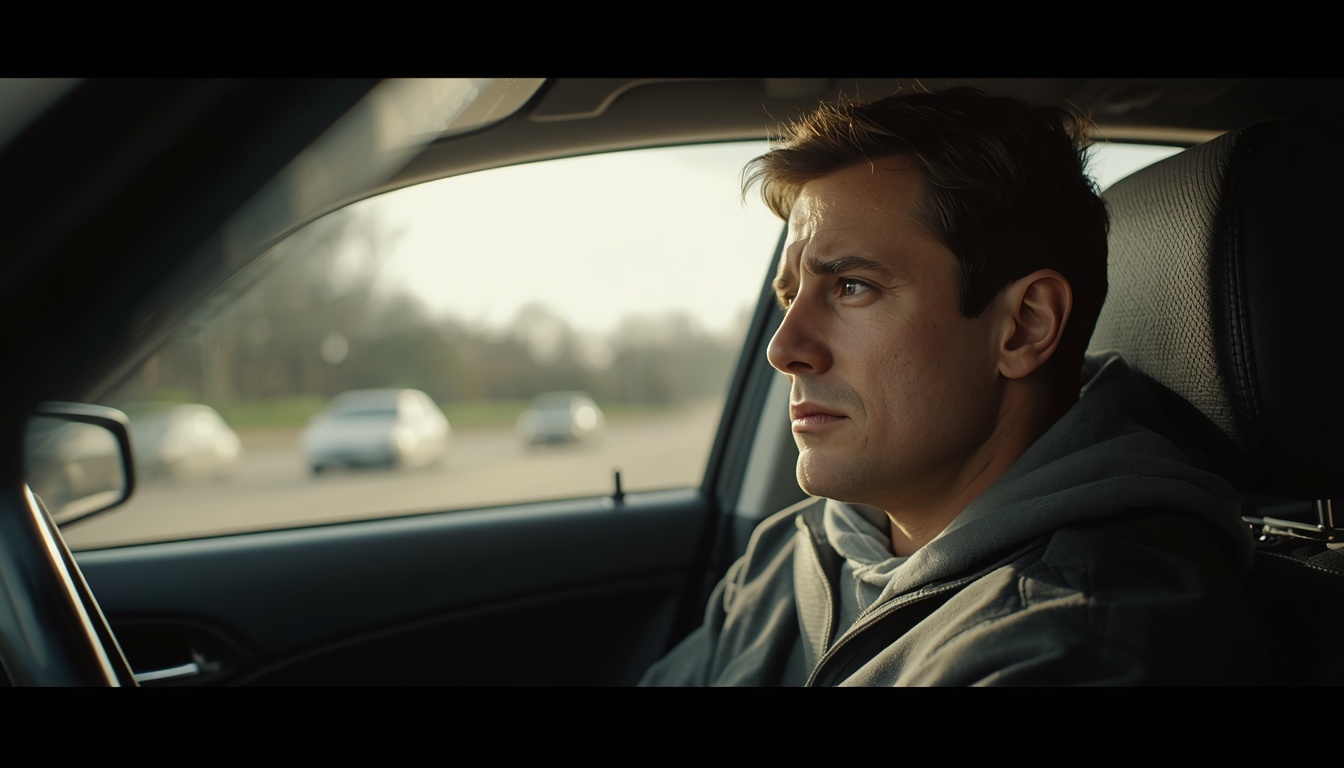
You can drive for two hours without a flicker of nausea and then, twenty minutes into the same route as a passenger, feel the familiar sequence: a warm flush, a yawn you did not ask for, saliva that suddenly tastes metallic, and a stomach that wants the world to stop moving. Switching seats should not change the physics of the car. It changes the information your brain is given about the physics. That is why passenger-only carsickness is one of the most reproducible human motion patterns ever measured.
It is not weakness. It is not “just anxiety,” though anxiety can amplify it. It is a mismatch between what your inner ears feel, what your eyes see, and what your body expected to do next.
What This Symptom Feels Like
Motion sickness is a cluster, not a single sensation. Classic carsickness often arrives in this order:
- A slightly warm face and a sudden need to look at the horizon
- Increased swallowing and a thin, sour or metallic saliva
- Yawning, drowsiness, or a heavy-headed fog that feels unlike ordinary tiredness
- Stomach awareness that rises toward nausea, sometimes with a cold sweat
- In children, pallor, quietness, and a request to stop long before they can name nausea
The driver, meanwhile, is making the same turns. Their inner ears feel the same accelerations. They rarely get the cluster. That discrepancy is the clue.
Why Drivers Usually Don’t Get It
A driver is not a passive occupant. They generate a prediction. Before the car yaws into a curve, the driver’s hands, eyes, and vestibular system have already written a short forecast: this much lean, this much deceleration, this visual flow across the windshield. When the car then does roughly that, the forecast matches the incoming signals. Matching forecasts do not trigger the sickness circuit.
A passenger does not write that forecast in the same way. They may be looking at a phone, a book, or the seat back. Their inner ears still register every surge, brake, and lateral acceleration. Their eyes, if they are fixed on a page a foot away, report a world that is barely moving. The mismatch is the problem.
James Reason, working with J.J. Brand in the 1970s, formalized this as sensory conflict or neural mismatch: motion sickness appears when the pattern of vestibular, visual, and proprioceptive signals is not the pattern the brain stored from previous, coherent movement. Charles Oman later refined the idea into an observer-theory model: the brain is constantly estimating “what state am I in?” and computing an error. Large, unexpected error is what feels like sickness.
That is why the same person can be fine driving, mildly sick in the front passenger seat looking forward, and miserable in the back seat looking down. The motion did not change. The error signal did.
The Inner Ear’s Version of the Story
Your vestibular organs do two different jobs that cars mix together.
The semicircular canals sense rotation: yaw when the car turns, pitch when it crests a hill, roll when it leans. The otolith organs — the utricle and saccule — sense linear acceleration and tilt. In a car, braking is a linear acceleration that the otoliths cannot perfectly distinguish from a nose-down tilt. On a winding road, canal signals of yaw arrive while the visual scene, if you are reading, stays almost still.
Willem Bles and Jelte Bos developed a related account called subjective vertical conflict: nausea is especially likely when the brain cannot settle on which way is “up.” A vehicle that banks, brakes, and pitches keeps rewriting that answer. A driver who watches the road and steers has extra visual and motor evidence for “up.” A passenger staring at a screen does not.
This is also why the pattern overlaps with seasickness and simulator sickness, and why it shares circuitry with the dizziness some people feel after unusual motion. Your inner ear was built for walking, turning your head, and looking at a world that moves with you — not for sitting still inside a machine that moves you. That older expectation is the same one described in why your inner ear still expects natural motion.
Why Looking at a Phone Makes It Worse
Near work in a moving vehicle is almost a laboratory recipe for conflict.
The page or screen is visually stable relative to your head. The vestibular system reports that the head is accelerating. Extraocular muscles and neck proprioceptors add a third story about how the head is oriented. The brain cannot reconcile “I am still” with “I am turning.” Nausea is the output.
John F. Golding, who spent decades measuring motion-sickness susceptibility, showed that visual tasks which disconnect you from the outside world reliably raise scores on standardized questionnaires. Reading, detailed phone use, and virtual screens in cars and aircraft are among the strongest everyday triggers. Looking at the horizon — a distant, stable visual frame that agrees with the vestibular sense of motion — is among the strongest everyday protectors.
Children are often more susceptible because their vestibular systems are still calibrating, they sit lower (so they see less of the outside world), and they are more likely to be given a screen or a book to “keep them busy.” Many grow out of the worst of it in adolescence as prediction and visual-vestibular coupling mature. Some adults never do, especially those with a history of migraine.
The Poison Hypothesis — and Why It Still Matters
In 1977 Michel Treisman proposed an evolutionary explanation that still shapes how researchers talk about the symptom. If the brain receives contradictory motion signals, one historically common cause would have been a neurotoxin — something that scrambled vestibular or visual processing. Vomiting would then be an adaptive dump of whatever had just been eaten.
Cars are not poisons. The circuit does not know that. It only knows that the motion map just failed. That is why anti-nausea drugs that act on vestibular and brainstem pathways can help, and why “just relax” rarely does. You cannot talk a mismatch detector out of firing.
Thomas Stoffregen has argued a complementary view: people get sick when they cannot stabilize their posture in a moving environment. Drivers make continuous micro-adjustments with the wheel and trunk. Passengers, especially those looking down, sway more and control that sway less well. Instability and sensory conflict are not rivals so much as two descriptions of the same failed prediction.
Who Gets It More
Golding’s work, and earlier surveys by Reason, mapped a fairly stable pattern:
- Women report carsickness more often than men, on average, with a peak around hormonal fluctuations that also track migraine risk
- People with migraine are substantially more susceptible; the overlapping brainstem and vestibular pathways are not a coincidence
- Children between about 4 and 12 are the peak passenger group; infants who cannot sit independently rarely show classic carsickness
- A first bad episode can sensitize the next one — expectation itself becomes part of the error signal
- Poor ventilation, heat, strong smells, and a full or empty stomach all lower the threshold
None of that means the driver is “tougher.” It means the driver has a better forecast.
Less Common but Serious Lookalikes
Ordinary passenger carsickness fades when the motion stops or when you take the wheel and look at the road. Seek care rather than assuming “just carsickness” if:
- Vertigo, vomiting, or imbalance continues for hours after the car stops
- The episodes come with one-sided hearing change, severe headache unlike your usual pattern, double vision, weakness, or trouble speaking
- You suddenly cannot tolerate any motion, including walking, after a head injury
- A child has projectile vomiting, a stiff neck, unusual lethargy, or a first severe episode with no motion at all
Those patterns can reflect vestibular disorders, migraine variants, or, rarely, central causes that need examination. Carsickness itself does not damage the inner ear. Persistent spinning after the trip is a different story.
Brief lightheadedness when you finally stand up at a rest stop is often a separate orthostatic effect after sitting still, closer to why you get lightheaded when you stand up than to true motion sickness.
Hidden Triggers
A few everyday details make passenger sickness more likely than people realize:
- Rear seats, especially middle seats, give the worst view of the outside world and the most lateral motion
- Headphones plus a screen remove both visual horizon and some of the engine-and-road sound that helps timing predictions
- Hairpin roads, stop-and-go traffic, and reading a map on your lap stack conflicts
- A large fatty meal just before the trip, or a long fast with only coffee, both irritate an already unsettled gut
- Strong cabin heat and perfume, which add to the same brainstem nausea network
People who get a pounding head after hard exercise are not the same group as people who get carsick, but shared vascular and migraine traits can overlap. If exertion headaches are already part of your map, see whether a headache after exercise is a separate pattern.
When to Worry
Worry less about the fact of passenger nausea and more about the company it keeps.
Worry more if motion sickness is new in later adulthood, if it appears with ear fullness or hearing loss, if it does not fade after the vehicle stops, or if it is accompanied by neurological signs. Worry less if it has been your pattern since childhood, it tracks rear seats and screens, and it settles when you drive or look at the horizon.
Myths vs Facts
Myth: Only weak-stomached people get carsick.
Fact: Astronauts, pilots in simulators, and people with excellent fitness get motion sickness when the conflict is large enough. Susceptibility is a trait with a distribution, not a moral category.
Myth: Opening a window is superstition.
Fact: Cooler air, less odor, and a better view of the passing world all reduce the error signal. The window is not magic. It is extra coherent data.
Myth: If you don’t vomit, it isn’t motion sickness.
Fact: Drowsiness, yawning, pallor, and a sour mouth are earlier points on the same scale Golding and others use. Many people never reach vomiting and still have the syndrome.
Myth: Kids should just look at a tablet so they stay quiet.
Fact: That is the intervention most likely to produce the conflict. Quiet is not the same as well.
How to Manage It
The most reliable strategies restore agreement between eyes, ears, and prediction.
Sit where you can see the road. Front passenger is better than rear. Facing forward is better than sideways. Looking at the distant scene is better than looking at a lap.
If you must use a phone, raise it toward the windshield line so some of the outside world stays in view. Take visual breaks before nausea starts. Once the cascade is underway, stopping the screen is less effective than preventing it.
Keep the cabin cool. Avoid heavy perfume and leftover food smells. A light starchy snack helps some people; a greasy feast helps almost no one.
Behavioral tools with evidence behind them include controlled breathing, looking at a stable distant point, and, for repeat travelers, gradual exposure on milder roads so the brain updates its motion model. Ginger has modest support for nausea in some trials; it is not a vestibular reset. Over-the-counter antihistamines used for motion sickness (such as dimenhydrinate or meclizine) and prescription scopolamine act on the same brainstem pathways the conflict uses. They work best taken before the trip, not after vomiting has started. They also cause drowsiness — which is why they are a poor choice for the driver.
If you are the passenger who always gets sick, offering to drive — when safe and licensed — is not a personality quirk. It is the most effective non-drug intervention in the car.
When to See a Doctor
See a clinician if passenger sickness is new, severe, or paired with hearing change, persistent spinning, migraine that is changing character, or neurological symptoms. Mention whether you also get sick on buses, boats, or in virtual-reality headsets; that map helps separate ordinary sensory conflict from a vestibular disorder.
Children who vomit on every short trip, lose weight, or cannot keep fluids down need more than a front-seat experiment. Adults who have to avoid all vehicles may benefit from vestibular physiotherapy rather than only tablets.
FAQs
Why can I drive for hours but get sick after twenty minutes as a passenger?
Driving supplies a prediction the vestibular system can match. Passengers, especially those looking down, receive motion without that forecast. The conflict — not the miles — produces nausea.
Does sitting in the front really help?
Usually yes. You see more of the outside world, feel slightly less of the rear-seat sway, and can watch the road’s upcoming curves. It is not a guarantee on a mountain road with a phone in your lap.
Why are children more carsick than adults?
Their visual-vestibular calibration is still developing, they sit lower, and they are often handed a book or screen. Many improve after puberty. Persistent severe vomiting still deserves a check.
Is carsickness the same as vertigo?
No. Vertigo is a false sense of spinning or movement. Motion sickness is nausea and autonomic activation triggered by conflicting motion signals. They can overlap in vestibular disorders, but ordinary carsickness is not an inner-ear disease.
Can anxiety alone cause it?
Anxiety raises attention to bodily signals and can lower the threshold, especially after a previous bad trip. It does not create the visual-vestibular conflict. Both can be true at once.
Will I grow out of it?
Many childhood sufferers do. Adult-onset susceptibility often tracks migraine, hormones, or a new visual habit (screens in cars). Adaptation with repeated, well-dosed exposure helps some people; others will always do better as the driver.
Conclusion
Getting carsick only as a passenger is one of the cleanest demonstrations that the brain is not a camera. It is a prediction engine. When you steer, the prediction and the motion agree. When you sit in the back and watch a small bright rectangle, they do not. Reason’s mismatch, Oman’s observer error, Golding’s susceptibility maps, and Stoffregen’s postural account all point at the same everyday scene: a healthy nervous system receiving an unnatural combination of signals.
You do not need to be tougher. You need a horizon, a cooler cabin, and, when you can have it, the wheel.