Feeling a rhythmic pulse in your fingertips is usually just the normal pressure wave from your heart traveling through small arteries close to the skin. Learn why it happens and when it might need attention.
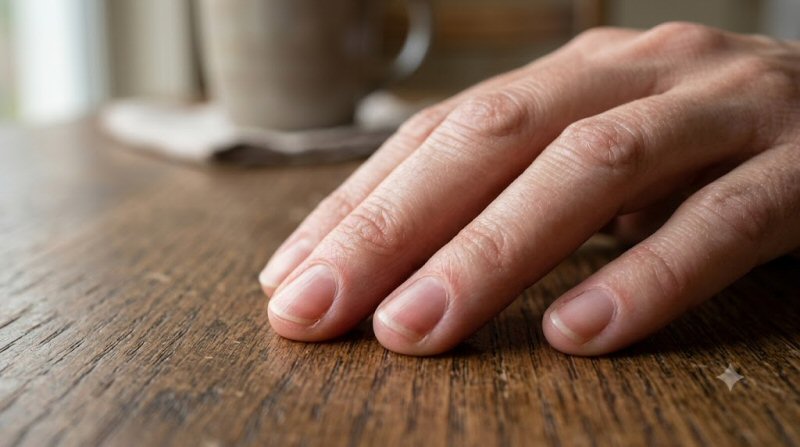
You rest your hand on the desk, or lightly press one fingertip against another, and there it is: a steady, rhythmic thump that matches the beat in your chest. For a moment it feels surprisingly strong, almost as if your finger has its own heartbeat. Most of the time this is completely ordinary. Your fingertips contain small arteries that sit close to the surface and against bone, so the pressure wave created by each heartbeat can be easy to notice when conditions are right.
What This Sensation Feels Like
The feeling is usually a gentle, regular pulse rather than pain. Some people notice it most clearly when they press a fingertip against a firm surface—the edge of a table, the side of another finger, or even a pillow. Others feel it without pressing at all, especially after walking up stairs, finishing a cup of coffee, or lying quietly in bed. It can come and go within minutes. The rhythm is almost always regular and matches the pulse you would feel at the wrist.
It is different from the throbbing that comes with a cut or a hangnail. That kind of throbbing is often warmer, more localized, and paired with swelling or tenderness. The ordinary fingertip pulse is cooler and more mechanical—simply the arrival of each arterial pressure wave.
Why You Can Feel It So Clearly
Each time the left ventricle contracts, it ejects a stroke volume of blood into the aorta. The sudden rise in pressure stretches the elastic walls of the large arteries and creates a pressure wave that travels outward much faster than the blood itself. In the aorta the wave moves at roughly 3–5 meters per second; by the time it reaches the small arteries of the fingers it is still strong enough to expand the vessel walls slightly. Physiologist Arthur Guyton described this transmission of the pressure pulse in detail: the wave front spreads along the arterial tree, and the difference between systolic and diastolic pressure (the pulse pressure) determines how forceful the expansion feels.
Fingertips are especially good at detecting this wave for two reasons. First, the digital arteries run close to the skin and are backed by the firm bone of the distal phalanx, so even a small expansion can be felt. Second, the pulp of the fingertip is packed with sensory nerve endings. Research on finger-pad afferents has shown that a substantial fraction of slowly adapting nerve fibers fire in time with the cardiac cycle under normal conditions. When you apply light pressure, you simply amplify a signal that is already present.
Cardiac electrophysiologist Glenn Meininger has noted that some people can appreciate their pulse through a fingertip pressed against an object, even if this method is not reliable for formal heart-rate checks. The sensation itself is not a sign that anything is wrong.
Common Everyday Triggers
Several ordinary situations make the fingertip pulse more noticeable:
- After movement or mild exercise. Stroke volume and pulse pressure rise temporarily, so the wave arriving at the fingers is stronger.
- Caffeine or a warm room. Both can increase heart rate or relax peripheral vessels, changing how the pulse feels.
- Quiet moments or light pressure. When you are still and you gently compress the finger, background noise drops and the regular expansion stands out.
- Anxiety or excitement. Sympathetic activation raises heart rate and pulse pressure; the same mechanism that makes your heart feel louder in your chest can make it louder in your fingers. If you also notice your hands growing cold during stress, the contrast can be striking—see why typing sometimes leaves hands cold.
- Thinner fingers or lower body fat. Less soft tissue between the artery and the surface makes the pulse easier to detect.
These are the same reasons people sometimes feel their heartbeat in other places. The temples, the neck, and the left side of the chest when lying down are common examples; the fingers are simply another site where the arterial tree comes close to the surface. Related experiences are described in articles on feeling your heartbeat in your temples and noticing it when you lie on your left side.
Less Common but Still Benign Reasons
Pregnancy, fever, mild anemia, or an overactive thyroid can raise cardiac output and make peripheral pulses more obvious. After a large meal or in a warm shower, blood is redistributed and the pulse wave can feel different for a short time. None of these automatically means disease; they simply change the strength of the pressure wave that reaches the fingers.
When the Sensation Deserves a Closer Look
Most fingertip pulses are harmless. A few patterns are worth mentioning to a clinician:
- The pulse is strong and bounding in only one hand or a few fingers, especially if those fingers also look pale, blue, or swollen.
- It is accompanied by chest pain, marked shortness of breath, dizziness, or fainting.
- You can see a rhythmic flushing of the nail bed (sometimes called Quincke’s pulse) together with other signs of a heart valve problem.
- The feeling is new, persistent, and paired with unintentional weight loss, heat intolerance, or a racing heart at rest.
- You have known peripheral artery disease, diabetes, or a history of blood clots and the pulse feels weaker or absent on one side.
These situations are uncommon. The ordinary experience of noticing a regular beat in a fingertip does not belong on this list.
Myths vs Facts
Myth: Feeling your pulse in your fingers means you have high blood pressure.
Fact: Pulse pressure (the difference between systolic and diastolic) influences how strong the wave feels, but a noticeable fingertip pulse can occur at perfectly normal blood-pressure readings. Formal measurement is still the only way to know your numbers.
Myth: You should never feel a pulse anywhere except the wrist or neck.
Fact: Arteries supply every part of the body. The same pressure wave that is easy to find at the radial artery can be detected in many other places when the vessel is superficial and you apply light pressure.
Myth: A visible or strong pulse in the fingers is a reliable way to check heart rate.
Fact: It can give a rough idea, but clinicians prefer the radial or carotid pulse for accuracy. Smartphone apps that use the camera on a fingertip (photoplethysmography) are designed for this purpose, yet even they are wellness tools rather than diagnostic devices.
Simple Ways to Make the Sensation Less Noticeable
If the feeling bothers you, a few small changes often help:
- Avoid pressing or rubbing the fingertips while you are thinking about the pulse; attention itself amplifies interoceptive signals.
- Stay well hydrated and keep caffeine moderate if you notice the sensation mainly after coffee.
- Gentle movement—walking around the room or opening and closing the hands—usually shifts attention and normalizes peripheral blood flow.
- If anxiety is the main driver, the same slow breathing that calms a racing heart often quiets the fingertip awareness as well.
There is no need to treat a normal pulse wave. The goal is simply to recognize it as ordinary physiology rather than a warning.
When to See a Doctor
Schedule a visit if the fingertip pulse is new and persistent, clearly stronger on one side, or accompanied by pain, color change, swelling, chest symptoms, or unexplained fatigue. Bring a simple note of when you notice it most (after coffee, at rest, only in one hand) so the conversation stays focused. For the great majority of people who simply notice the beat now and then, no medical work-up is required.
Frequently Asked Questions
Is it normal to feel my pulse in my fingers when I press them together?
Yes. Light pressure against bone makes the small expansion of the digital arteries easier to detect. Many people discover this accidentally and find it continues as long as they keep checking.
Why do I notice it more after exercise or coffee?
Both raise heart rate and pulse pressure for a while. The pressure wave that reaches the fingers is simply stronger, so the same arteries that were quiet a few minutes earlier now feel obvious.
Can anxiety make my fingertips throb with my heartbeat?
Yes. The same sympathetic surge that increases cardiac output and can make your hands feel cold also increases the force of each arterial expansion. The sensation usually fades as the stress response settles.
Should I worry if I can see my pulse in my fingernail?
A faint rhythmic color change under the nail can be normal in people with thin skin. A very obvious, repeated flushing (Quincke’s pulse) together with other symptoms is uncommon and worth mentioning to a doctor, because it has classically been linked to aortic valve regurgitation.
Is feeling a pulse in my fingers a sign of poor circulation?
No. Poor circulation usually makes pulses harder, not easier, to feel. A clear fingertip pulse generally means blood is reaching the end of the arterial tree in the usual way.
How is this different from the throbbing of an injured finger?
Injury throbbing is typically warmer, more painful, and localized to the damaged area, often with visible swelling. The ordinary heartbeat sensation is rhythmic, matches your wrist pulse, and is not tender.
Conclusion
Feeling your heartbeat in your fingers is almost always a straightforward consequence of normal arterial physiology. The pressure wave that begins in the aorta travels all the way to the digital arteries, and the dense sensory endings in the fingertip are well suited to notice it—especially after movement, caffeine, or a moment of quiet attention. Recognizing the sensation for what it is removes most of the worry. If the pattern is new, one-sided, or joined by other concerning symptoms, a brief medical check is reasonable. For everyday awareness of a regular fingertip pulse, the explanation is simple: your circulation is doing exactly what it evolved to do.