
A thin white film on the tongue at first light is usually overnight biofilm, slower saliva and a night without chewing — not automatically thrush. Tonzetich, Dawes, Marsh and Scully mapped the chemistry of that morning coat.
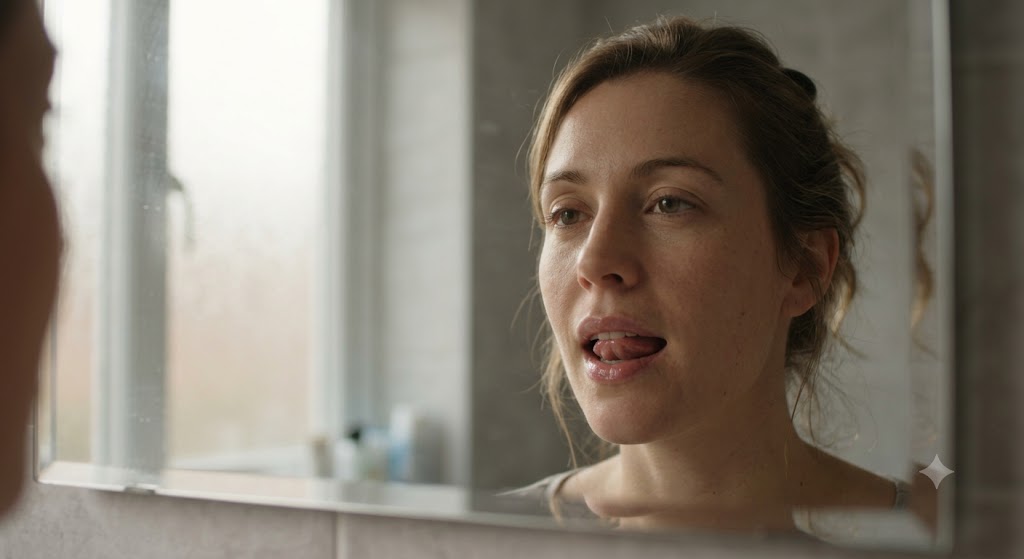
You pad into the bathroom, stick out your tongue at the mirror, and there it is: a pale coat that was not that obvious last night. Sometimes it is a thin milk-film. Sometimes it is thicker toward the back. A sip of water and a first swallow often thin it. Coffee and breakfast thin it more. By mid-morning many people forget it was there.
That pattern is common. A morning white tongue is usually the overnight version of a living surface, not a sudden infection. The coating is mostly shed cells, food remnants, and a biofilm that had eight hours without chewing, talking, or a strong saliva rinse. Joseph Tonzetich spent decades measuring the sulfur compounds that live in that coat. Colin Dawes mapped how saliva flow collapses in sleep. Philip Marsh described the tongue dorsum as one of the densest microbial neighborhoods in the mouth. Crispian Scully’s clinical work still separates that ordinary film from the infections and dermatoses that can mimic it.
The coat is information. It is not, by itself, a diagnosis.
What This Morning Coat Actually Is
The top of the tongue is not a smooth slab. It is a field of papillae — filiform threads in front, larger fungiform dots, and a V of circumvallate papillae farther back. Between those projections sit crypts. Cells slough into the crypts all day. Bacteria colonize the slough. A thin glycoprotein pellicle forms on the surface the way it forms on teeth.
During waking hours the system is restless. You chew. You swallow about once a minute while awake. Parotid, submandibular and sublingual glands keep a film of saliva moving. Mechanical shear from the palate and teeth scrapes the dorsum. Volatile compounds get washed toward the throat.
Sleep changes the contract. Saliva flow falls sharply. Swallowing becomes infrequent. The mouth may open. Bedroom air is often dry. Filiform papillae keep shedding, but the rinse slows. By dawn the crypts hold a visible paste of keratin debris, mucin, and anaerobes. That paste looks white or off-white because it scatters light. It is not pus. It is not a paint the body applied as a warning label.
Tonzetich’s classic work on oral malodor showed why the back third of the tongue is the usual culprit. Gram-negative anaerobes in those crypts generate hydrogen sulfide, methyl mercaptan and dimethyl sulfide from sulfur-containing amino acids. The same niche that makes morning breath also makes the coat you can see. Yaegaki and Sanada later confirmed that tongue coating, more than dental plaque alone, tracks those volatile sulfur compounds in many otherwise healthy mouths.
Why Night Is the Perfect Time for a Film
Dawes showed that unstimulated saliva flow is already modest by late evening and drops further in sleep. The glands do not shut off. They idle. Without chewing and without the cephalic cues of taste and smell, the major glands have little reason to surge. A dry, still mouth is a better incubator than a wet, working one.
Mouth breathing makes the incubator worse. Overnight air across the dorsum evaporates the thin saliva film and leaves debris stuck instead of suspended. People who also wake with a dry mouth or a morning sore throat often see a thicker coat for the same reason: the night shift ran without enough liquid traffic.
Reflux can add a second layer. Acid or pepsin that reaches the pharynx overnight can irritate the posterior tongue and change the way debris clings. Some people notice a white or yellowish back-third coat plus a sour or metallic taste on first waking. That is chemistry plus posture, not a new species of plaque.
Marsh’s ecological view is useful here. The tongue is not sterile at bedtime and infected at dawn. It is a stable community that shifts when moisture, oxygen and shear change. Night lowers shear and moisture. Morning looking-in-the-mirror is simply the first time you inspect the result under bathroom light.
What Is Usually Not Happening
Oral candidiasis — thrush — is the label people reach for first. True thrush is a different picture. Candida overgrowth tends to make a creamier, sometimes curd-like plaque that can be wiped and may leave a raw or bleeding surface. It favors people who have used recent broad-spectrum antibiotics, high-dose inhaled or systemic steroids, who wear poorly cleaned dentures, who have poorly controlled diabetes, who are immunosuppressed, or who have severe hyposalivation. A thin film that fades after breakfast in an otherwise well adult is a poor match for that list.
Leukoplakia is another word that travels faster than the lesion. Leukoplakia is a persistent white patch that cannot be scraped off and cannot be explained as ordinary coating, candidiasis or a known bite line. It lives on a site for weeks. It does not appear only at 7 a.m. and vanish after coffee. Geographic tongue can look alarming in a mirror — migrating red islands with white borders — but it is a benign pattern of filiform loss, not an overnight film.
Hairy tongue is also easy to confuse with “white coat.” When filiform papillae elongate, they trap debris and can look white, yellow, brown or black depending on coffee, tea, tobacco and chromogenic bacteria. The texture is the clue: a fur rather than a wipeable mist.
Hidden Triggers That Thicken the Film
Dry bedroom air and open-mouth sleep are the quiet majority. Add a congested nose, a late heavy meal, alcohol, or a bedroom heater and the dorsum spends the night under a desert wind.
Medications that reduce saliva — many antihistamines, some antidepressants, bladder antispasmodics, older blood-pressure drugs — leave more debris behind. So do consistent mouth breathing, CPAP dryness if humidity is set too low, and all-day sipping of acidic drinks that change the oral ecology without restoring a chew-and-swallow rhythm.
Soft, low-chew diets do less mechanical cleaning. A day of smoothies, yogurt and soup is kinder to teeth in some ways and less useful to the tongue’s self-scrape. Smoking and vaping change both saliva and the microbial mix; coats tend to be thicker and more stained.
After antibiotics the community can tilt for days to weeks. A temporary thicker coat is common while streptococci, anaerobes and yeasts renegotiate territory. That tilt is not automatically thrush, but it is a reason to watch for a wipeable curd or a burn that does not fade.
When the White Tongue Is Worth a Closer Look
See a dentist or physician if the coat:
- Does not thin after eating, drinking and gentle cleaning for several days
- Wipes off and leaves a raw, sore or bleeding surface
- Comes with pain, burning, taste loss, or difficulty swallowing
- Is one-sided, firm, or fixed to a single patch that does not migrate
- Arrives with fever, white plaques elsewhere in the mouth, cracked corners of the lips, or denture soreness
- Appears in a child who is feeding poorly, or in an adult with new diabetes symptoms, recent chemotherapy, or inhaled-steroid use without rinsing
Unexplained weight loss, persistent oral ulcers, or a white patch in a long-term tobacco or heavy alcohol user needs a proper exam, not another week of waiting for the film to behave like ordinary morning debris.
Myths vs Facts
Myth: A white morning tongue always means you have a yeast infection.
Fact: Most healthy adults grow an overnight biofilm that looks white under bathroom light. Thrush has risk factors and a different texture.
Myth: You should scrape until the tongue is baby-pink every dawn.
Fact: Gentle cleaning helps. Aggressive scraping of papillae can inflame the surface and does not sterilize a living community.
Myth: The coat is leftover toothpaste or milk.
Fact: Those can add color for a few minutes. The durable film is keratin, mucin and microbes that accumulated while saliva was low.
Myth: If you can see a coat you must have poor hygiene.
Fact: Even careful brushers coat overnight because sleep reduces flow and swallow frequency. Hygiene changes thickness, not the existence of a night film.
Myth: Mouthwash alone will keep the tongue clear.
Fact: Alcohol-heavy rinses can dry the mucosa. Mechanical cleaning plus saliva-friendly habits beat a single antiseptic pass.
How to Manage an Ordinary Morning Coat
Treat the night, not only the mirror. Nasal breathing, bedroom humidity in a comfortable mid-range, and a last hour without alcohol give saliva a better chance. If you use a steroid inhaler, rinse and spit. If you wear a night guard or denture, clean it as carefully as the teeth it covers.
In the morning, drink water first. Then brush teeth and, with a soft brush or a dedicated tongue cleaner, make a few gentle strokes from back to front. Do not gouge the circumvallate V. You are shearing debris, not sanding anatomy. Eating breakfast — especially food that needs chewing — finishes the job better than a second rinse.
Sugar-free xylitol gum later in the day raises saliva and adds a mechanical sweep. A diet with some fibrous chew does the same. People who live on soft calories often notice that the coat returns faster.
If reflux is in the story — night sourness, hoarseness, a coat that lives on the back third — earlier dinners and not lying down immediately after eating help the tongue by helping the sphincter. That is plumbing, not a new toothpaste.
Do not start an antifungal on a photograph of a morning tongue. Reserve those medicines for a clinician who has seen a lesion that matches candidiasis or another specific diagnosis.
When to See a Doctor or Dentist
Book a visit for a persistent patch, pain, bleeding after a light wipe, taste change that does not track a cold, or a coat plus systemic red flags. Bring a list of inhalers, antibiotics, and drying medicines. Mention tobacco, vaping, dentures, and whether the nose is blocked at night. The exam is usually a light, a glove, and sometimes a swab — not an automatic prescription.
Children who suddenly refuse food, wear white plaques on the inner cheeks, or have diaper yeast at the same time deserve a same-week look. Adults with new thrush and no obvious trigger deserve a glucose check and a review of immune and steroid history.
FAQs
Is a slightly yellow morning tongue different from a white one?
Often no. The same debris picks up stain from coffee, tea, smoking or chromogenic bacteria. Persistent deep yellow with pain still deserves an exam.
Should I use a metal tongue scraper every day?
A soft scraper or toothbrush is enough for most people. Daily gentle cleaning is reasonable. Daily force is not. Stop if the surface stays sore.
Can dehydration overnight cause the coat?
Yes, indirectly. Lower saliva means less rinse. You do not need to chug water at 2 a.m.; you need enough evening fluid and a less arid bedroom.
Why is the back of the tongue whiter than the tip?
The posterior dorsum has deeper crypts, less abrasion from teeth, and a denser anaerobic community. Tonzetich’s odor work pointed at that neighborhood for a reason.
Does probiotic yogurt clear a white tongue?
Food that you chew helps more than a specific branded microbe in most everyday cases. Yogurt is fine as breakfast. It is not a substitute for saliva, nasal breathing and mechanical cleaning.
Can geographic tongue look white in the morning too?
Yes. The white borders can be more obvious after a dry night. The migrating map over days is the giveaway that you are not looking at simple overnight film.
Conclusion
A pale coat on first inspection is what a papillated, microbial, low-saliva surface does when you stop chewing for a third of the day. Tonzetich measured the chemistry. Dawes measured the drought. Marsh described the ecology. Scully drew the line between that ordinary film and the infections and patches that need a chair and a light.
Drink, chew, breathe through your nose if you can, and clean the dorsum as if it were a textured tool rather than a stain to punish. The mirror will still catch a mist some mornings. That mist is usually last night’s quiet, not a verdict.