A dull knee ache when the air turns cold is usually stiffer muscle, thicker joint fluid, and a quieter day, not a joint that can forecast storms.
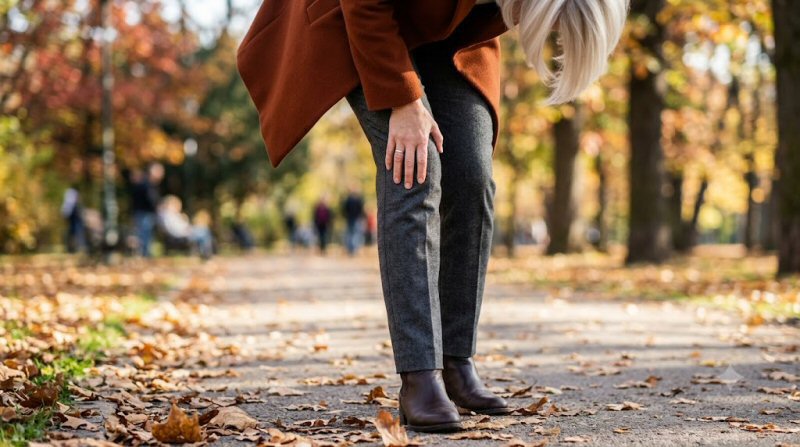
The first cold morning of the season has a specific feel in the knees. The joint is not hot or locked. It is dull, a little heavy, and slow to trust the first few steps off the curb. Stairs feel higher. A deep bend to tie a shoe complains at the front of the knee. By afternoon, after a walk and a warmer room, a lot of that ache has faded. People say the knee can tell the weather. The knee cannot read a forecast. It can feel cold, stillness, and a drop in the pressure of the air around it.
A weather-linked ache that settles with warmth and ordinary walking is common, especially if the knee already has some wear, an old sprain, or a winter of desk days behind it. A knee that swells, locks, gives way, or stays stiff for more than an hour after you are up is a different problem.
What Cold-Weather Knee Ache Feels Like
The usual pattern is familiar once you notice it.
It shows up when you step outside, when the office air conditioning is aggressive, or on a damp day when the barometer is falling. The pain is deep and achy rather than sharp and catching. It often sits around the kneecap, along the inner joint line, or behind the knee where the hamstring and calf meet. Both knees can complain, or only the one that took an old injury.
The first steps are the worst. After a few minutes of walking the ache often eases, then returns if you stand still in the cold or sit through a long meeting with the knees bent. There is no fever, no red hot swelling, and no true giving way. A crack or click on the way up from a chair can come with it, and that noise alone is usually harmless.
People with a known arthritic knee notice it most. People with otherwise quiet knees can still feel it after a cold commute, a sideline at a game, or a day of damp chores. The shared piece is tissue that got cold and a joint that did not get much motion.
Why Cold Makes a Knee Complain
Several ordinary mechanisms stack. None of them require the joint to predict a storm.
Local temperature drops first. The knee is a relatively exposed hinge. Skin, the thin tissues over the kneecap, and the muscles that cross the joint all cool faster than the core. Colder muscle contracts more slowly and feels stiffer. The quadriceps and hamstrings guard a little, so the knee tracks with more friction on the first bends. That guarding is a reflex, not damage.
Joint fluid changes with temperature too. Synovial fluid, the slick film inside the knee, becomes more viscous as it cools, in the same way oil thickens in a cold engine. A thicker film does not block the joint, but the first bends can feel draggy until movement and local blood flow warm the fluid again. Joseph Hollander’s climate-chamber work in the early 1960s, at the University of Pennsylvania, was an early attempt to test this kind of claim under controlled pressure and humidity rather than folklore.
Barometric pressure is the part people argue about. When a front approaches, air pressure often falls a little. Some patients in Hollander’s chamber reported more joint pain as pressure dropped and humidity rose. Later diary studies have been mixed, which is honest. Timothy McAlindon and colleagues, tracking people with knee osteoarthritis in Boston, found that changes in barometric pressure and ambient temperature tracked with pain severity in online diaries. Erik Timmermans and the European Project on Osteoarthritis found small links between weather, especially humidity and pressure, and joint pain across several countries. Geir Smedslund and Kåre Hagen, reviewing the trials, concluded the effect is real for some people and small on average. A knee can be weather-sensitive without the weather being the disease.
There is also a behavior effect. Cold days mean more time indoors, shorter walks, and more sitting. A knee that expects varied steps gets a quiet day, then aches when it is asked to bend. That is the same stillness problem described in why your joints still expect motion, not rest, only dressed for winter.
Who Feels It Most
Weather ache is not evenly shared.
Knees with osteoarthritis notice it more, because the lining and the bone under worn cartilage already send more signals. David Felson’s epidemiologic work on knee osteoarthritis makes the baseline clear: ache, brief stiffness, and weather complaints cluster in joints that already have structural change, not in every knee on a cold street. An old meniscus tear, a healed ligament sprain, or surgery can leave the same joint a little more vocal in the cold.
Low muscle around the knee matters. If the quadriceps have gone quiet from a season of sitting, they do not warm or steady the joint as well. Stair descent already loads the front of the knee hard, which is why knees that ache going down stairs often complain on cold days too.
Mood and expectation play a smaller role. Robert Jamison’s surveys of people with chronic pain found that a large share describe themselves as weather-sensitive. Expecting a bad day can turn a mild signal up. That does not make the ache imaginary. It means attention and cold tissue are both in the mix.
Age raises the odds, but a runner in their thirties can feel the same dull front-of-knee ache on a cold easy day if the tissues are under-recovered.
Less Common but Serious Causes
Cold is a trigger, not a diagnosis. A few patterns should not be filed under weather.
Inflammatory arthritis, including rheumatoid arthritis and some crystal diseases, often brings morning stiffness that lasts well over an hour, swelling, and warmth. Pablo Strusberg’s work in Córdoba found weather correlations in both osteoarthritis and rheumatoid arthritis, so a weather story does not rule inflammation out. The length of morning stiffness and the swelling do.
A hot, red, swollen knee with fever is not a cold-front ache. Infection and gout or pseudogout need same-day care. A knee that locks so it will not fully straighten, or that gives way without warning, needs an exam. Night pain that wakes you, pain after a fall, or a calf that swells on one side are also outside ordinary weather ache.
True circulatory disease is uncommon as a cause of isolated knee ache, but a cold pale foot, sudden severe calf pain, or pain that only comes on with a set walking distance and stops at rest is a circulation question, not a joint question.
Hidden Triggers That Travel With Cold
The forecast gets blamed for aches that have a nearer cause.
Long sits with the knees bent pool fluid and quiet the muscles that warm the joint. A cold car, then a cold office, then a sofa, is a full day of that. Thin trousers and a short coat leave the knee in moving air while the torso stays warm. Dehydration from indoor heat thickens how tissues feel. A sudden return to hills or a weekend project after weeks indoors loads a joint that has not been earning its keep. Old shoes with a dead heel drop the landing harder on cold pavement.
A cracking knee on the stand-up is usually a separate, harmless event. If the only new thing is noise, the piece on knees that crack when you stand up is the closer match.
When to Worry
Most cold-weather knee ache can be watched for a few days while you warm the joint and walk.
Seek care sooner if the knee is hot, red, or visibly swollen, if you cannot bear weight, or if it locks or gives way. Morning stiffness that lasts more than an hour, pain that wakes you most nights, a fever, or ache after a twist or fall all deserve an exam. One-sided calf swelling, chest pain, or a foot that stays cold and pale are urgent, and they are not knee-weather problems.
A dull ache that eases after ten minutes of walking, tracks with cold or damp days, and leaves the knee looking normal is the everyday pattern.
Myths vs Facts
Myth: Knees can forecast storms. Fact: Some knees ache when pressure, humidity, or temperature shift. Diary studies from McAlindon and Timmermans show small average effects, not a reliable personal weather station.
Myth: Cold ache means the arthritis is suddenly much worse. Fact: Cold and stillness turn the volume up on a joint that was already a bit noisy. The structure did not change overnight.
Myth: You should rest a weather-achy knee until spring. Fact: Gentle motion warms fluid and muscle. Total rest usually makes the first steps worse.
Myth: A knee sleeve is just a placebo. Fact: A light sleeve or an extra layer mainly keeps local temperature up and can remind you the joint is there. It does not rebuild cartilage. Warmth is still useful.
Myth: Cracking in the cold means the joint is grinding itself away. Fact: Painless noise is usually gas or tendon glide. Pain, swelling, and locking are the signals that matter.
How to Manage It
Treat the cold and the stillness, not an imaginary forecast.
Warm the joint before you ask it to bend. A few minutes of indoor marching, sit-to-stand from a chair, or a short walk in the hallway beats stepping straight into a cold wind. Keep the knee covered on the commute. A light layer over the joint is enough for most people. Save thick braces for a clinician’s advice.
On the cold day itself, take the stairs slowly and use the rail if the first flight complains. Short walks beat one long push. If the front of the knee aches on descents, shorten the step and keep the knee tracking over the foot. Easy quadriceps and hip work on warmer indoor days — sit-to-stands, a slow step-up, a side step — gives the joint a steadier winter. Varied ground still helps when it is safe, which is the point of why your knees still expect varied terrain.
Heat after you come in, a warm shower or a warm pack for ten minutes, eases muscle guard. Ice is for a newly swollen joint, not for a cold ache. Sleep, a normal meal pattern, and enough fluid matter more than special supplements for this pattern. If a clinician has already suggested a topical anti-inflammatory for known osteoarthritis, cold days are a reasonable time to use it as directed.
If you are starting a winter walk habit, add distance gradually. A cold first week of hills is a common way to turn a weather ache into a tendon ache.
When to See a Doctor
Book a routine visit if cold-weather ache is new, one-sided, and still limiting walks after a couple of weeks of warmth and ordinary motion. Mention how long morning stiffness lasts, whether the knee swells, and whether stairs or sitting are worse. An exam can separate a quiet osteoarthritic knee from a meniscus flap, a kneecap tracking problem, or inflammatory disease.
Go sooner for heat, redness, fever, locking, giving way, or pain after an injury. Sudden calf swelling or breathlessness is an emergency path, not a joint clinic.
FAQs
Can a healthy knee ache just because it is cold?
Yes. Exposed muscle and thicker joint fluid can make the first bends feel dull even without arthritis. It should ease as you warm up and walk. Swelling or a long lock is not part of that pattern.
Why do old injuries hurt when the weather changes?
A healed sprain or surgery leaves local nerves and scar a little more ready to signal. Hollander’s chamber work and later diary studies both found weather-linked pain clustered in joints that already had a reason to be sensitive. The drop in pressure is small. The joint is simply easier to annoy.
Does a knee brace fix weather ache?
A light sleeve mainly holds warmth and can make the knee feel steadier. It does not change the joint surface. Layers and a short warm-up do most of the same job. A rigid brace should be fitted for a specific reason.
Should I stop walking on cold days?
No, unless the knee is hot, unstable, or too painful to bear weight. Shorter, warmer walks are better than a week indoors. Total rest makes the next cold start stiffer.
How is this different from inflammatory arthritis?
Weather ache usually loosens in minutes of walking. Inflammatory stiffness often lasts more than an hour, and the joint may be swollen and warm even indoors. A clinician sorts that with the history and, if needed, an exam and blood tests.
When is cold knee pain an emergency?
A hot swollen knee with fever, a knee you cannot walk on after a fall, sudden locking, one-sided calf swelling, chest pain, or a foot that turns cold and pale all need urgent care. A dull ache that fades after a warm walk does not.
Conclusion
A knee that aches when the air turns cold is usually reporting temperature, thicker fluid, and a quieter day. Hollander’s chamber, McAlindon’s diaries, and Timmermans’ European cohort all point the same way: weather can turn the volume up, and the effect is modest. Warm the joint, cover it, and keep the steps. Save the clinic for swelling, long stiffness, locking, or a knee that no longer trusts you. The forecast can change. The joint still wants motion.