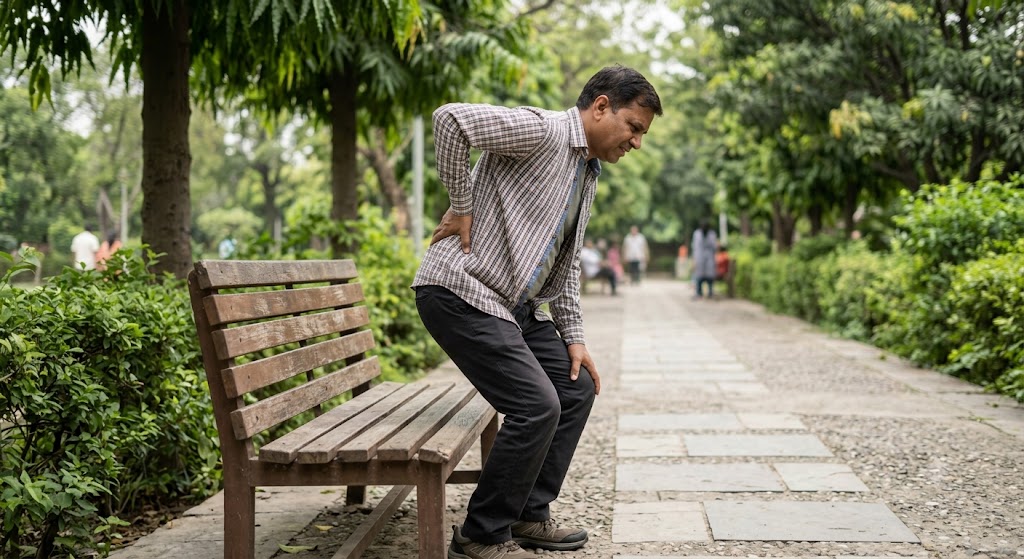
Knee ache on the way down stairs is usually eccentric quad load and higher joint force — not automatically cartilage wearing out with every step.

Going up is work. Coming down is a different kind of work. The step looks the same. Your knee often does not feel the same. A dull ache under the kneecap, a catch on the first few steps, or a protest that eases once you reach the landing is one of the most common “why only downstairs?” complaints in everyday life.
That pattern is usually a loading story, not a sudden failure story. Descent asks the thigh muscles to lower you under control. The joint sees higher compressive force than level walking. A knee that sat all morning, a quad that has not practiced lowering, or a kneecap that tracks under extra pressure can all file the same complaint.
What This Symptom Feels Like
People describe:
- Ache under or around the kneecap that shows up more going down than going up
- A sharp pinch on the first step after sitting
- Stiffness that eases after a few controlled steps
- The feeling that the knee might “give” even when it does not
- One side louder after a long drive, a desk day or a new pair of shoes
- More protest on steep or uneven stairs than on a gentle flight
- Soreness later the same day after a lot of descent
Pain that is brief, activity-related and calms with slower steps is a different signal from a knee that locks, swells overnight or cannot bear weight.
Common Causes
Stair descent is an eccentric task. The quadriceps lengthen while they contract so the body can lower instead of drop. Paul DeVita and colleagues measuring stair gait showed that descent loads the knee differently from ascent: the quads work as brakes, not only as lifters.
That braking raises contact force at the patellofemoral joint — the kneecap sliding in its groove. Thomas Andriacchi’s group mapped how stair tasks increase knee moments compared with level walking. A joint that spent hours flexed in a chair then meets that load without a warm-up is a common office-to-staircase pairing.
Other frequent contributors:
- A quiet vastus medialis and a kneecap that tracks with extra lateral pressure
- Limited ankle dorsiflexion that forces the knee to absorb more of the step
- Soft, flat or very stiff shoes that change how the foot meets the tread
- Recent increase in hills, stadiums, travel or apartment stairs
- A movie-theater or desk knee that already ached after sitting, then meets descent
Scott Dye’s “envelope of function” idea is useful here. The tissue can handle a range of load. A sudden stack of eccentric steps after a still day can sit outside that envelope without meaning the cartilage has failed.
Why Going Down Is Harder Than Going Up
Ascent is concentric. You shorten the quads to lift the body. Descent is eccentric. You lower a falling center of mass. Peak knee flexion is often greater. The kneecap is pressed into the femur over a longer arc.
Researchers including Bradford McFadyen and David Winter described the distinct motor pattern of stair walking decades ago. Later instrumented-stair work by Robert Riener and by Patrick Costigan confirmed that descent is not simply ascent in reverse. The joint kinetics change. So does the demand on control.
That is why a knee can feel fine on the way to the second floor and complain on the way back down. It is also why people with early patellofemoral irritation or mild osteoarthritis often name stairs — especially down — as the first daily task that argues.
Hidden Triggers
A few quiet habits make descent louder:
- Sitting with the knee bent past 90 degrees for a long commute, then hitting stairs immediately
- Looking at a phone while descending, which shortens the step and stiffens the trunk
- Skipping the handrail when control is the actual problem
- Only training the “up” of lunges and step-ups and never the slow lower
- Tight calves that steal ankle travel so the knee flexes more to reach the next tread
- A sudden week of airport stairs, stadium seats or a new walk-up
Evening stairs after a day of sitting often feel worse than morning stairs after a night of unloading. The joint has been flexed. The fluid has been still. The first eccentric demand is the complaint.
Related sitting and terrain stories live in why a knee can ache after a long sit and in why knees still expect turns, hills and mixed ground.
When to Worry
Most stair ache is mechanical and activity-tied. Get checked sooner if you notice:
- The knee locks and will not straighten
- Sudden swelling after a twist or a missed step
- Giving-way that is true collapse, not just a feeling of caution
- Pain at rest that does not ease after a day of easier loading
- Fever, redness and a hot joint
- Inability to walk on level ground after the stairs
- A recent fall or a pop followed by rapid puffiness
Those patterns are not explained by ordinary eccentric load. They need a clinician who can examine the joint, not another stretch video.
Myths vs Facts
Myth: Pain going down stairs means the cartilage is grinding away with every step.
Fact: Pain is a load-and-sensitivity signal. Imaging often shows wear in people with no stair pain, and stair pain in people with modest imaging changes. David Felson’s osteoarthritis work and Ewa Roos’s patient-reported stair items both treat function as more than a picture.
Myth: You should avoid stairs completely to save the joint.
Fact: Sudden high volume is unwise. Removing all descent removes the exact eccentric practice the quads and the joint need, in smaller doses, to stay capable.
Myth: Only “bad knees” hurt on the way down.
Fact: A healthy but deconditioned knee can ache after a still day plus a steep flight. Capacity is use-dependent.
Myth: A brace or a gel insert will fix the pattern by itself.
Fact: External supports can change comfort for a week. The durable change is usually slower descent, stronger lowering strength and more varied walking, which is the same lesson as why your quads still expect you to stand from the floor.
How to Manage It
Slow the first flight. Let the foot find the tread. Use the rail for control, not as a confession.
Practice the lower. A slow step-down from a low step, five to eight quiet repetitions, teaches the eccentric task without a full staircase. Kim Bennell’s exercise trials in knee pain keep coming back to quadriceps capacity plus graded exposure, not rest as a lifestyle.
Wake the joint before the stairs when you can. A minute of easy walking in the hallway is a better briefing than standing up from the chair and dropping onto the first step.
Check the ankle. If the heel cannot drop and the shin cannot travel forward, the knee takes the leftover motion. Calf length and simple ankle rocks on a step often change how the next flight feels.
Shoes matter more on stairs than on carpet. A slight heel-to-toe drop and a tread you trust beat a floppy slide or a brand-new stiff trainer.
Do not pile new stadiums, hiking descents and apartment stairs into the same week. Raise eccentric volume the way you would raise any other load.
When to See a Doctor
See a clinician if stair pain lasts more than a few weeks despite slower loading, if swelling returns, if the joint locks, or if you cannot trust the knee on level ground. A physical therapist who watches you descend is often more useful than another image alone. Urgent care is for a hot joint, a post-injury collapse or a knee that will not take weight.
FAQs
Why do my knees hurt going down stairs but not up?
Descent is eccentric. The quads lengthen under load and the kneecap sees higher compressive force. Ascent is a different motor task.
Is this the start of arthritis?
Not by itself. Early osteoarthritis can announce itself on stairs, but so can a deconditioned, recently sedentary knee. Duration, swelling and other joints help sort the two.
Should I take the elevator instead?
For a flare day, yes. As a permanent plan, no. Graded stair practice is usually part of getting the envelope of function back.
Does extra weight explain all of it?
Load matters. So does how you lower that load. People of many sizes have quiet stair pain after sitting weeks, and people of many sizes improve with control and capacity.
Can a weak hip make stairs louder?
Yes. Poor hip control lets the knee drift inward on the step, which raises demand on the kneecap and the inner joint. Hip and calf work often travel with quad work.
Will stretching the front of the thigh fix it?
A short stretch after sitting can ease the first step. Lasting change usually needs strength through the lowering phase, not only length.
Conclusion
A knee that argues on the way down is often a knee meeting a hard eccentric job after a still day. The joint was built for lowering as well as lifting. It was not built for eight hours of flexion and then a sudden flight of uncontrolled steps.
Slow the descent. Practice the lower. Give the ankle and the hip a share of the work. Keep walking on mixed ground. The complaint is common. It is also, in most people, trainable rather than tragic.