A sore outer hip after a night on your side is often pressure on the greater trochanter and the tendons that wrap it — not a worn-out joint. Learn why side sleeping loads that spot, when to worry, and how to sleep without waking stiff.
You roll out of bed and the first step feels like someone pressed a bruise into the side of your hip. The outer bone is tender. Sitting is fine. Walking after a few minutes is usually fine. Lying on that side again is not. The ache can linger through breakfast and then fade until the next night you drop onto the same shoulder of the pelvis.
A sore outer hip after side sleeping is extremely common. Most of the time it is not the ball-and-socket joint wearing out. It is pressure on a bony landmark called the greater trochanter and on the gluteal tendons and bursa that drape over it. Hours of body weight on a small contact patch is a mechanical problem, not a character flaw in the hip. What matters is whether the pain is only on the outside after lying on that side, how quickly it eases once you are upright, and whether night fever, true groin pain, or a sudden inability to bear weight join the story.
What This Ache Feels Like
A typical benign post-sleep outer-hip ache is:
- A bruise or “lying on a stone” feeling on the bony point at the side of the hip
- Worse when you roll onto that side or when someone presses the spot
- Easier after you stand, walk, and warm the area
- Louder on a firm mattress, a thin travel mattress, or a night with no pillow between the knees
- Sometimes a dull ache that travels a few centimeters down the outer thigh
- Not a deep groin pinch, locking, or giving-way of the joint itself
Clinics often call the broader pattern greater trochanteric pain syndrome. Older labels said “trochanteric bursitis.” Imaging and surgical studies later showed that the bursa is not always the main actor. The gluteus medius and minimus tendons that pass over the bone take a lot of the load, and a night of compression can make an already irritable tendon louder by morning.
This is a different story from hip tightness after a long day in a chair, which is more about shortened flexors than a compressed outer bone. That sitting pattern is covered in Is It Normal for Your Hips to Feel Tight After Sitting?. A snapping or clicking hip while you walk is another mechanical pattern again, described in Is It Normal for Your Hip to Click When You Walk?.
Why Side Sleeping Loads a Small Patch of Bone
When you stand or walk, the greater trochanter is a lever, not a cushion. Gluteus medius and minimus attach there so they can keep the pelvis level on one leg. When you lie on that side, the same landmark becomes a contact point. Body weight funnels through a few square centimeters of bone, tendon, and a thin bursa.
The mattress does not spread that load the way a standing foot does. A firm surface concentrates pressure. A very soft surface lets the pelvis sink and the top knee drop, which adds a stretch-and-compress twist to the same tendons. A pillow between the knees is not décor. It keeps the top hip closer to neutral so the outer structures are not cranked all night.
Angela Fearon and colleagues who mapped greater trochanteric pain found that tendon change around the trochanter is common in people with side-lying tenderness. Alison Grimaldi’s clinical work emphasizes the same anatomy: the outer hip is a tendon and compression problem at least as often as it is a “bursa only” problem. Neil Segal’s population studies showed how frequent outer-hip pain is in midlife, especially in people who already load the area all day and then compress it all night.
The hip joint itself — the ball in the socket — sits deeper and more toward the groin. Isolated outer tenderness after a night on that side is a poor match for classic osteoarthritis of the joint. Groin pain with rotation, morning stiffness that lasts an hour, or a limp that does not ease after a short walk is a different conversation.
Mattresses, Knee Drop, and a Day of Already-Tired Tendons
Side sleeping is not the only load. It is often the last load. A day of standing on one hip more than the other, a long walk on a cambered road, stairs, or a new running week can leave the gluteal tendons already sensitive. Eight hours of compression then feels like the cause because it is the moment you notice the bruise.
Common amplifiers include:
- A new firmer mattress or a guest-bed that is thinner than home
- Losing the knee pillow and letting the top thigh fall across the body
- Sleeping on a couch with a sharp edge under the hip
- Rapid weight change that alters how the pelvis meets the mattress
- A recent increase in walking or standing work that already taxed the same tendons
- Tight hip flexors from sitting, which change how the pelvis rests once you lie down
Desk days that leave the front of the hip short and the outer tendons doing extra stabilizing work often share the same week. Shoulder and neck tightness from the same desk posture can also make you guard and twist in sleep, which shifts more weight onto one hip. That upper-body pattern is covered in Is It Normal for Your Shoulders to Feel Tight From Desk Work?.
Hidden Triggers That Make the Outer Hip Louder
The same mattress can feel fine for months and then suddenly leave a bruise. Quiet contributors include:
- A week of more standing than usual, then the usual side-sleep night
- Crossing the top knee far forward so the pelvis rotates
- A wallet-less but still-lopsided daytime habit — always standing on the same leg in queues
- Pregnancy, when the pelvis is more mobile and side lying is often the only comfortable option
- A recent fall onto the side that bruised the trochanter and is still settling
- Very low body fat over the outer hip, so bone meets foam sooner
Bursae exist to let tendons glide. They do not enjoy being a mattress. Repeated compression can irritate the bursa, the tendon, or both. That is still a local soft-tissue problem. It is not proof the joint cartilage has failed.
When to Worry
See a clinician promptly if any of these show up:
- Pain that is mainly in the groin, not the outer bony point
- Inability to bear weight after a fall or a twist
- Fever, unexplained weight loss, night sweats, or a hip that is hot and red
- Pain that wakes you every night and does not ease at all once you are up and walking
- Numbness, weakness, or pain shooting past the knee in a clear nerve pattern
- A new limp that lasts more than a couple of weeks despite changing sleep position
True hip-joint problems, stress fractures of the femoral neck, referred pain from the lumbar spine, and rare infections or inflammatory disease can all pretend to be a “sore side hip.” Location and behavior still help. Isolated outer-point tenderness that tracks with side lying is usually mechanical. Groin pain plus rotation pain is more joint. Back pain plus leg symptoms is more spine.
Myths vs Facts
Myth: A sore hip after side sleeping means the joint is wearing out.
Fact: The tender spot is usually the greater trochanter and the tendons over it. Joint arthritis more often speaks from the groin and with rotation.
Myth: You must stop sleeping on your side forever.
Fact: Most people can keep side sleeping with a knee pillow, a slightly softer topper under the pelvis, and a habit of not dropping the top knee across the body.
Myth: If the bursa is irritated, you need an injection before anything else.
Fact: Load management, sleep-position changes, and gradual gluteal strengthening help many people. Injections are a tool, not the first sentence.
Myth: Stretching the outer hip hard every morning will fix it.
Fact: Those tendons often already spend the night compressed. Aggressive stretching can add insult. Gentle movement and strength through the mid-range usually serve better than forcing a split.
How to Make Side Sleeping Kinder
Small changes beat a new identity as a back sleeper.
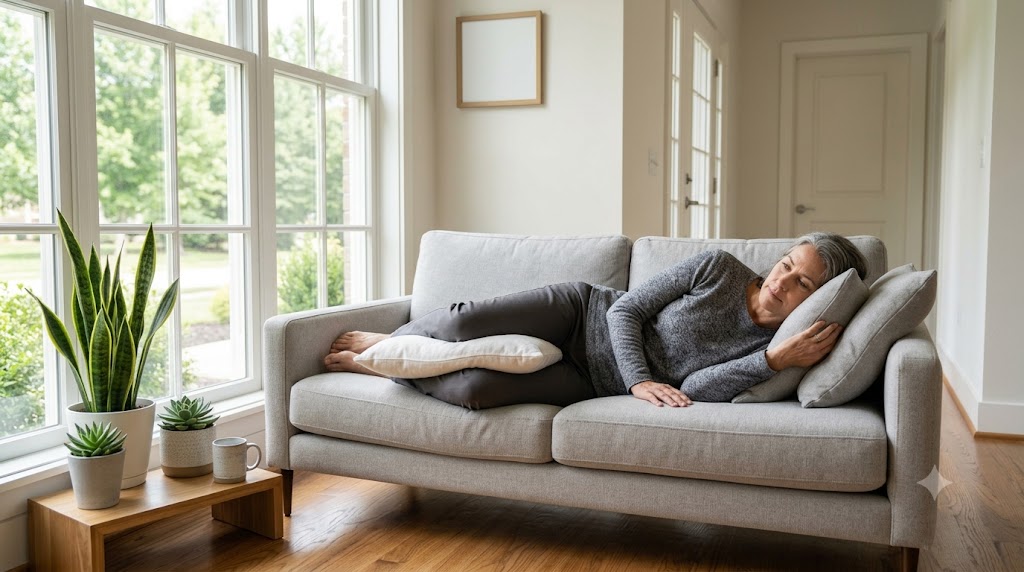
- Put a pillow between the knees so the top hip stays closer to stacked.
- If the mattress is very firm, a thin mattress topper under the pelvis can spread contact.
- Alternate sides through the night instead of parking on the already-sore one.
- Before lights-out, a few easy side-lying clam shells or standing hip abductions give the tendons a short, controlled load rather than only compression.
- During the day, stand on both feet in queues and take the stairs when you can, so the same muscles work as movers, not only as night-time shock pads.
- After you get up, walk before you stretch. Warm tissue complains less than cold compressed tissue.
If sitting all day is part of the week, stand and walk in short blocks. The hip that only ever folds in a chair and then compresses on a mattress never gets the varied load it was built for.
When to See a Doctor
Book a visit if the outer-hip bruise lasts more than two or three weeks despite a knee pillow and less side-lying on the sore side, if groin pain appears, or if walking stays painful after the first few minutes. A clinician can check for greater trochanteric pain syndrome, referred lumbar pain, and true joint disease. Imaging is not always required on day one. It becomes useful when the story does not match a simple compression pattern.
Physical therapy that targets gluteus medius control — not only stretching — is the usual first skilled step. That is the same family of muscles that keep the pelvis level when you walk. Night compression is easier to tolerate when the tendon is not already exhausted from a day of poor control.
FAQs
Is it normal for only one hip to hurt after side sleeping?
Yes. Most people have a preferred side. That side takes the hours. The other hip may feel fine until you switch.
Why does the pain fade after I walk for a few minutes?
Walking warms the tendons and moves fluid that sat still under pressure. A problem that eases with easy walking is a better mechanical sign than a problem that worsens with every step.
Can a new mattress cause this even if the old one never did?
Yes. Firmer foam or a guest-bed slat can raise peak pressure on the trochanter. The hip did not suddenly become fragile. The contact patch changed.
Does this mean I have bursitis?
Sometimes the bursa is irritated. Often the gluteal tendons are the louder tissue. The practical treatment overlap is large: reduce night compression, keep daytime load sensible, and strengthen the abductors.
Will sleeping on my back fix it immediately?
It removes the compression. Some people still feel residual tenderness for a few days. A week of mixed positions plus a knee pillow when you do lie on the side is a fair trial.
Can tight hip flexors from sitting make side-sleep pain worse?
They can change pelvic rest position and how the outer tendons are pre-tensioned. Loosening the front of the hip during the day often makes the night quieter without heroic stretching of the sore outer spot.
Conclusion
A bruised outer hip after a night on your side is usually a small bone and a pair of tendons doing a job they were not designed to do for eight still hours. The greater trochanter is a lever in walking and a pressure point in side lying. For most people the fix is mechanical: stack the knees, spread the contact, give those tendons some honest daytime work, and treat morning tenderness as a load signal rather than a verdict on the joint. Seek care when the pain lives in the groin, follows a fall, or refuses to ease once you are up and moving. Otherwise the hip that aches at dawn is often the same hip that will feel ordinary after breakfast — if the night stop compressing the same square centimeter every time.