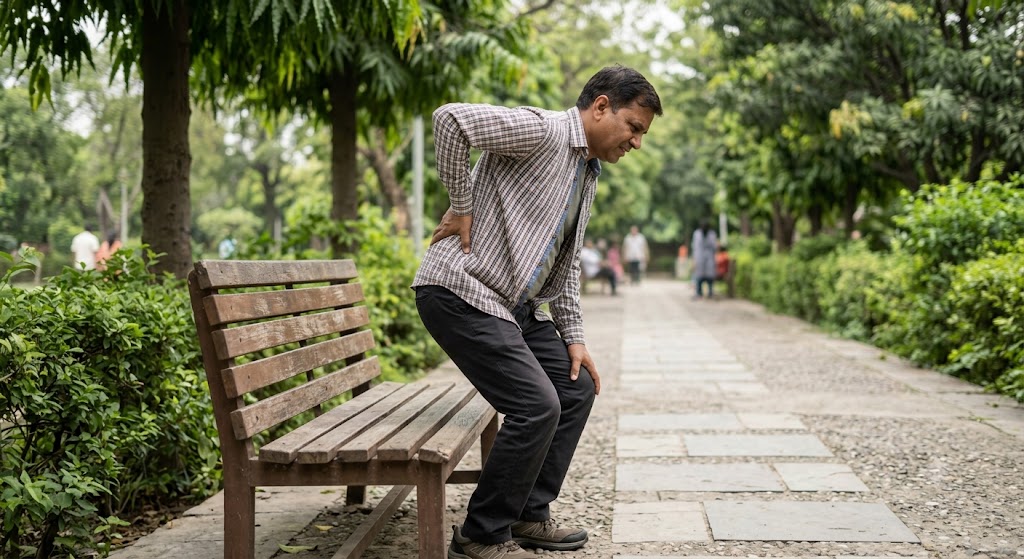
A painless snap or click at the front or side of the hip while walking is usually a tendon sliding over bone, not a joint falling apart. How Byrd, Lewis and Paluska mapped snapping hip — and when the sound is a red flag.

You take a step, swing the leg through, and something at the front or outside of the hip snaps. It can feel like a guitar string slipping off a fret. Sometimes you hear it. Sometimes you only feel it. It may happen once on the way to the kitchen and vanish, or it may punctuate every long stride on a walk. The mind reaches for the worst picture: cartilage tearing, a ball leaving its socket, a joint that is “going.”
A painless hip click or snap during walking is common enough that sports physicians and hip arthroscopists have a name for it — snapping hip, or coxa saltans — and a map of where the snap usually lives. Most of the time the joint itself is not coming apart. A tendon or the iliotibial band is sliding over a bony landmark and then dropping back with a thud. The useful skill is telling that mechanical slap from the smaller list of clicks that come with catching, giving way, or true inside-the-joint trouble.
What this snap actually is
The hip is a deep ball-and-socket joint. The femoral head sits in the acetabulum, sealed by a labrum and wrapped by a thick capsule. Outside that capsule sit the structures that make most walking clicks: the iliopsoas tendon at the front, and the iliotibial band or gluteus maximus tendon at the side. When one of those taut bands slides over a ridge of bone — the iliopectineal eminence or femoral head in front, the greater trochanter at the side — it can catch, stretch, and then release. The release is the click.
J. W. Thomas Byrd, who spent decades describing hip arthroscopy and extra-articular snapping, divided the pattern the way clinicians still do: external snapping at the greater trochanter, internal snapping at the front of the hip, and a much smaller intra-articular group that truly comes from inside the joint. Carl Lewis and others mapped the iliopsoas as it travels over the pelvic brim and the anterior hip capsule. Stephen Paluska and Douglas Schwenk reviewed the same taxonomy for sports medicine: most walkers who hear a snap have the extra-articular kind. The sound is loud because a taut band slapping bone conducts well through the pelvis. Loud is not the same as damaged.
This is a cousin of the painless knee pop on standing and of jaw clicking while you chew. Cavitation inside a joint can pop. A tendon flipping over a pulley can pop louder. Neither pop is, by itself, a diagnosis of arthritis.
Why walking brings it out
Walking is a repeated swing of the femur under a pelvis that is also rotating. At toe-off the hip extends. In swing it flexes, slightly adducts or abducts depending on the stride, and the pelvis drops a few degrees on the swing side. That combination drags the iliopsoas across the front of the joint and the IT band across the trochanter. If the band is a little tight, the trochanter a little prominent, or the psoas a little thickened from sitting-then-sprinting, the tendon can ride up and then drop. One clean step is enough.
The modern mix makes the geometry easier to catch. Hours in a chair shorten the front of the hip and leave the deep rotators and glute medius under-recruited. Then a walk, a hike, or a sudden longer stride asks the psoas to slide over a joint that has been parked in flexion. Dancers, hurdlers, and people who sit all day and then take a weekend trail are over-represented in clinics, not because the joint is exotic, but because the excursion is sudden.
A hip that still expects a deep fold and a varied stance does not get that fold from a desk chair. The capsule and the crossing tendons adapt to the range they are given. Give them a sudden full swing and the extra-articular bands are the first to announce the mismatch.
External, internal, and the rarer inside click
External snapping is the side-of-the-hip version. The IT band or the anterior edge of gluteus maximus catches on the greater trochanter as the hip moves from flexion toward extension. You can often reproduce it standing, by shifting weight and rolling the pelvis. Some people can make it happen on command. When it is painless, it is a mechanical curiosity. When the trochanteric bursa underneath is irritated, the same snap comes with side-lying tenderness and an ache after walking.
Internal snapping is the front-of-the-hip version. The iliopsoas tendon leaves the pelvic brim, crosses the iliopectineal eminence and the anterior femoral head, and can flick as the hip extends from a flexed, externally rotated position — the motion of standing from a low chair, climbing a stair, or finishing a stride. Byrd and colleagues showed that what patients call a “clunk in the groin” is often this extra-articular slide, not a labral tear, though the two can coexist.
Intra-articular clicks are the ones to take more seriously when they travel with pain. A torn labrum, a loose body, cartilage flaps, or femoroacetabular impingement can catch inside the socket. Those clicks usually come with a sharp pinch in flexion and rotation — putting on a sock, getting out of a car, pivoting on a planted foot — not only with an ordinary straight-ahead walk. The sound is less often a loud external slap and more often a deep catch you cannot make on purpose from the outside.
Hidden triggers that make a quiet hip noisy
A week of extra sitting followed by a long walk. New shoes or a wider stride on a trail. A sudden return to running after a rest. Sleeping with the hip fully flexed. A growth spurt in a teenager whose IT band has not caught up with femoral length. Hypermobility that lets the femur travel farther under a band that still has the same resting tension. Weak glute medius, so the pelvis drops and the IT band is asked to stabilize from a stretched position. A recent increase in hill work that repeatedly slides the psoas under load.
None of these mean the joint is failing. They mean the crossing tissues were given a new excursion before they were given time to glide quietly through it. The same logic that asks the IT band to meet sideways hills gradually applies here. Sudden range plus sudden mileage is how a silent tendon becomes a percussion instrument.
When to worry
See a clinician promptly if the click arrives with true giving way, a feeling that the hip is locking and will not come through the step, night pain that wakes you, fever, unexplained weight loss, or pain that shoots past the knee with back symptoms. A new snap after a fall, a tackle, or a dashboard injury is not the ordinary walking click. Pain that lives deep in the groin and is reproduced by flexion, adduction, and internal rotation — the impingement family of tests — deserves an exam, not a wait-and-see stretch plan alone. A child with a limp and a hip click needs a different workup than an adult walker; that is not a “tight psoas” default.
One loud painless snap that you can reproduce and that does not change your gait is usually extra-articular. A quiet, painful catch that changes how you climb stairs is a different sentence.
Myths vs facts
Myth: If the hip clicks, the joint is wearing out.
Fact: Extra-articular snapping is a tendon-on-bone event. Imaging of many loud, painless snap hips shows a structurally ordinary joint.
Myth: You should stop walking until the sound disappears.
Fact: Quiet, graded walking is often part of the solution. Rest that turns into days of sitting can shorten the same tissues that were catching.
Myth: Cracking the hip on purpose “relocates” it.
Fact: Habitual self-snapping can irritate the bursa or the tendon sheath. The ball is not out of the socket in ordinary coxa saltans.
Myth: A click always means a labral tear.
Fact: Labral tears can click, and they can also be silent. Pain, catching, and examination findings matter more than the soundtrack.
Myth: Only athletes get this.
Fact: Desk workers who take a long Saturday walk are a large share of the people who notice a new front-hip clunk.
What actually helps
Stop chasing the snap. If you can make it happen for fun, stop doing that. Give the crossing tissues a week of ordinary walking without extra stretching into the exact angle that produces the clunk.
Restore the ranges the hip was built to use, slowly. A supported deep squat or a box squat to a depth you can control, a short lunge that does not pinch, and easy hip-extension work off the floor teach the psoas to glide through flexion and extension without a sudden slap. Side-lying or standing hip abduction that actually asks glute medius to hold the pelvis cuts the extra drop that tightens the IT band against the trochanter.
Shorten the sitting block that precedes the walk. A two-minute stand and a few easy strides every hour is not a training plan. It is how you keep the front of the hip from parking in the position that makes the first outdoor step a snap. If hills or speed work started the noise, keep walking on flat ground for a stretch and add the hill back in smaller doses.
A brief period of relative rest from the specific trigger — dancing the same combination, sitting then sprinting — plus graded loading is the conservative core Byrd and sports-medicine reviews still start with. Injections and surgery exist for painful snapping that fails that plan. They are not the first answer to a painless walking click.
When to see a doctor
Book an exam if the snap is new and painful, if it is changing your stride, if groin pain lasts more than a couple of weeks, or if you have locking, giving way, or pain at night. A sports-medicine physician or physiotherapist who treats hips can often tell external from internal snapping on the table and decide whether you need imaging. Urgent care is for trauma, inability to bear weight, fever with hip pain, or a child who will not walk. Painless, long-standing, reproducible side-hip snapping that has not changed in years can be mentioned at a routine visit rather than treated as an emergency.
FAQs
Is a loud hip snap dangerous if it does not hurt?
Usually no. Volume tracks how taut the band is and how well bone conducts sound, not how torn the cartilage is. Pain, locking, and a changed gait are the better alarms.
Why does it happen more after I sit all day?
Sitting holds the hip flexed. The iliopsoas stays short. The first extended strides of a walk then drag that tendon over the front of the joint. A mid-day stand-and-walk often quiets the evening clunk.
Can I click my hip back into place?
In ordinary snapping hip the ball is already in the socket. Forcing the snap can inflame the bursa. Treat it as a tendon slide, not a dislocation.
Does this mean I have hip arthritis?
Not by itself. Arthritis can stiffen and sometimes grind. A clean, painless extra-articular snap in a young or middle-aged walker is a different mechanism. Arthritis is diagnosed by pain pattern, exam, and imaging when those are indicated — not by a soundtrack on a sidewalk.
Should I stretch my hip flexors hard?
Aggressive end-range stretching into the exact angle that snaps can irritate the psoas as it slides. Gentle, frequent movement through a comfortable range plus glute strength is usually kinder than a long forced lunge hold.
When is surgery discussed?
When painful extra-articular snapping persists after a serious stretch of load management, strength, and, when appropriate, imaging that has ruled out an intra-articular source worth treating first. That is a specialist conversation, not a first-line plan for a painless walk-click.
Conclusion
A hip that clicks on a walk is usually announcing a tendon crossing a ridge of bone, not a joint coming undone. The sound is old anatomy meeting a modern day of sitting and then suddenly striding. Let the snap be information: restore a little extension, a little side-hip strength, and a little less time parked in flexion, and most extra-articular clicks fade into the background of an ordinary gait. Keep the rare painful catch on a short list of things worth examining. The rest is a noisy pulley, not a broken socket.