Tight, high, or burning shoulders after desk work are usually a long isometric hold of the upper trapezius and a quiet rotator cuff, not automatically a torn tendon.
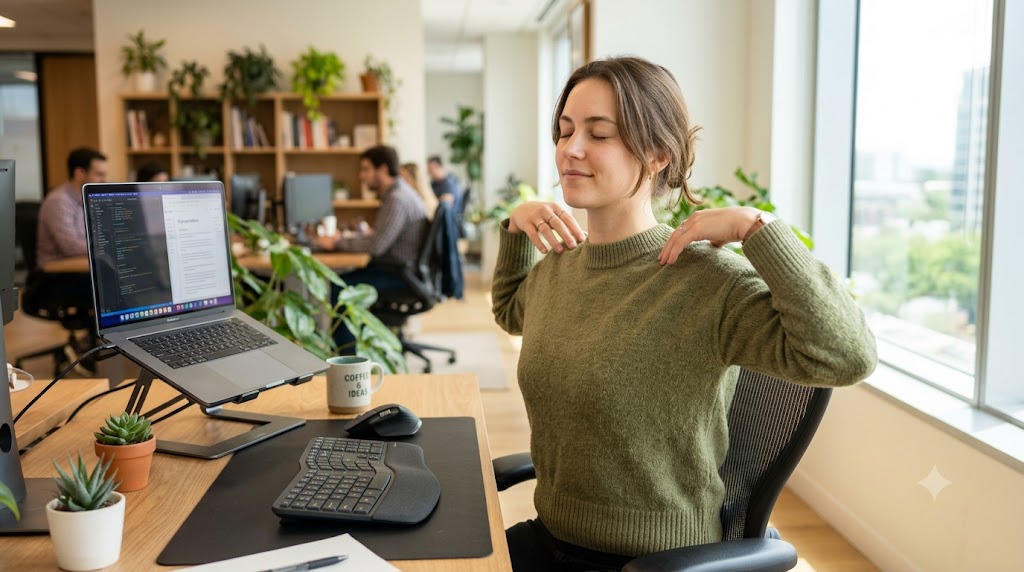
You finish a block of email and notice your shoulders have crept up toward your ears. The tops of them feel dense. The space between neck and shoulder blade burns. Rolling them backward gives a brief, satisfying stretch and then the tightness returns as soon as the next sentence needs typing.
That pattern is one of the most common office complaints in the world. It is usually not a sudden tear. It is a long, quiet isometric hold in muscles that were built to lift, carry and reach — and then a sudden request that they let go.
What This Symptom Feels Like
People describe:
- A band of tightness across the tops of both shoulders by mid-afternoon
- A “hanger” or coat-hook feeling where the neck meets the shoulder
- A dull burn between the shoulder blades that eases when you stand and reach
- One side tighter than the other after a mouse-heavy day
- A sense that the shoulders will not drop even when you tell them to
- Occasional clicking when you roll the joint after hours of stillness
- A headache that starts at the base of the skull after a long keyboard session
The feeling often arrives without a dramatic moment. You did not lift a suitcase. You sat still.
Common Causes
The everyday version is a stack of small loads.
A long isometric hold. Upper trapezius, levator scapulae and the cervical extensors stay slightly “on” to hold the head and shoulder girdle over a keyboard. Isometric work does not look like exercise, but it still costs blood flow and leaves the muscle short and irritable. Work by Veiersted, Westgaard and Andersen on office neck-shoulder pain showed that even low-level continuous activity, without rest gaps, tracks with end-of-day tightness.
Forward reach and a quiet rotator cuff. Typing and mousing keep the arms in front of the body. The small muscles that center the ball in the socket — the rotator cuff that still expects reaching behind and overhead — spend the day in a short, under-varied range. Physical therapists such as Shirley Sahrmann and researchers of scapular control such as Ann Cools and W. Ben Kibler have described how a protracted, downwardly rotated shoulder blade changes the resting length of the cuff and the upper trapezius.
A raised shoulder “set.” Many people park the shoulder a few millimeters higher on the mouse side. The brain treats that as the new floor. By 4 p.m. the set point feels like the only available posture.
Screen height and arm support. A laptop on a dining table, a chair without armrests, or a desk that is a few centimeters too high all ask the same muscles to hover. The load is small. The duration is not.
Stress and breath. When attention narrows, the ribs lift and the upper trapezius joins the breathing pattern. A tense afternoon can look identical to a poorly fitted desk.
The same shoulders that feel tight after a document can feel loose after a walk with swinging arms. The tissue did not fail. The input changed.
Why This Happens
Shoulder muscles are not built for hours of mid-range stillness.
Upper trapezius can shrug a load and stabilize the shoulder blade during a carry. Levator scapulae can help lift and rotate the blade. Mid-back muscles such as the rhomboids can retract the blade during a pull. None of those jobs is “hold 8% of maximum for three hours while the hands stay on a flat plane.”
When a motor unit stays recruited without a pause, local metabolites collect, blood flow through the muscle is less rhythmic, and the muscle spindle — the stretch sensor — starts to report a shorter resting length as normal. That is why “just relax your shoulders” often fails at 5 p.m. The nervous system has updated the map.
There is also a blood-flow story. Low-level continuous activity reduces the small rest gaps that normally let capillaries refill. People who type with almost no micro-pauses tend to report more end-of-day trapezius tightness than people whose EMG traces show brief, frequent quiet moments — a finding that shows up repeatedly in occupational studies of visual display work.
The joint itself is usually innocent. A painless click when you finally roll the shoulder is often a tendon sliding or a small cavitation after stillness, the same family of sounds described in other joints after sitting. Pain that appears only after hours of hover is more often muscle and tendon load than a structural emergency.
A related pattern is the stiff neck that follows phone flexion. The shoulder version is the same family of problem one joint lower: a long isometric in a flexed, forward world. You can read more about the neck version in Is It Normal to Get a Stiff Neck From Looking at Your Phone?.
Less Common but Serious Causes
Most desk tightness is mechanical and reversible. A smaller list needs a different response:
- Sudden shoulder pain after a fall, a yank, or a night of sleeping on a dead arm
- Weakness: you cannot lift the arm, pour from a kettle, or reach a high shelf
- Night pain that wakes you when you roll onto that side and does not ease when you change position
- Pain that shoots below the elbow with numbness in a specific finger pattern
- Swelling, heat, fever, or a red joint
- Pain after a seizure, a new sport with heavy overhead work, or a recent vaccination that is still worsening after several days
- A history of cancer, unexplained weight loss, or pain that is worse at rest than at the desk
Referred pain from the neck, a true rotator-cuff tear, calcific tendinitis, adhesive capsulitis, and cardiac or gallbladder pain that “lives” in the shoulder are all less common than desk tightness — and they do not behave like a muscle that eases when you walk around the block.
Hidden Triggers
A few extras make an ordinary desk day feel worse:
- A laptop used as the only computer, so the screen is too low and the shoulders shrug to see it
- A mouse that sits too far forward, so one shoulder stays reaching
- Phone-cradling while you type
- A bag always on the same shoulder on the commute, then a desk that never unloads that side
- Cold air-conditioning on the upper back, which makes people hike the shoulders without noticing
- Glasses with a small laptop-friendly zone that pulls the head and girdle forward
- Strength training that is only pressing, with no hanging, rowing or reaching behind
- Clenching the jaw during concentration — the same session that tightens the neck often tightens the shoulder
The trapezius still expects a pack, a reach and a swing, not a floating keyboard. That mismatch is the same story told from the mid-back in Why Your Trapezius Still Expects a Pack on Your Back.
When to Worry
Seek care promptly if tightness comes with:
- True weakness or a sudden inability to lift the arm
- Pain after trauma
- Numbness, tingling or color change in the hand that does not clear when you change position
- Chest pain, breathlessness, jaw pain or sweating with shoulder discomfort
- Fever, a hot swollen joint, or pain that is steadily worse at rest
- Symptoms that climb week after week even after you change the desk and start moving
Ordinary tightness that blooms after a long sit and fades with a walk, a hang from a bar, or a night of better arm support is in a different category.
Myths vs Facts
Myth: Tight desk shoulders mean the rotator cuff is torn.
Fact: Tears are usually accompanied by night pain, weakness or a specific painful arc. End-of-day density after typing is far more often load and posture than a tear.
Myth: You need a perfect ergonomic chair before anything will change.
Fact: A slightly better screen height, the mouse closer to the body, and two minutes of reaching every half hour often beat an expensive chair used in the same shrug.
Myth: Stretching the upper trapezius for ten minutes will fix it.
Fact: A stretch feels good because it changes spindle input. If you return to the same hover, the set point comes back. You also need the opposite job: depression of the blade, retraction, and overhead or behind-the-body reach.
Myth: The pain is “just stress,” so the desk does not matter.
Fact: Stress can raise the shoulders. So can a desk that is too high. Both can be true at once.
Myth: If an X-ray is normal, nothing is wrong.
Fact: Muscle and tendon load do not show on a plain film. A normal image does not mean the feeling is imagined.
How to Manage It
Drop the shoulder on purpose, often. Every time you send an email, let both shoulders fall and take one slow exhale. Frequency beats a heroic stretch at 6 p.m.
Bring the work to you. Keyboard and mouse close. Elbows near the ribs. Screen so the top third is near eye height. If you use a laptop, a cheap stand plus a separate keyboard is more useful than a new chair.
Give the blade a job it recognizes. Two or three times a day: stand, reach both arms overhead as if putting a box on a high shelf, then reach one arm behind you as if taking a wallet from a back pocket. The rotator cuff still expects that behind-the-body reach. The background is in Why Your Rotator Cuff Still Expects Reaching Behind.
Hang or hang-approximate. A bar, a tree branch, or even holding a door frame and sitting the hips back unloads the upper trapezius and asks the shoulder blade to rotate up — the motion desk work never requests.
Walk the hall with swinging arms. A five-minute loop is not cross-training. It is the missing rest gap in the EMG trace.
Unmatch the mouse side. Switch the mouse for a block if you can, or move it closer and lower. A laptop trackpad used for hours with one shoulder internally rotated is a reliable one-sided trigger.
Warm the area if the room is cold. A light layer on the upper back reduces the unconscious shrug that air-conditioning produces.
Train the missing directions, not only the sore one. Rows, face-pulls, farmer carries and slow wall slides usually help more than endless upper-trap stretching. Load should rise gradually. Sudden heavy pressing on already irritable tendons is a common weekend mistake.
Check the neck and the low back in the same week. A flexed cervical posture and a slumped lumbar posture often arrive as a set. Sitting-day back ache is a sibling problem: Is It Normal for Your Back to Hurt After Sitting All Day?.
When to See a Doctor
Book a clinician if tightness lasts more than a few weeks despite a better desk and regular reaching, if one side is clearly weak, if night pain dominates, or if nerve symptoms travel into the hand. A physical therapist who looks at scapular control and cervical motion is often the most useful first stop. A physician visit is the right first stop after trauma, with chest symptoms, or with fever and a hot joint.
Imaging is a tool, not a first reflex. Many mid-life MRI scans show cuff “fraying” that has nothing to do with today’s desk burn. History and a strength exam still lead.
FAQs
Why is only my mouse-side shoulder tight?
That arm spends more time reaching and internally rotating. The other side still types, but it does not hover over a device that sits six inches too far forward.
Can a standing desk fix this?
It can help if you actually change arm position and take reaching breaks. Standing with the same shrugged laptop posture just moves the isometric to a new height.
Is a massage useful?
A massage can lower spindle gain and feel like relief. It does not replace the missing reaching and hanging. Use it as a reset, not as the entire plan.
Why does the tightness come back the next morning after I felt loose last night?
Overnight the shoulders rest in a shortened desk-like position for some sleepers, and the first hour of sitting rebuilds the set point quickly. Morning reaching plus a better first-hour setup usually flattens that rebound.
Does this mean I should stop lifting weights?
No. Varied loading is part of the fix. Avoid a sudden spike in overhead pressing while the area is irritable, and keep rows and carries in the week.
Can kids get this from tablets and homework?
Yes. The same hover exists at a kitchen table. The same rules apply: raise the screen, bring the device closer, and interrupt with reaching and outdoor play.
Conclusion
Tight shoulders after desk work are usually a long, quiet hold in muscles that were built to lift, carry and reach behind you. The joint is often fine. The day was not varied enough for the map the nervous system keeps of “normal shoulder height.”
Bring the keyboard closer, drop the shoulders on a schedule, and give the blade a few jobs it still recognizes — overhead, behind the body, a walk with swinging arms. The burn that feels structural at 4 p.m. is, most days, a posture the body can unlearn as fast as it learned it.