Hip tightness after a long sit is usually shortened flexors, a quiet posterior chain and a first-step protest — not automatically arthritis or a labral tear.
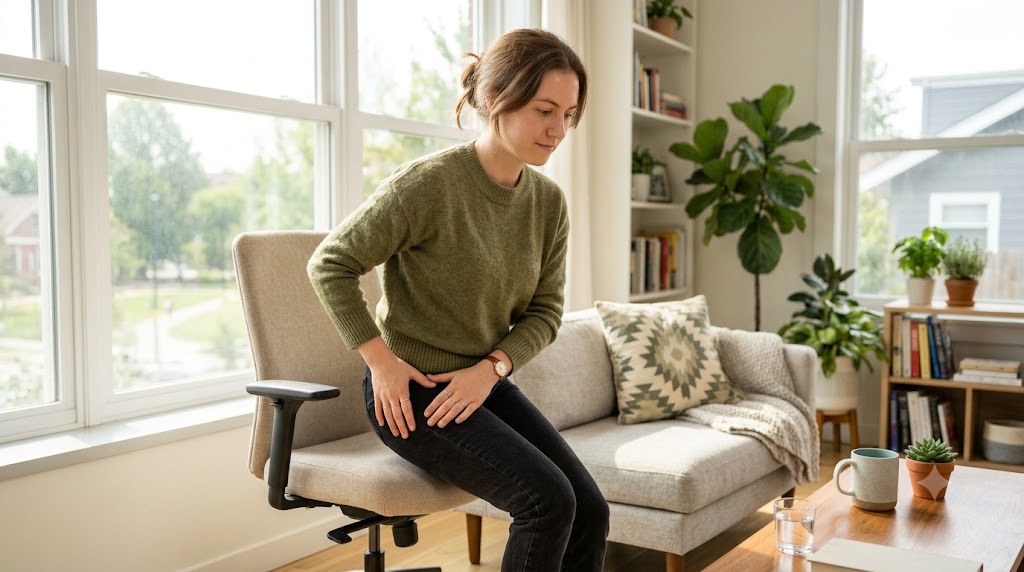
You stand up from the chair and the front of the hips feel short. The first few steps are stiff. Straightening up takes a second you did not budget for. Sitting back down feels like folding into a crease that has already been used all afternoon.
That protest is one of the most common office and car sensations in modern life. It is usually not a sudden cartilage failure. It is a joint and a set of muscles that spent hours in a folded position they were built to visit — not to live in.
What This Symptom Feels Like
People describe:
- A tight band across the front of the hip crease after a long sit
- Stiffness that eases after a minute of walking
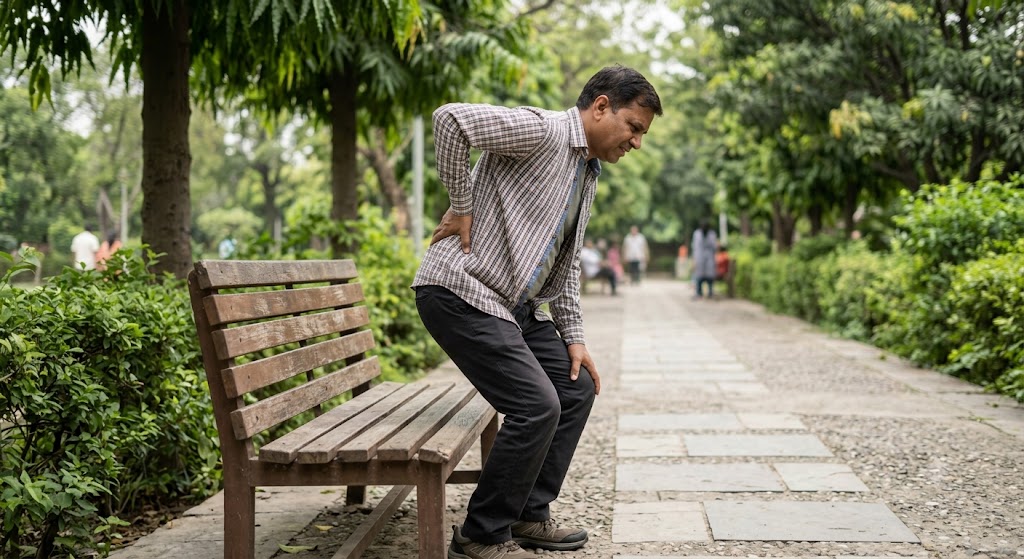
- A pinchy feeling when you first extend the hip or take a long stride
- One side tighter than the other after a wallet, a crossed-leg habit or a driving foot
- A dull ache in the front of the thigh that is not quite a quad cramp
- Difficulty standing fully upright for the first few steps
- A “stuck” sensation when you try to lift the knee high after sitting
The feeling often arrives without a twist or a fall. You sat. Then you stood.
Common Causes
The everyday version is a stack of quiet, reversible loads.
A long fold at the hip. A typical chair parks the hip near 90 degrees of flexion. The iliopsoas and rectus femoris sit in a shortened position. Shirley Sahrmann’s work on movement impairment and decades of clinical observation of “lower crossed” patterns described by Vladimir Janda both point to the same everyday result: muscles left short become reluctant to lengthen on the first demand.
A quiet backside. While the front of the hip is folded, the glutes and deep hip rotators do almost no work. Standing then asks those muscles to produce force from a cold start. The first steps feel wooden because the posterior chain was not briefing the joint.
A lumbar spine that was doing the hips’ job. Sitting often slumps the low back and tucks the pelvis. When you stand, the hips are asked to extend while the spine is still flexed. That mismatch shows up as a pinch in the crease and an ache that people blame on the hip when part of the story is the sit described in Is It Normal for Your Back to Hurt After Sitting All Day?.
A short first stride. After hours of flexion, the hip flexors resist the long walking stride they were built for — the same mismatch covered in Why Your Hip Flexors Still Expect a Long Stride. The tightness is the muscle reporting a sudden stretch after a long nap.
Heat, swelling and stillness. Synovial fluid in the hip moves with compression and glide. A still, flexed joint is a colder joint. The first steps are a warm-up the chair never provided.
Asymmetry you stopped noticing. A wallet under one cheek, a habitual cross of one ankle, a driving hip that stays slightly more flexed than the passenger hip — all bias one capsule. The tight side is often the one that sat “almost the same” for years.
The same hips that feel locked at 5 p.m. often feel ordinary after a walk around the block. The tissue did not fail. The input changed.
Why This Happens
The human hip is a deep ball-and-socket joint built for walking, squatting, climbing and changing direction. Daniel Lieberman’s work on endurance walking and running, and Donald Neumann’s descriptions of hip muscle mechanics, both underline how much the joint expects repeated extension and a deep fold — not a single mid-range park.
In a chair, the femur sits in the front of the socket more than it does in a standing stride. The anterior capsule and the iliopsoas tendon share a crowded neighborhood. After a long sit, extending the hip can feel pinchy even when imaging would look ordinary. The pinch is often the capsule and tendon reporting a sudden change of neighborhood, not a labrum that tore while you answered email.
Muscle length is also a nervous-system story. Stretch tolerance research associated with Malachy McHugh and others shows that “tightness” after stillness is often protective tone, not a tape-measure that shrank overnight. Walking, gentle extension and a few bodyweight sit-to-stands usually restore the range faster than a heroic stretch held in a painful crease.
There is a disc-and-hip conversation too. Alf Nachemson, Hans-Joachim Wilke and Michael Adams mapped how sitting raises load in the lumbar discs. A spine that stayed flexed asks the hips to do a sudden extension job they were not warmed for. That is why hip tightness and low-back stiffness so often clock out together, and why walking — the input in Why Your Spine Still Expects You to Walk More Than You Sit — eases both.
The joint surface itself is usually the last thing to blame. Articular cartilage likes compression and glide, not a static fold. Ache after sitting that walks off is more often capsule, tendon and motor control than a sudden case of arthritis.
Less Common but Serious Causes
Most post-sit hip tightness is mechanical and reversible. A smaller list needs a different response:
- Pain that shoots into the groin and will not walk off after a few minutes
- Night pain that wakes you, or pain that is worse lying on that side
- A true limp, giving-way, or a hip that locks and will not unlock
- Fever, unexplained weight loss, or a hip that is hot and swollen
- Pain after a fall, a twist, or a sudden pop
- Numbness, saddle anesthesia, or bowel and bladder change — emergency territory, not a tight flexor
- Progressive loss of rotation so you cannot put on socks or get in a car
Those patterns can reflect labral injury, femoroacetabular impingement that has become symptomatic, inflammatory arthritis, avascular necrosis, infection, or referred pain from the lumbar spine or sacroiliac joint. Tightness that is only a first-step protest after a meeting is a different category.
Hidden Triggers
A few ordinary habits make the crease feel shorter than the clock says it should:
- A chair that is too high, so the hips stay more flexed than 90 degrees
- A seat that slopes back and tucks the pelvis
- Crossing one thigh over the other for a whole call
- A thick wallet or phone in a back pocket
- Driving with the seat too close, so the working hip never quite extends
- Standing up in a rush from a deep sofa
- Stretching the front of the hip aggressively into a pinch instead of easing into a walk
- A day of sitting followed by a sudden long walk in a stiff pair of shoes
None of these is a moral failure. They are inputs a folded joint notices.
When to Worry
Seek care promptly if tightness comes with:
- Groin pain that is sharp, constant, or worse at night
- A limp that lasts more than a few days
- Clicking or catching with pain, not just a painless slide
- Inability to bear weight
- Pain after trauma
- Fever or feeling systemically unwell
- Neurological symptoms in the legs or saddle area
Painless stiffness that walks off in under two minutes after most sits is a much calmer story.
Myths vs Facts
Myth: Tight hips after sitting mean you have arthritis. Fact: Osteoarthritis can stiffen a hip, but first-step tightness that eases with walking is far more often shortened flexors and a cold capsule.
Myth: You need a long, painful hip-flexor stretch at the desk. Fact: Aggressive end-range stretching into a pinch can irritate the anterior structures. A walk and gentle standing extension usually do more.
Myth: One tight hip means the joint is “out.” Fact: Asymmetry from sitting habits is common. The hip is not a door that popped off its hinge during a spreadsheet.
Myth: If imaging is clean, the tightness is imaginary. Fact: Muscle tone, capsule stiffness and motor control do not always photograph. The sensation can be real and still benign.
Myth: Standing desks fix tight hips automatically. Fact: Standing still in one place is not the same as walking. The hip still wants change of position, not a new statue.
How to Manage It
You do not need a perfect office. You need to interrupt the fold.
Stand before the hip files a complaint. A brief stand every 20–30 minutes is more useful than one heroic stretch at 6 p.m.
Walk the first minute. Do not stretch into a pinch from a cold sit. Take an easy 60–90 second walk and let the stride lengthen itself.
Open the hip without yanking it. A gentle standing lunge with the pelvis tucked slightly — not a huge backbend — is enough. Stop short of groin pinch.
Un-tuck the wallet. Sit on both sit bones. Take objects out of back pockets.
Raise or lower the chair. Hips slightly higher than knees is often kinder than a deep fold. A footrest can help if the chair is too high.
Use sit-to-stands as the warm-up. Five slow chair stands before a walk cue the glutes that the meeting is over.
Change the drive. Slide the seat back a notch if you can still reach the pedals safely. Unlock the working hip between errands.
Give the joint a deep fold on purpose. A comfortable squat to a low stool, or sitting on the floor for a few minutes, is the range the chair never asked for — the idea behind Why Your Hips Still Expect a Deep Fold.
If tightness lasts weeks, a physical therapist who looks at gait, squat and single-leg stance can tell flexor tone from a joint that needs imaging.
When to See a Doctor
Book an appointment if:
- Tightness is becoming pain that limits walking or sleep
- One hip is clearly worse and not easing over two weeks of walking breaks
- You have a history of childhood hip disease, steroid use, or heavy alcohol use and new groin pain
- You cannot rotate the hip enough for shoes and socks
- There are red-flag symptoms from the list above
Bring notes on when it started, which positions help, and whether the first steps still loosen it. That timeline is more useful than a single painful stretch in the waiting room.
FAQs
Is it normal for hips to feel tight after sitting? Yes, for many people. A long fold shortens the flexors and stills the capsule. Tightness that walks off is common and usually mechanical.
Why is only one hip tight? Driving, crossing a leg, a wallet, or a preferred sit bone can bias one side. True one-sided night pain or a limp still deserves an exam.
Should I stretch my hip flexors every hour? Short, gentle standing extension or a brief walk is safer than repeated aggressive stretching into the crease.
Can sitting give me hip arthritis? Sitting is not a proven fast track to osteoarthritis by itself. What sitting does well is make unused range feel like tightness. Lifelong movement still matters for joint health.
Why do my hips feel better after a walk and worse after a long movie? Walking loads and glides the joint. A long sit does the opposite. The difference is input, not a joint that only works outdoors.
Does a standing desk solve this? It can help if you also shift, walk and sit in other shapes. Standing still in one lock is another version of stillness.
Conclusion
Hips that feel tight after sitting are usually doing something honest. They spent the afternoon in a fold they were built to visit, then were asked to stride as if the fold had never happened. The first stiff steps are a protest, not a verdict.
Give the joint a reason to extend. Stand before the crease files a complaint. Walk the first minute instead of stretching into a pinch. Sit on both bones and take the wallet out of the pocket. The goal is not a heroic stretch. It is a hip that still remembers how to fold and how to open — in the same day, on purpose.