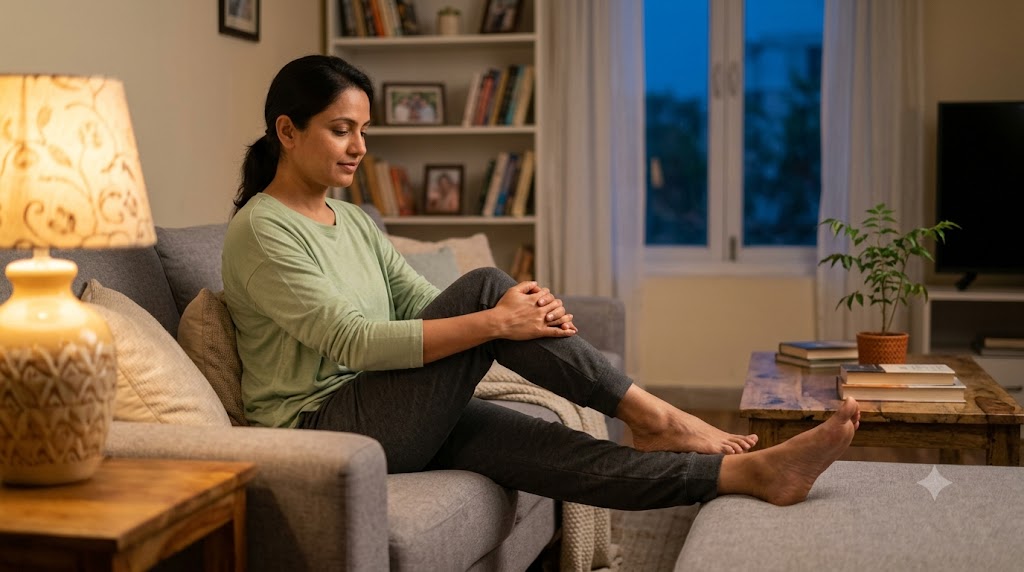
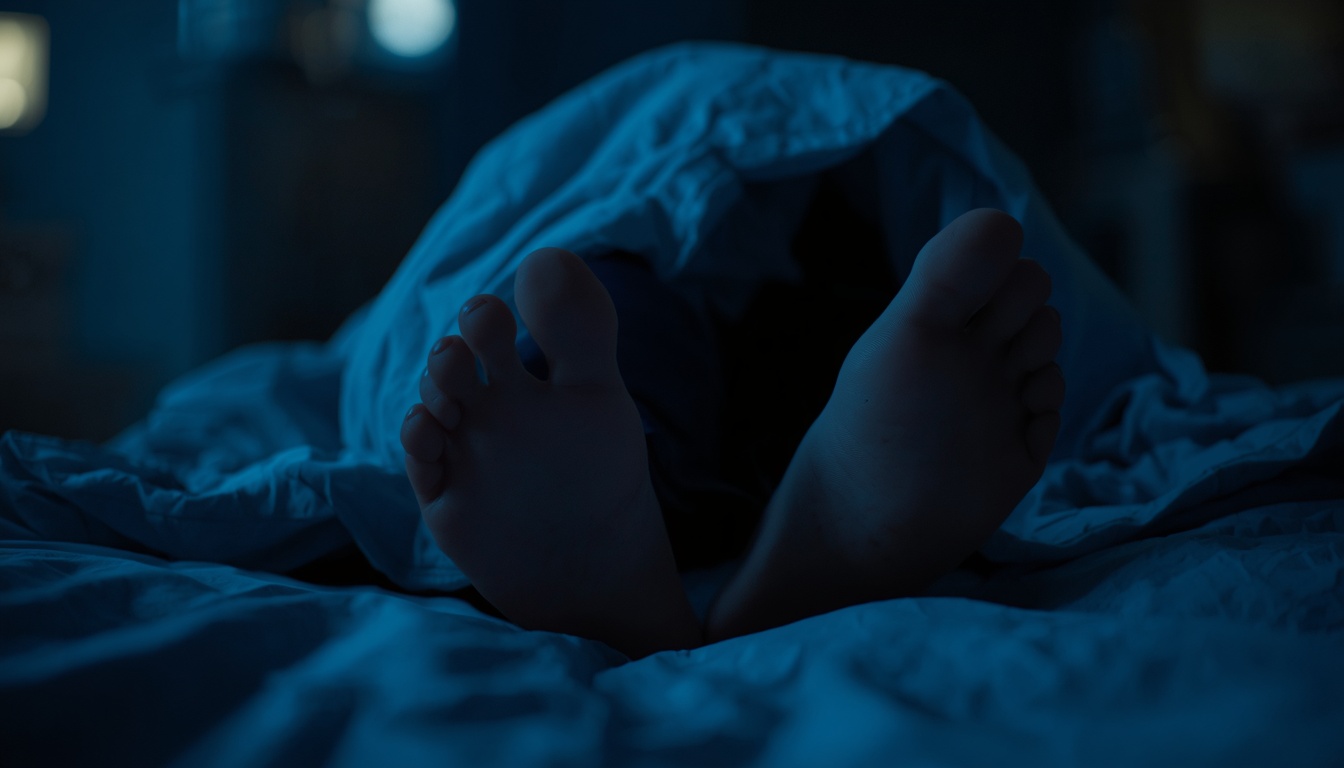
You get into a bed that felt fine ten minutes ago. The sheets are not icy. The room is not a cellar. Your torso is already warm. Your feet are not. They stay cool against the mattress, or they steal heat from a partner’s calves and still feel like two small stones. You wait. Sleep does not arrive as quickly as it should.
That mismatch — a warm core and cold distal skin at lights-out — is one of the most quietly studied sleep problems in human thermophysiology. It is not automatically “bad circulation.” It is often a failure of the evening program that is supposed to open heat-dumping shunts in the hands and feet so core temperature can fall and the brain can cross the sleep gate.
What This Symptom Feels Like
The pattern is distal and stubborn.
Toes cool first. The soles follow. The rest of the body may already feel ready for sleep. Color is usually normal or only slightly pale; a full white-blue-red Raynaud sequence is a different story. Some people feel a light ache or a pins-and-needles film as flow stays low. Others feel only temperature — the covers never quite catch up.
The sensation is worse at the start of the night than at 3 a.m. Once sleep finally comes, the same feet often warm. That timing is a clue. The problem is not that the bed cannot hold heat. The problem is that the vessels that should have opened before sleep did not.
People with this pattern also tend to take longer to fall back asleep after a nocturnal awakening. The same distal vessels have to reopen.
Common Causes
Most everyday cold-foot nights sit in a few buckets.
Failed evening distal vasodilation. Kurt Kräuchi, Christian Cajochen, Esther Werth, and Anna Wirz-Justice showed that the distal-to-proximal skin-temperature gradient — how much warmer the hands and feet are than the trunk — is a better predictor of sleep-onset latency than core temperature, melatonin timing, or how sleepy you say you feel. Warm feet shorten the wait. Cold feet lengthen it.
A cool bedroom that the core can tolerate and the feet cannot. Distal arteriovenous anastomoses (AVAs) in the soles are exquisitely temperature-sensitive. A room that feels fine on the chest can still keep those shunts shut.
Vasospastic tendency. In 2001, Martina Pache and colleagues in Basel reported that people with primary vasospastic syndrome — cold hands and feet and an exaggerated response to local cold — had longer sleep-onset latency at night and after a waking. The sleep complaint was not “insomnia in general.” It was getting into sleep.
Anxiety, rumination, or a still-running day. Skin sympathetic vasoconstrictor bursts to glabrous skin (palms and soles) fire on emotion and mental effort, the same circuit that cools the hands when you are anxious. A mind that has not stood down keeps the foot shunts closed.
Lying down too soon after a large late meal, bright light, or a workout. Those inputs raise heat production or delay the circadian signal that normally opens distal vessels in the evening.
Age. Eus van Someren and others have argued that some later-life sleep-onset trouble is, in part, a thermoregulatory problem: the evening heat-loss cascade is blunted, so the feet stay relatively cool and the core drop is shallower.
Nicotine, some beta-blockers, and a cold floor just before bed. Anything that adds sympathetic tone or a last local cold stimulus makes the first twenty minutes under the covers harder.
None of these require arterial disease. The foot is a radiator with an off switch. The switch is still on.
Why This Happens
Human sleep is timed, in part, by a heat-loss maneuver.
Core body temperature falls across the evening. Jürgen Aschoff mapped the architecture of that fall decades ago: heat production declines, and heat loss from the shell rises. The most efficient radiators are the hands and feet. Glabrous skin there is packed with AVAs — short, densely innervated shunts between arterioles and venules. When they open, a large volume of warm arterial blood bypasses capillaries and dumps heat. When they stay closed, heat stays in the core and the brain is slower to accept sleep.
Kräuchi’s group measured this as the distal–proximal gradient (DPG). In a modified constant-routine protocol that still allowed a nocturnal sleep episode, DPG in the ninety minutes before lights-out beat every other candidate variable as a predictor of how long it took to fall asleep. Interventions that opened the feet — a warm bath, a carbohydrate-rich evening meal in some protocols, melatonin — shortened sleep-onset latency. Interventions that left the feet vasoconstricted lengthened it.
Melatonin is part of the evening opening. When it rises, distal vessels tend to dilate. That is one reason dim light and a consistent dusk help more than a darker bedroom at midnight. Peretz Lavie described a circadian “sleep gate.” Distal vasodilation looks like one of the gate’s physical correlates.
Why does opening the feet help the brain sleep? Two linked reasons.
First, heat leaving the shell lets core temperature fall. Sleep propensity tracks that falling limb more closely than the absolute number on a thermometer.
Second, the act of lying down, turning the lights off, and relaxing itself evokes distal vasodilation. Kräuchi later framed sleep inertia on waking as the reverse: lights-on and standing close the same vessels. Cold feet at bedtime are the evening version of a body that has not completed the relaxation-and-heat-loss step.
The same AVAs are under dual control. Local skin temperature can override them. So can skin sympathetic nerve activity — the bursts B. Gunnar Wallin and colleagues recorded in nerves to glabrous skin. A cool sole plus a still-alert cortex is a reliable way to keep the radiator shut.
This is why a hot-water bottle at the foot of the bed is not folklore dressed up as science. It is a local thermal cue to open the same shunts the circadian system was trying to open anyway. A warm bath an hour or two before bed works from the other direction: it loads the shell with heat, then the after-drop in core temperature and the open distal vessels arrive together.
People who camp know the practical version. It is hard to fall asleep with cold feet. The Basel group wrote that sentence almost as a theorem.
Less Common but Serious
Most cold-foot nights are autonomic and thermal. A minority are not.
True peripheral arterial disease. Cold feet that are also pale at rest, that hurt with walking, or that have poor pulses, slow capillary refill, or non-healing sores need vascular evaluation. Bedtime coolness alone does not make that diagnosis.
Secondary Raynaud phenomenon. White-blue-red color changes triggered by cold or emotion, especially with fingertip ulcers, sclerodactyly, or a positive autoantibody panel, is not “just cold feet.”
Neuropathy. Burning, numbness, or temperature misperception in a stocking distribution — diabetes, B12 deficiency, chemotherapy — can make feet feel cold even when skin temperature is normal.
Hypothyroidism and anemia. Both can add cold intolerance. They announce themselves with more than soles.
Medication effects. Some antimigraine drugs, older beta-blockers, and high-dose vasoconstrictors can lock distal flow down.
Red flags are unilateral persistent coldness, color change that does not reverse with warmth, rest pain, skin breakdown, and cold feet plus new weakness or sensory loss. Those are clinic problems, not duvet problems.
Hidden Triggers
A few extras keep showing up.
A partner who runs hot and a duvet that is therefore thinner than your feet need. The trunk is fine. The toes are not.
Socks that are tight at the ankle. Mild venous or arterial constraint plus a cold room is a poor combination.
Evening screens. Bright light delays melatonin. Delayed melatonin delays the usual distal opening.
Alcohol at bedtime. A small drink can open skin vessels for a while, then the later drop in core temperature and the fragmented second half of the night undo the gift. It is a poor long-term foot-warming strategy.
A pre-sleep scroll that keeps skin sympathetic activity high. The feet do not distinguish a work email from a predator. They only hear the burst.
Getting into bed from a tile floor. Local cold on the sole is a direct vasoconstrictor stimulus. Thirty seconds on a rug changes the starting condition.
Cold feet also pair with nighttime nasal congestion and waking between 2 and 4 a.m. in people whose evening wind-down never quite completes. Different organs, same unfinished downshift.
When to Worry
Worry less about the first ten minutes of cool toes in a cool room.
Worry more when:
- One foot is consistently colder and paler than the other.
- Color changes through white, blue, and red.
- Walking brings calf or foot pain that eases with rest.
- Skin on the toes looks shiny, hairless, or ulcerated.
- Numbness, burning, or weakness travels with the cold.
- Sleep-onset delay is new, severe, and paired with other systemic symptoms — weight change, hair loss, unusual bruising, fever.
A lifetime of “my feet are always the last to warm up” with no color drama and no exertional pain is usually the vasospastic or low-DPG pattern Pache and Kräuchi described, not a hidden arterial occlusion.
Myths vs Facts
Myth: Cold feet in bed mean your circulation is failing.
Fact: They more often mean the evening heat-loss program has not opened the foot AVAs. Circulation to muscle and brain can be fine.
Myth: You should keep the whole bedroom tropical.
Fact: A slightly cool room helps core temperature fall if the feet are allowed to warm. Warm feet, cool room is the combination the data favor — not a sauna and not a cellar.
Myth: Thick socks all night are the only fix.
Fact: Tight socks can work against you. A pre-sleep warm-up of the feet, then loose bedding or a bottle at the foot of the bed, matches the physiology better.
Myth: If you fall asleep eventually, the cold feet did not matter.
Fact: Prolonged sleep-onset latency is the measured cost. You paid in minutes, even if you won the night.
Myth: Only old people have this.
Fact: Vasospastic young adults in the Basel questionnaire study had the same sleep-onset delay. Age makes the pattern more common. It does not own it.
How to Manage
Treat the radiator, not a slogan about “poor circulation.”
Warm the feet on purpose before lights-out. A bath, a shower that includes the feet, or ten minutes with a warm pack or bottle. The goal is a positive DPG — feet warmer than the trunk — in the hour before you try to sleep.
Keep a bottle or wheat bag at the foot of the bed, not clutched to the chest. Local sole warmth is the cue the AVAs understand.
Cool the room a little after the feet are warm. The core still needs a place to dump heat.
Dim the last hour. Melatonin helps open distal vessels. A bright phone fights that.
Stand down the skin sympathetic system. The same measures that quiet anxious cold hands — slower exhalations, dropping the shoulders, getting the day’s unfinished loop onto paper before you lie down — let sole vessels open.
Avoid a last cold-floor crossing in bare feet. Socks for the trip to bed, then off if they are tight.
Move earlier, not at 10:59 p.m. Exercise raises heat production. Done in the late afternoon or early evening, the after-drop can help. Done as a sprint at bedtime, it can delay the opening.
Check medications and nicotine if the pattern is new.
Thermal biofeedback has been used in small older case work (including Sonia Ancoli-Israel’s) for people who cannot vasodilate distally. It is not first-line for ordinary cool toes. It is a reminder that the vessels can learn.
When to See a Doctor
See someone if cold feet come with exertional pain, color attacks, ulcers, asymmetric pulses, or stocking numbness. See sleep medicine if the delay to sleep is chronic, if you need two hours most nights, or if cold feet are only one piece of a larger insomnia that is wrecking the day.
Bring a simple log: room temperature, whether the feet were warmed first, time to sleep, and whether a partner or a bottle changed the night. That log is more useful than a generic “circulation” complaint.
FAQs
Why are my feet cold when the rest of me is warm?
Because the radiators and the furnace are under different control. Trunk skin and distal AVA-rich skin do not open on the same schedule. Evening biology wants the feet open and the core falling. If the feet stay shut, you get exactly this split.
Will electric blankets fix it?
They can, if they warm the feet without overheating the trunk all night. A targeted foot warmer is closer to the mechanism Kräuchi measured than a whole-bed oven.
Is this Raynaud’s?
Not by itself. Raynaud’s is a triphasic color attack, usually of the fingers, triggered by cold or emotion. Isolated cool toes under a duvet, without color drama, is more often low evening DPG or mild vasospasm.
Why do I fall asleep faster on holiday?
Warmer evenings, more walking, earlier light, less rumination, and a bath are a natural DPG protocol. The bed is rarely the only variable that changed.
Can children have this?
Yes. Cold feet and a long settle are common in kids who run from a cold floor into a cool room. Warm the feet first. The mechanism is the same.
Do compression socks help or hurt?
Medical compression for venous disease is a separate issue. Tight ankle bands at night can keep an already hesitant shunt even more hesitant. If you need compression, ask whether a night version is necessary.
Conclusion
Cold feet in bed are not a character flaw and not, in most people, a hidden arterial crisis. They are a visible failure of a specific evening maneuver: open the distal radiators, dump heat, let the core fall, and cross the sleep gate.
Kräuchi, Cajochen, Werth, and Wirz-Justice put a number on what campers already knew. The best physiological predictor of how fast you fall asleep is not how tired you feel. It is whether the hands and feet have been allowed to get warm while the rest of the body is ready to cool. Treat that gradient — on purpose, an hour before the light goes out — and the stones at the end of the bed often become feet again.