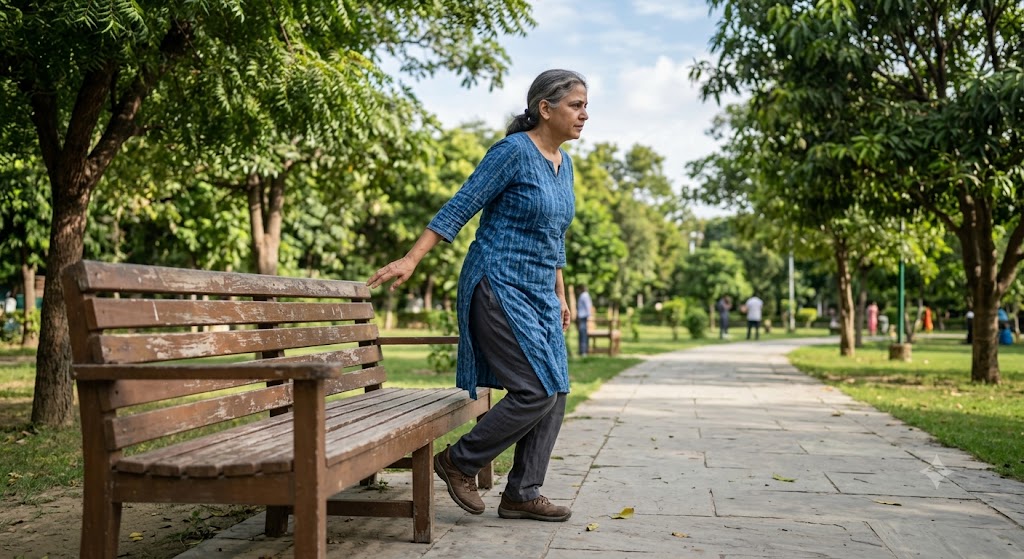
Neck and aortic stretch sensors still expect upright days. Sitting flattens the baroreflex briefing that Heinrich Hering, Corneille Heymans and later human labs mapped as the first defense of blood pressure.
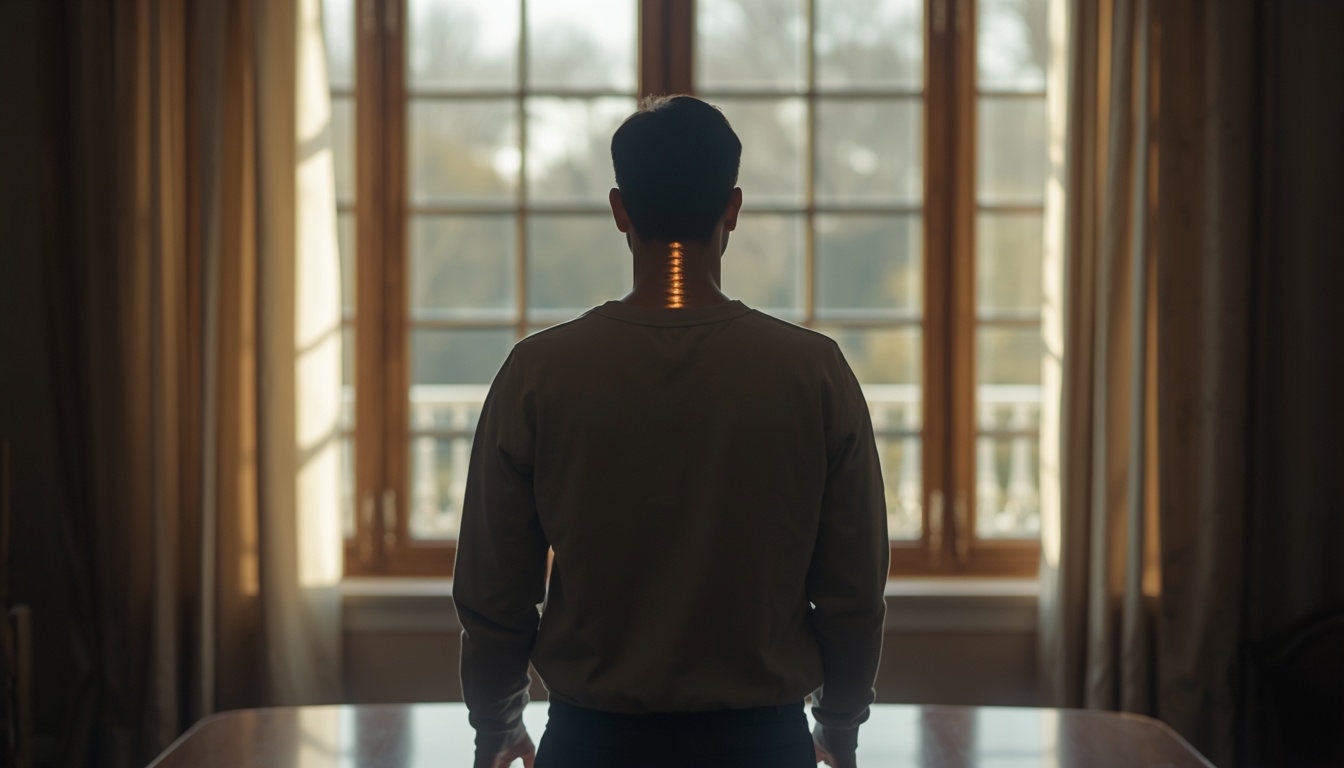
Every time you stand, about half a liter of blood tries to stay in your legs and belly. Gravity is not subtle. The brain still needs the same perfusion it had in the chair. The first system that notices the drop is not a thought. It is a pair of stretch sensors in the carotid sinuses and another set in the aortic arch. They fire when the vessel wall is taut. They go quieter when the wall slacks. That change in firing is the briefing that tells the brainstem to speed the heart, squeeze arterioles and hold more blood in the chest.
Those sensors were calibrated for a day that kept standing up. Walking, carrying, rising from the ground, looking across a horizon — each one stretched the neck vessels in a living pattern. A chair flattens the pattern. Hours of sitting keep the sensors in a narrower band. When you finally stand, the briefing can arrive late, weak or noisy. That is why a long sit can leave you briefly gray at the edges, why bed rest ruins orthostatic tolerance in days, and why a healthy blood-pressure number in a clinic chair is not the same as a healthy reflex on your feet.
This is not a scolding about never sitting. It is a reminder that blood pressure is not a single number. It is a conversation between stretch, nerves and vessels that still expects you to use your height.
What This System Was Built to Do
Heinrich Ewald Hering, working in Cologne in the 1920s, showed that stretching the carotid sinus slowed the heart. Corneille Heymans later proved the reflex was a true afferent nerve loop, work that earned him the 1938 Nobel Prize in Physiology or Medicine. The sensors are not pressure gauges in the abstract. They are mechanoreceptors in the adventitia of elastic arteries. When pulse pressure stretches the wall, they increase firing on the glossopharyngeal (carotid) and vagus (aortic) nerves. The nucleus tractus solitarius in the medulla reads the rate and pattern, then splits the answer: more vagal brake on the heart when pressure is high, more sympathetic drive to heart and vessels when it falls.
Dwain Eckberg spent decades showing that the human version of this loop is beat-to-beat, not a sluggish average. A single long pulse can change the next R-R interval. Respiratory sinus arrhythmia rides the same circuit. So does the first second of standing. Arthur Guyton’s larger model of long-term pressure put the kidneys and salt at the center of the set point — a story we told in why your blood pressure still expects scarce salt — but the baroreflex is what keeps you from fainting while that slower system thinks.
The reflex has two time scales that matter in a body that stands. The first is neural and fast: heart rate and vascular tone in one or two beats. The second is a reset. If pressure stays high or low for hours to days, the sensors start firing as if the new stretch were normal. That reset is useful after a true change in volume. It is less useful when the “new normal” is eight hours of a compressed pulse in a chair, then a sudden column of blood.
The Ancestral Briefing
Upright life is old for our lineage. Bipedal walking means a tall hydrostatic column. Without a fast neck-and-arch reflex, every stand would be a small experiment in cerebral hypoperfusion. Hunter-gatherer days were not gym sessions. They were frequent posture changes: squat, stand, walk, carry, sit on the ground, stand again. Each change stretched the sensors through a range. Muscle work in the legs also helped venous return, so the reflex was not the only pump — a partnership we described in why your veins still expect the calf pump.
Night added a second briefing. Lying down unloads the column. Healthy pressure falls. The sensors see less stretch and, over the night, the set point eases downward — part of the dip mapped in why your blood pressure still expects a nighttime dip. Dawn and standing load it again. The system was built for that daily fold and unfold, not for a single seated posture from breakfast to dinner.
What Changed
Modern sitting is not the brief rest between tasks. It is the task. Desks, cars, sofas and screens keep the torso flexed and the legs quiet. Venous pooling increases. Stroke volume on standing has farther to fall. The baroreceptors still work, but they spend long stretches in a flatter pulse-pressure band, then get asked for a large correction.
Spaceflight and head-down bed-rest studies made the mismatch visible. After days without a gravity column, astronauts and volunteers stand and the reflex is blunt: heart rate jumps, vessels lag, some people cannot stay up. Victor Convertino and colleagues showed that even short confinement reduces orthostatic tolerance. The sensors did not vanish. The daily dose of stretch and the vascular response behind them did.
Aging adds a second modern problem. Carotid arteries stiffen. A stiff wall transmits less stretch to the receptors for a given pressure change. The briefing gets quieter just as the veins get leakier. Combined with all-day sitting, that is a lot to ask of a reflex built for walking years.
What Happens When the Briefing Is Thin
A weak or delayed baroreflex does not always announce itself as a faint. More often it is a two-second gray-out on standing, a need to pause at the top of the stairs, a heart that races out of proportion to the task, or a clinic reading that looks fine while home standing readings wander. Wouter Wieling and colleagues mapped the normal first-second drop and recovery of pressure on active standing. When recovery is late, the person feels it as lightheadedness even if they never lose consciousness.
The reflex also talks to breathing and vagal tone. A long exhale can raise vagal firing into the same nucleus that reads the baroreceptors — the partnership in why your vagus nerve still expects a long exhale. Sitting, shallow chest breathing and a quiet calf pump stack three missing cues at once.
Blood that sits also changes the other half of circulation. Stasis is a clotting cue. Standing and walking are how the same vessels keep flow and shear — the story in why your blood still expects movement to stay liquid. The baroreflex and the clotting system are not the same circuit. They share a habitat: a body that was supposed to change posture.
Hidden Triggers in Ordinary Days
A large meal pulls blood into the gut. Standing after it asks the baroreflex to cover splanchnic steal and gravity at once. Heat opens skin vessels and steals more volume. Alcohol does both: vasodilation plus a blunter reflex. Dehydration shrinks the stroke volume the reflex is trying to protect. Early morning is a known risk window because the overnight fast, a full bladder, and the first stand land together.
Medications that drop pressure or slow the heart — some antihypertensives, some antidepressants, some prostate drugs — do not break the sensors. They change the effectors the sensors are talking to. The briefing can be perfect and the answer still late.
When to Worry
Brief lightheadedness that lasts a few seconds after standing, especially after a long sit, heat or a meal, is common. See a clinician promptly if standing brings chest pain, true fainting, confusion, a pounding irregular heartbeat, or if you fall. Repeated fainting, fainting without warning, or fainting during exercise is not “just the reflex being dramatic.” Sudden one-sided weakness, speech change or a thunderclap headache with standing symptoms is an emergency, not a posture problem.
New orthostatic symptoms after starting a medicine, after a virus that left you deconditioned, or after weeks in bed deserve a proper standing blood-pressure check — lying, then at one and three minutes — not only a seated clinic number.
Myths vs Facts
Myth: If seated blood pressure is normal, the standing system is fine.
Fact: Seated readings miss the reflex. Orthostatic drop is defined on standing, timed.
Myth: Lightheadedness on standing always means low iron or a weak heart.
Fact: Those can cause it. Far more often the issue is volume, deconditioning, heat, a meal, or a delayed baroreflex recovery.
Myth: Crossing your legs or tensing them is a trick with no physiology.
Fact: Physical counter-maneuvers — leg crossing, buttock and thigh tensing — raise pressure within seconds by restoring venous return. Wieling and others used them as first aid for impending faint.
Myth: You can train the baroreflex only in a gym.
Fact: Frequent standing, walking and mild heat-to-cool contrast are the original dose. Formal tilt training exists for some fainting syndromes; daily posture change is the population version.
How to Give the Sensors a Day They Recognize
Stand up more often than your calendar suggests. A brief walk after sitting is a baroreflex drill and a calf-pump rinse at once. Rise in two steps if you already know the first second is ugly: sit at the edge, wait, then stand. Point the gaze at a horizon, not a phone in your lap, so the neck is not flexed into a smaller carotid geometry all afternoon.
Keep a modest amount of salt if you are a fainter without high pressure — the opposite advice from someone with salt-sensitive hypertension, which is why this is not a universal slogan. Drink when you are thirsty, and do not stand out of a hot shower as if it were a sport. After a large meal, give the splanchnic bed a few minutes before you demand a full upright column.
Strength in the legs is not vanity here. Muscle is a second heart for venous return. Slow daily walking does more for this reflex than a single heroic Saturday. If you have been ill or in bed, rebuild standing time the way you would rebuild a tendon: small doses, then longer ones.
When to See a Doctor
Ask for help if you faint more than once, if standing symptoms are new and worsening, if you have known heart disease, if you are pregnant and collapsing, or if a family member has unexplained sudden death. Bring a log of seated and standing numbers if you can measure them safely. A clinician can sort reflex syncope, orthostatic hypotension, postural tachycardia and cardiac causes that share a first-second gray-out.
FAQs
Why do I only feel dizzy after sitting a long time, not after walking?
Walking already runs the calf pump and keeps the baroreflex in a working band. A long sit pools blood and then asks for a large correction in one movement.
Is this the same as low blood pressure?
Not always. You can have a normal seated number and still drop on standing. Orthostatic hypotension is a measured fall, usually at least 20 mm Hg systolic or 10 mm Hg diastolic within three minutes of standing.
Can anxiety cause the same rush when I stand?
Anxiety can speed the heart and change breathing, which makes the first seconds of standing feel louder. It does not invent gravity. Both can be true in the same person.
Does compression hosiery help the baroreflex?
It helps the volume the reflex is guarding by limiting venous pooling. It does not replace standing practice, but it can make the first seconds kinder in people who already drop.
Why are mornings worse?
Overnight you are relatively dry, cortisol and sympathetic tone are shifting, and the first stand of the day is often the largest posture change. Heat, coffee on an empty stomach and a full bladder can stack on top.
Will drinking more water fix it?
A bolus of water can raise pressure for an hour or two in some fainting syndromes. Chronic overdrinking is not a substitute for standing practice, salt advice tailored to your pressure, and a look at medicines.
Conclusion
Baroreceptors are stretch reporters, not lifestyle coaches. They still expect a day that loads the neck and aortic wall with real posture change. Chairs flattened that dose. The reflex did not disappear. It got fewer rehearsals, then a sudden exam every time you stood up from a long sit.
You do not need to live on your feet to respect the design. You need enough standing, walking and recovery from sitting that the first second of height is a familiar problem, not a surprise. Gravity is not new. The all-day chair is.