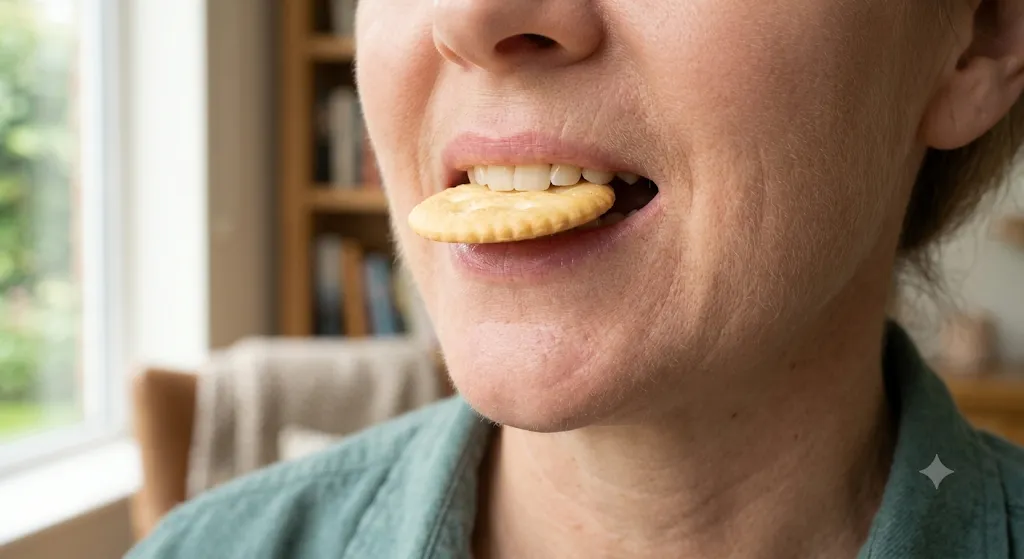
A sneeze burst after a full meal is often a stomach-stretch reflex or a spicy-food nasal reflex, not an allergy. Most fades in minutes.

You push the plate back, feel properly full, and then sneeze three times in a row. Nothing tickled your nose. The pepper was mild. The room is not dusty. It happens often enough that you have started waiting for it at the end of a large lunch.
That pattern is common, and it is usually a reflex, not a food allergy. Two different circuits get mixed up in everyday talk. One fires when the stomach is simply full, no matter what you ate. The other fires when spicy, hot, or strongly flavored food switches on the nerves that also run the nose. Both can end in a sneeze. Neither is the immune system attacking dinner.
What This Symptom Feels Like
The classic full-stomach version arrives as you finish, or within a few minutes of standing up from the table. It is a short volley — two, three, sometimes more — then it stops. Your nose may water a little. Your eyes may water, the way they do with any hard sneeze. You do not feel itchy in the mouth, you do not get hives, and you can eat the same food in a smaller portion without the burst.
The spicy version starts earlier, while you are still eating. Steam from hot soup, black pepper, chili, horseradish, or wasabi makes the nose run and can tip into a sneeze before the plate is empty. That one tracks the food, not the fullness.
A third, less discussed version is mechanical. Talking while you chew, a crumb near the soft palate, or a gulp of a fizzy drink can send a brief irritant signal up the back of the nose. That sneeze is single and immediate, more like a tickle than a ritual at the end of the meal.
People who have the fullness pattern often notice it runs in the family. A parent does it. A sibling does it. The meal does not have to be spicy.
Common Causes
Stomach fullness crossing into the sneeze circuit. In 1989, clinical geneticists Ahmad Teebi and Qasem Al-Saleh described families in which uncontrollable sneezing was provoked by a full stomach, not by a particular food, and the pattern fit autosomal dominant inheritance — a trait that can pass to children if one parent has it. The following year, Judith G. Hall, already known for naming the photic sneeze trait ACHOO, proposed the label SNATIATION: a blend of sneeze and satiation. The mechanism is still thinly mapped. The leading idea is neural spillover. Stretch receptors in the stomach travel with the vagus nerve into the brainstem, close to the pattern generator that organizes a sneeze. A large meal turns the volume up on those signals, and in some people the sneeze circuit joins in.
Gustatory rhinitis. Gordon Raphael, Mindy Hauptschein Raphael, and Michael Kaliner studied people who get a watery nose from certain foods. Spicy challenges, not bland ones, raised albumin and total protein in nasal fluid. Pretreatment with atropine, which blocks muscarinic signals to glands, stopped the drip. That is a parasympathetic gland reflex, not histamine leaking from mast cells. James Baraniuk’s work on nonallergic rhinitis puts the same idea in plain language: the nose can secrete because a nerve fired, without an allergen anywhere in the meal. Sneezing is the louder cousin of that drip.
Capsaicin and heat on trigeminal endings. Chili’s burn is the receptor TRPV1 on sensory nerves. Those same nerves supply the mouth, the palate, and the nasal lining. A strong hit can be read as an irritant and handed to the sneeze pathway. Steam from a very hot drink does something similar by warming and drying the nasal entrance. This is the overlap with a runny nose from spicy food, which is the watery version of the same wiring.
Already-sensitive nasal lining. If you are mid-cold, in pollen season, or living in dry indoor air, the threshold for a sneeze is lower. A full meal or a peppery bite only has to nudge a lining that was ready to fire. The meal gets the blame. The priming was already there.
Fast eating and swallowed air. Large bites, talking, and carbonated drinks increase belching and palatal tickle. A sneeze in that setting is often a palate event, cousin to the hiccups some people get after eating.
Why This Happens
A sneeze is not a random spasm. Sensory branches of the trigeminal nerve report irritants from the nasal lining to a small coordinating region in the medulla. That region then runs a fixed program: a deep inhale, a shut soft palate, a blast of expiratory muscle. Murat Songu’s review of the sneeze reflex makes the point that many triggers are “wrong-address” signals — light, eyebrow plucking, a full stomach — riding the same output because the brainstem is economical with reflexes.
The fullness version is the oddest of those wrong addresses, and the least studied. Teebi and Al-Saleh were not claiming a disease. They were documenting a reproducible, inherited reflex. Hall’s letter treated it the same way she and colleagues had treated sunlight sneezing: a named quirk of wiring, not an illness. Most carriers never seek care, which is why the papers are short family notes rather than large trials.
The food version has better physiology. Raphael and Kaliner’s atropine block is the cleanest evidence that glands, not allergy cells, make the fluid. If antihistamine tablets do nothing and a smaller, milder portion does, you are looking at nerve traffic, not IgE.
There is also a timing clue. Fullness sneezes cluster at the end of the meal, when gastric stretch is highest. Spice sneezes cluster during the bites that burn. Allergy symptoms build, linger, and bring company: mouth itch, lip swelling, gut cramps, wheeze, or hives. A three-sneeze coda at a birthday lunch, gone before dessert is cleared, does not match that timeline.
Less Common but Serious
Isolated meal sneezes are almost never the dangerous story. A few neighboring patterns are.
True food allergy can include sneezing, but not as a solo act. Itching in the mouth, swelling of lips or tongue, hives, vomiting, wheeze, or a feeling of throat tightness in the same episode needs urgent care, especially if it has happened before with the same food.
Uncontrollable sneezing that lasts many minutes, repeats through the day, and is not tied to meals is a different problem. Rare intractable sneezing has been linked to nasal lesions, irritation from a foreign body, or, in case reports, a functional pattern. A single end-of-meal volley is not that picture.
One-sided nasal obstruction, bloody discharge, or facial pain that arrives with the sneezing is about the nose itself, not the stomach. Persistent one-sided symptoms deserve an exam.
Severe abdominal pain, vomiting, or a sneeze volley that comes with chest pain is not snatiation. Treat those on their own merits.
Hidden Triggers
Portion size is the quiet one. The same pasta that is fine at a weeknight serving can trigger the reflex at a restaurant portion. People often “develop” the habit in their thirties, when meals get larger and faster, and assume a new allergy.
Eating pace matters. A meal finished in ten minutes stretches the stomach harder than the same calories over half an hour.
Temperature stacks with spice. Hot broth plus chili is a double hit: steam at the nasal valve and capsaicin on trigeminal endings.
Alcohol can exaggerate nasal drip in some people by widening vessels in the lining. A large dinner with wine may sneeze more than the same dinner with water.
Dry indoor air and an overdue cold lower the threshold, so winter holiday meals look guiltier than summer ones.
Posture at the table — leaning forward, talking through bites — pushes air and crumbs toward the palate.
A family script helps. If a parent sneezes at the end of Sunday lunch and always has, you are likely looking at the trait Hall named, not a new sensitivity to gluten or dairy.
When to Worry
Most meal sneezes are a brief, predictable coda. Look closer if any of these show up.
- Sneezing with lip or tongue swelling, hives, wheeze, vomiting, or a tight throat.
- Symptoms that start with a specific food even in a small amount, and repeat every time.
- A sneeze attack that will not stop, or sneezing all day unrelated to meals.
- One-sided blockage, nosebleeds, or facial pain with the sneezes.
- Weight loss, night sweats, or a new cough alongside a change in sneezing.
- Chest pain, severe abdominal pain, or fainting with the episode.
A lifelong end-of-meal volley that your parent also has, with a clear nose between meals, is the pattern Teebi and Al-Saleh wrote down. It is inconvenient. It is not a warning light.
Myths vs Facts
Myth: Sneezing after dinner means you are allergic to what you just ate.
Fact: Allergy brings itch, swelling, hives, or breathing change, and it tracks a specific food at any portion. Fullness sneezing tracks size. Spice sneezing tracks heat and pepper, and Raphael and Kaliner showed it is a gland reflex blocked by atropine, not histamine.
Myth: The sneeze is your body rejecting a heavy meal.
Fact: Rejection would be nausea, pain, or vomiting. A sneeze is an airway reflex that borrowed a stomach signal. Digestion continues as usual. The related heavy feeling after a large plate is a different story, covered in sleepiness after a meal.
Myth: Only spicy food can do this.
Fact: Spice is the gustatory path. Snatiation, as Teebi and Al-Saleh described it, happens with a full stomach regardless of the menu. Bland holiday portions can do it if they are large enough.
Myth: Holding the sneeze in is safer.
Fact: Stifling a hard sneeze raises pressure in the chest, ears, and vessels for a second. Letting a meal sneeze finish is the simpler option. You do not need to dramatize it. Just do not clamp the nose and mouth shut.
Myth: It will turn into asthma.
Fact: A brainstem fullness reflex does not remodel airways. People with asthma can also have the reflex, but one does not create the other.
How to Manage It
Match the fix to the pattern.
If it is fullness, shrink the peak. Pause halfway, put the fork down, and give the stomach a few minutes before seconds. The reflex seems to care about stretch more than calories. Eating the same meal more slowly often drops the volley without changing the menu.
If it is spice or steam, test a milder bowl on a different day. Let soup cool a little. Keep pepper on the side. A short walk away from the plate steam is enough for some people.
If your nose is already drippy from a cold or pollen, treat that lining. Saline rinse, and whatever your clinician already recommended for rhinitis, raises the threshold so dinner is less likely to be the last straw.
Notice family pattern and portion, and write it down once. “Large meal, any food, three sneezes, gone” is a useful sentence if you ever mention it to a clinician. It points away from allergy testing you do not need.
Do not start antihistamines solely for an end-of-meal sneeze that never itches. They are reasonable when a clinician is treating allergic rhinitis. They are a poor match for a stretch reflex.
A related light-triggered sneeze — the photic reflex Hall helped name — is a different entrance to the same exit. If bright sun also sets you off, that is the sneeze in bright sunlight, not a sign that meals are becoming dangerous.
When to See a Doctor
Mention it at a routine visit if it is new, getting longer, or tied to one food you are starting to avoid. Bring the pattern: which meals, how fast, whether spice is required, whether anyone in the family does it, and whether there is itch, swelling, or wheeze.
See someone sooner for swelling, breathing trouble, a sneeze attack that will not settle, one-sided nasal symptoms, or pain that does not belong to a ordinary full feeling. Emergency care is for throat tightness, widespread hives, wheeze, or collapse after a food — that is allergy care, not a snatiation conversation.
FAQs
Is sneezing after a big meal a sign of food allergy?
Usually no. Allergy repeats with a specific food at modest portions and brings itch, swelling, hives, vomiting, or wheeze. A short volley only after you are full, with the same foods tolerated in smaller servings, fits the fullness reflex Teebi and Al-Saleh described.
Why does it run in my family?
The published families fit autosomal dominant inheritance, which is why Hall treated it as a named trait. Not everyone with the habit has had a genetic test — almost no one has — but a parent and child with the same end-of-meal sneeze is exactly the picture in those notes.
Can spicy food and a full stomach both do it?
Yes. They are different on-ramps. Spice and steam use trigeminal and parasympathetic nasal pathways, the circuit Raphael and Kaliner blocked with atropine. Fullness seems to use vagal stretch spilling into the medullary sneeze program. Some people have both.
Should I take an antihistamine before large meals?
Not for a pure fullness sneeze. Antihistamines do not relax stomach stretch receptors. They may help if you also have allergic rhinitis that is priming the nose. Ask a clinician before using them as a meal ritual.
Is it dangerous to keep sneezing at the table?
The sneeze itself is a normal airway blast. The risk is stifling it hard, or missing a true allergic episode hiding in the same moment. A predictable three-sneeze coda is an annoyance, not an emergency.
Does eating slower actually help?
Often, when the trigger is stretch. A smaller peak volume, reached more gradually, gives the vagal signal less of a spike. It will not stop a chili-triggered sneeze if the pepper is the cause. Separate the two by trying a large bland meal and a small spicy one on different days.
Conclusion
A sneeze at the end of a big meal is, for most people, a borrowed reflex. The stomach reported that it was full. In a subset of brains the sneeze circuit answered. Teebi and Al-Saleh wrote the family pattern down. Hall gave it a name. Raphael and Kaliner showed that the spicy, watery cousin is a gland nerve, not an allergy cell. Neither finding asks you to fear dinner.
Smaller peaks, a slower pace, and milder heat remove most of the volleys. Itch, swelling, wheeze, or a sneeze attack that ignores meals are the signals that belong to a clinician. The ordinary end-of-lunch burst can stay what it is: a quirky coda, over before you have cleared the plates.