Yes—sudden cold air from air conditioning often triggers harmless goosebumps. Learn why your skin still raises tiny bumps, what it means, and when it is worth checking.
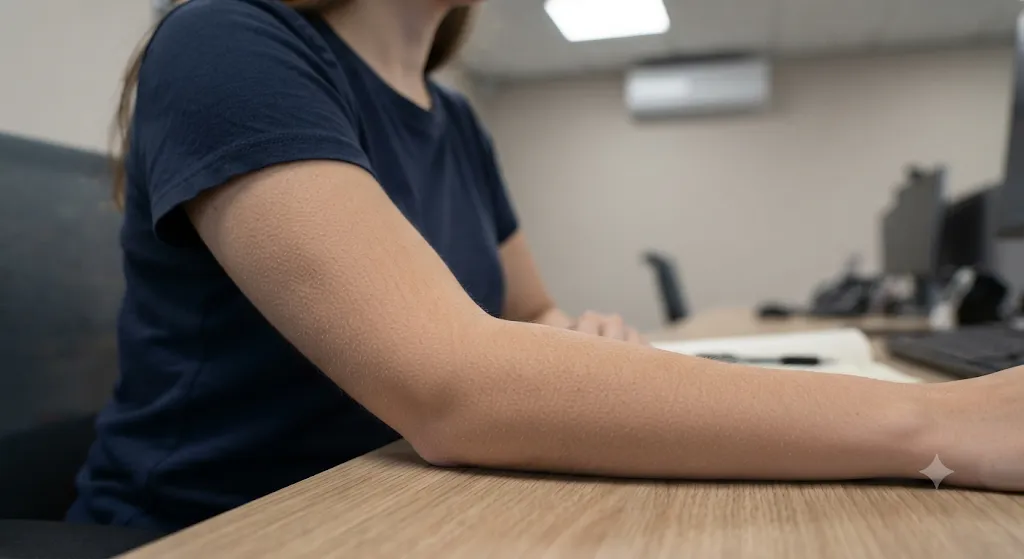
You step into a strongly air-conditioned room or the vent above your desk kicks on, and within seconds the skin on your arms or legs prickles. Tiny bumps rise and the fine hairs stand a little straighter. It feels like a mild chill even if the rest of the room does not seem that cold. For most people this is a completely ordinary reflex, not a sign that something is wrong with their temperature control.
What This Feels Like
The sensation is usually brief. The skin looks slightly rough or pebbled for a minute or two, then smooths again once you warm up or the air settles. You may notice it more on the outer arms, thighs, or the back of the neck. Sometimes it is paired with a small shiver or the urge to rub your arms. It can happen even when you are not actually cold enough to feel uncomfortable—just a sudden drop in skin temperature is enough.
Why This Happens
Goosebumps (also called cutis anserina or piloerection) are produced by tiny muscles called arrector pili that attach to each hair follicle. When those muscles contract, the hair stands up and the skin around it dimples. The signal comes from the sympathetic nervous system—the same branch that handles quick “fight-or-flight” adjustments.
Cold is one of the classic triggers. In our furrier ancestors the raised hairs trapped a layer of air that acted as insulation. Without a dense coat the effect is minor, but the wiring is still there. Air conditioning creates an abrupt, localized cool draft that the skin sensors register as a temperature drop, so the reflex fires. The same pathway can be activated by strong emotion, music, or a sudden noise, which is why goosebumps also appear in non-temperature situations.
Researchers who have studied human thermoregulation, including work following the classic observations of physiologists such as Yas Kuno on skin responses, have long noted that piloerection is part of the body’s rapid reaction to cooling. In modern indoor environments the reaction is simply more noticeable because we spend so much time in controlled air that can change temperature quickly.
Common Everyday Triggers
- Walking from a warm hallway into a cold office or store
- Sitting directly under an air-conditioning vent
- A car or room AC that blasts cold air after being off
- Wearing short sleeves or light clothing when the thermostat is set low
- Coming indoors after mild outdoor warmth and meeting refrigerated air
If your hands also feel cold in the same rooms, that is a related circulation response you can read more about in our piece on cold hands in air-conditioned spaces.
Less Common but Still Usually Benign Causes
Some people simply have a more sensitive sympathetic response and notice goosebumps more easily. Mild dehydration, fatigue, or low blood sugar can make the skin more reactive to temperature shifts. Certain medications that affect the nervous system or blood vessels may also increase the frequency. In almost all of these cases the bumps remain short-lived and do not interfere with daily life.
When to Pay Closer Attention
Goosebumps that appear only with cold air and fade within minutes are normal. Consider mentioning them to a doctor if they occur constantly without any temperature change, are accompanied by unexplained weight loss, night sweats, or persistent fatigue, or if you also notice patchy hair loss or skin changes in the same areas. Rare neurological conditions can affect the same pathway, but they produce other clear symptoms as well.
Myths vs Facts
Myth: Goosebumps from air conditioning mean your thyroid is off.
Fact: Thyroid issues can change temperature sensitivity, but ordinary goosebumps from a cold vent are not a diagnostic sign by themselves.
Myth: You should never get goosebumps indoors.
Fact: The reflex is built-in; modern climate control simply triggers it more often than outdoor breezes once did.
Myth: Rubbing the skin or covering up is useless.
Fact: Gentle warming or moving away from the direct draft usually stops the response quickly because the temperature signal disappears.
How to Manage It
Most people need nothing more than a light layer or a small shift in position. Keep a cardigan or long-sleeve shirt at your desk. Angle the vent so it does not blow straight onto bare skin. If the room is set very cold for others, a small personal fan set to low or a desk heater (used carefully) can create a more even micro-climate. Staying hydrated and avoiding long periods of complete stillness also help the body regulate temperature more smoothly.
For a broader look at why our circulation still reacts strongly to temperature swings, see why your circulation still expects temperature contrast. And if you are curious about the evolutionary leftover of the whole system, our article on why your skin still expects a coat of fur explains the original purpose of the arrector pili muscles.
When to See a Doctor
See a clinician if the goosebumps are new, constant, or paired with other symptoms such as unexplained chills, fever, muscle weakness, or changes in sensation. Otherwise this is one of the many small, automatic skin responses that simply become more visible in air-conditioned modern life.
FAQs
Why do I get goosebumps even when I do not feel cold?
The skin temperature sensors can fire before your core feels chilled. A direct draft cools the surface quickly, triggering the reflex while the rest of you is still comfortable.
Can air conditioning cause goosebumps every day?
Yes. People who work in cold offices or sit near vents often notice them regularly. It does not mean the AC is harmful; it just means the temperature drop is sharp enough to activate the muscles.
Do goosebumps actually warm you up?
Very little in humans. Without thick fur the insulation effect is negligible. The main remaining roles are the emotional and startle responses, plus a minor contribution in extreme cold.
Is it different from the goosebumps I get from music or fear?
The muscle action is the same, but the trigger differs. Cold uses temperature sensors; music or emotion uses central brain pathways that still connect to the same sympathetic nerves.
Will covering my arms stop them?
Usually yes. Once the skin surface warms or is shielded from the draft, the signal stops and the bumps flatten within a minute or two.
Conclusion
Getting goosebumps when the air conditioning turns on is a normal, leftover reflex. Your arrector pili muscles are still doing the job they evolved for—responding to a sudden cool signal—even though the thick fur that once made the response useful is long gone. A light layer or a small change in seating is usually all that is needed. If the bumps stay isolated to cold drafts and disappear quickly, there is no reason for concern.