
A painless click when you turn a wrist is often cavitation, a tendon sliding, or a midcarpal shift after keyboard stillness — not automatically a torn ligament. Learn when the sound is benign and when to get it checked.
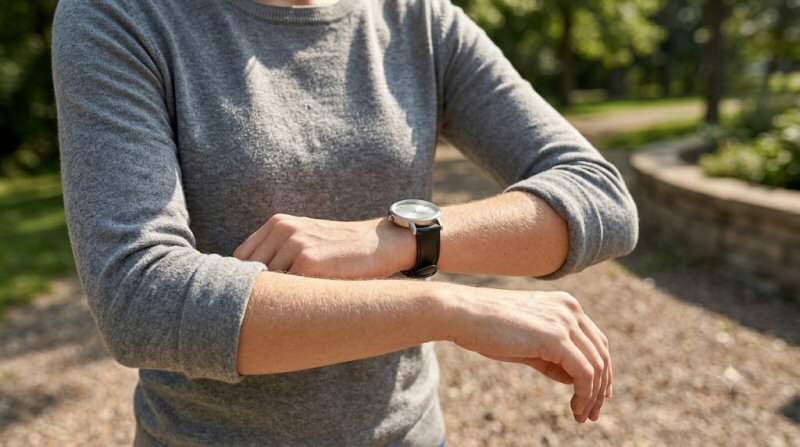
You flip a pan, twist a doorknob, turn your palm up to look at a watch, or roll a mouse sideways and hear it: a small click, clunk, or sandpaper tick from the wrist. Sometimes it is only the first rotation after hours of typing. Sometimes you can feel a tendon skip on the thumb side or a deeper shift near the little-finger bump. There is no sharp pain, the hand still grips, and the next twist is quieter. Still, the sound is hard to ignore.
A painless wrist click when you rotate the forearm or circle the hand is common. The wrist is not one joint. It is two rows of small bones, a triangular cartilage on the little-finger side, several tendons in tight tunnels, and a fluid-filled capsule that has to both bend and twist. When those parts glide, stretch, or briefly cavitate after being parked in extension on a keyboard, they can make noise. The sound is not, by itself, a diagnosis of a torn ligament or “arthritis setting in.” What matters is whether the click comes with pain, giving way, swelling, or a catch that stops the motion.
What This Symptom Feels Like
People describe it in a few overlapping ways:
- A single pop as you turn the palm up after a long stretch of typing
- A soft click on the thumb side when you open a jar or turn a key
- A deeper clunk on the little-finger side when you lean on the hand and twist
- A fine grinding you can hear more than feel during a slow circle
- A click that is louder in the morning or after a cold commute with stiff hands
The sound often fades once the joint has moved through a few full ranges. Many people can reproduce it once after stillness and then cannot find it again until the next long stretch of desk posture.
Common Causes
Most painless clicks fall into a short list.
Cavitation in the capsule. When you rotate a joint that has been held still, synovial fluid can form a brief gas bubble that collapses with a pop. Engineer A. Unsworth and later Gregory Kawchuk mapped this pattern in knuckles and other joints. The same physics applies at the wrist. The joint is quiet for a short time afterward because the gas has to redissolve before another pop can form.
Tendon glide in a tunnel. Extensor tendons on the back of the wrist and flexor tendons on the palm side run through compartments. After hours of mouse extension or phone grip, a tendon can catch slightly on a retinaculum or bony ridge and then snap into line as you rotate. The first-compartment tendons on the thumb side — the same corridor involved in scrolling-thumb ache — are frequent sources of a painless skip.
Midcarpal shift. The two rows of carpal bones can translate a few millimeters on each other as you move from one extreme of rotation to the other. David Lichtman described a midcarpal clunk that some people can produce on purpose. When it is painless and the wrist feels stable, it is often a loose but competent joint finding its seat, not a dislocation.
Triangular fibrocartilage complex (TFCC) seating. On the little-finger side, a small cartilage-and-ligament hammock (mapped in detail by Andrew Palmer and Julio Taleisnik) helps the ulna share load as you twist. A fold or slightly lax edge can catch and then settle with a click during rotation, especially if you have a longer ulna or you load the wrist in a twist after stillness.
A tight capsule after keyboard extension. Modern days park the wrist in mild extension — laptop, phone, driving. The palmar capsule shortens to that range. The first full circle or palm-up twist of the afternoon can tug that tissue over a joint line with a click, then settle.
These mechanisms often stack. A flexed-and-extended desk day plus a sudden jar twist plus cold, thicker fluid is a classic recipe for one loud, painless click.
Why This Happens
The wrist has to do two jobs that fight each other a little: it must be mobile enough to rotate a tool and stable enough to accept body weight on a push-up or a fall. Marc Garcia-Elias and Richard Berger’s work on carpal kinematics showed that the proximal row does not move as a rigid block. It flexes, extends, and shifts as the forearm bones turn around each other.
That design worked well when the hand spent the day gripping, hanging, prying, and changing shape. It is less rehearsed when the same joint spends eight hours in one angle on a pointing device and then is asked to unscrew a lid in one fast arc. Stillness lets synovial fluid thicken and lets ligaments take a slightly shortened set. The first rotation is then a catch-up motion — more sound, same structure.
A painless click is the joint announcing that catch-up. It is not a wear meter.
Less Common but Serious Causes
A minority of noisy wrists are asking for a closer look.
- True TFCC tear after a fall on the hand or a sudden twist while loaded — usually pain on the little-finger side, weaker twist, and a click that hurts
- Scapholunate or lunotriquetral ligament injury — a clunk with a sense of giving way, often after trauma; Melvin Rosenwasser and others mapped how those links keep the rows timed
- Extensor tendon subluxation after a blow to the back of the hand, with a visible snap as the tendon leaves its compartment
- Inflammatory arthritis — morning stiffness that lasts hours, several joints, swelling that does not fade with movement
- Ulnar impaction — a longer ulna repeatedly jamming the TFCC during loaded rotation, with activity pain rather than a one-off pop
Trauma, locking, and pain change the story. Sound alone does not.
Hidden Triggers
Everyday habits make a quiet wrist louder.
- All-day mouse work with the wrist cocked up on a hard edge
- Phone scrolling with a bent wrist and a tight thumb
- Yoga or gym sessions that load rotation after a week of stillness
- Push-ups or plank holds on a stiff, un-warmed wrist
- Cold rooms and air-conditioned offices, which thicken synovial fluid until the joint warms
- Dehydration and long stillness
- A sudden return to racquet sports, climbing, or kettlebell work
- Sleeping with the wrist fully curled under a pillow
None of these mean the joint is failing. They mean the first full rotation of the day is asking a parked cluster of bones to do a job it has not practiced in hours.
When to Worry
Get a click checked if any of these show up:
- Pain with the sound, especially a sharp pinch on the little-finger side or in the snuffbox
- Swelling, warmth, or a wrist that will not fully rotate compared with the other side
- A clunk that comes with giving way, or a need to “shake it back in”
- Numbness, burning, or night pain into the thumb, index, and middle fingers that does not fade when you change position
- A click that started after a fall, a jammed hand, or a pop during sport
- Progressive loss of rotation or grip over weeks
- Fever, redness, or a wrist that looks deformed
A single painless pop after sitting, with full strength and full motion, is a very different picture from a clunk that stops you mid-twist.
Myths vs Facts
Myth: If a wrist clicks, the ligaments are torn. Fact: Cavitation and tendon glide are common in intact wrists. Imaging of noisy but painless joints often looks unremarkable.
Myth: You should stop rotating the wrist so the click cannot happen. Fact: Avoiding rotation usually makes the next click louder. Gentle, frequent full circles are what the capsule expects.
Myth: Cracking a wrist on purpose will loosen it permanently. Fact: A typical cavitation pop does not stretch ligaments into instability. Forced end-range twists under load are a different, unwise habit.
Myth: Only “old” wrists click. Fact: Young people who type, game, or climb click too. Age changes the odds of cartilage-edge catching; it does not own the sound.
Myth: A little-finger-side click always means a TFCC tear. Fact: The TFCC can seat with a click and still be intact. Tear is suggested by pain, weakness of twist, and a history of load — not by sound alone.
How to Manage It
You do not need to silence every click. You can make the first rotation of the day less dramatic.
Circle more often. Every half hour, take both wrists through a slow, pain-free circle and a gentle palm-up, palm-down turn. The goal is to stop the capsule from adapting only to keyboard extension.
Warm the cluster before you load it. Open and close the fists, then rotate, then put weight through the hands. Cold, still fluid clicks more than warm, moving fluid.
Change the desk angle. A neutral wrist — not cocked up on a sharp edge — reduces the sudden stretch when you twist a lid later. The same setup that eases mouse-day wrist ache often quiets a rotation click.
Ease into loaded twist. If push-ups, yoga transitions, or racquets brought the click back, lower the volume for a week and rotate slowly rather than snapping into end range.
Unload the little-finger side if that is the noisy corner. Avoid long stretches of leaning on a twisted hand. Support the forearm when you type so the ulna is not jammed all day.
Hydrate and move after long sits. Synovial fluid behaves better when you are not still and dry — the same pattern that explains morning finger stiffness.
These are the same low-drama habits that help an elbow that clicks when you straighten it and a neck that clicks when you turn: give the joint the range it is about to use, then use it.
When to See a Doctor
See a clinician if pain, swelling, locking, giving way, or nerve symptoms travel with the click, or if you cannot fully rotate one wrist compared with the other. A hand-or-wrist-focused exam can tell cavitation from midcarpal shift, a TFCC irritant, tendon subluxation, or true instability. Imaging is not the first step for a painless pop with full motion, but it matters after trauma or when the joint catches.
If thumb-side night tingling is the main partner of the noise, the visit may look more like a carpal-tunnel evaluation than a “joint noise” visit.
FAQs
Is it normal for only one wrist to click? Yes. The dominant, mouse-using, or previously sprained side is often the noisy one. Compare strength, motion, and pain — not sound — with the quieter side.
Does a clicking wrist mean I am getting arthritis? Not by itself. Arthritis is more about lasting ache, swelling, and stiffness after rest than about a single pop. Many arthritic wrists are quiet; many young, stable wrists click.
Should I crack my wrist on purpose to “release” it? You do not need to. If a gentle circle produces one cavitation pop and then goes quiet, that is enough. Repeated forced twists add load without adding health.
Why is the click louder in the morning? Overnight stillness thickens synovial fluid and lets the capsule take a shortened set. The first rotations warm and redistribute that fluid. The sound often drops after a few minutes of ordinary use.
Can a click from the little-finger side wait? A painless, full-motion click can be watched. Pain with twist, weaker grip, or a history of a fall on that hand deserves a sooner exam, because the TFCC and ulnar-sided ligaments do better when irritants are caught early.
Will a brace stop the sound? A short period of support can calm a painful, swollen wrist. All-day rigid bracing of a painless click usually makes the next free motion louder, because the joint sees even less rotation.
Conclusion
A painless click when you rotate a wrist is usually the sound of a crowded, well-designed joint catching up after stillness — a gas bubble collapsing, a tendon lining up, or two rows of small bones seating. It is a common modern noise, not an automatic verdict on cartilage or ligaments. Give the wrist frequent, gentle circles, a warmer start before loaded twist, and a less cocked desk posture. Save the urgent visit for pain, swelling, giving way, or a click that began with a fall. The joint was built to turn. It just prefers not to spend the whole day frozen first.