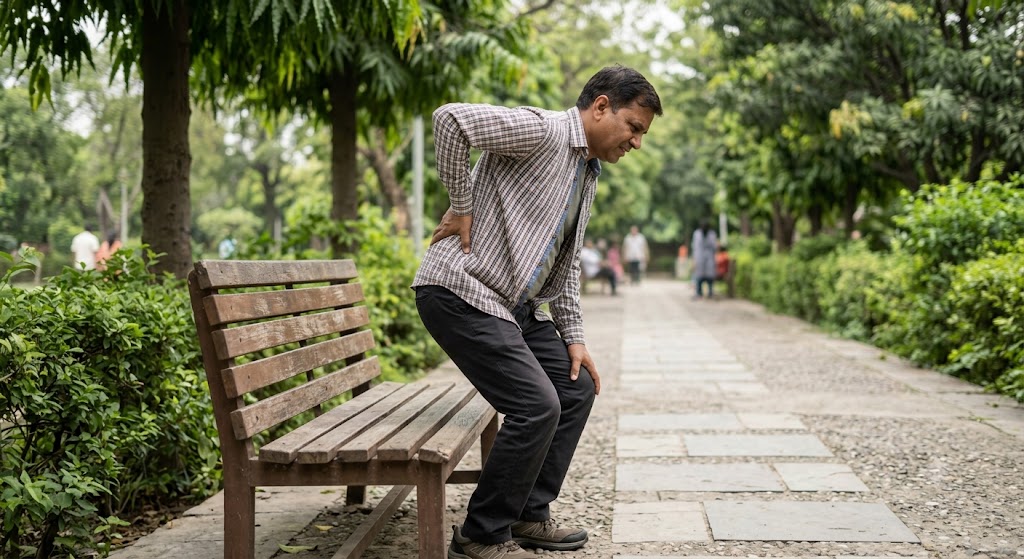
A painless click when you twist or stretch your back is often facet cavitation or a tight muscle skipping — not automatically a slipped disc. Learn when the sound is benign and when to get it checked.

You stand up from a chair, turn to grab a bag from the passenger seat, or reach behind you for a jacket, and your mid-back or low back answers with a click, pop, or small clunk. Sometimes you can make it happen on purpose by twisting until a vertebra “lets go.” There is no sharp pain, nothing locks, and you often feel a brief sense of space afterward. Still, the sound is hard to ignore when it lives in the spine.
A painless click when you twist is common. The spine is a stack of joints, discs, ligaments, and long muscles that spend most of a modern day in one flexed sitting shape. When you finally rotate, those small facet joints can cavitate, a tight band can skip over a ridge, or a segment that has been parked can find its next millimeter of motion all at once. The sound is not, by itself, a slipped disc or a vertebra “going out.” What matters is whether the click comes with pain that shoots, weakness, numbness, or a twist you cannot finish.
What This Symptom Feels Like
People describe it in a few overlapping ways:
- A single pop in the mid-back when you rotate to look over a shoulder
- A low-back clunk as you get out of a car or twist to pick something off a seat
- A string of small clicks when you stretch both arms and turn after sitting
- A click that is louder first thing in the morning or after a long drive
- A sense that one spot “needs” to pop and feels quieter after it does
The sound often happens once in a given direction and then stays quiet for a while. Many people can reproduce it after stillness and then cannot find it again until the next long sit.
This is different from the grinding you might hear when a neck turns — a pattern covered in our article on necks that click when you turn your head. A thoracic or lumbar twist click tends to be deeper and tied to rotation after flexion, not to every degree of turning.
Common Causes
Most painless twist clicks fall into a short list.
Facet cavitation. Each vertebra has two small sliding joints at the back — the facet (zygapophysial) joints. When you rotate after sitting, synovial fluid in those joints can form a brief gas bubble that collapses with a pop. Engineer A. Unsworth and later Gregory Kawchuk mapped this pattern in knuckles; the same physics applies to spinal facets. Nikolai Bogduk’s anatomical work on lumbar and thoracic facets explains why rotation plus a little extension is a classic setup. The segment is often quiet afterward because the gas has to redissolve before another pop can form.
Costovertebral skip. In the mid-back, ribs meet the spine at small joints. A long flexed sit leaves those joints under-rotated. A sudden twist can let a rib head glide and then seat with a click you feel between the shoulder blades.
Muscle or fascia glide. The long muscles that run beside the spine, and the thoracolumbar fascia that wraps them, can catch slightly on a bony edge or on each other after hours of sitting still. When you finally rotate, a band skips into line. The sound is extra-articular — outside the disc.
Segmental “catch-up.” Sitting keeps the lumbar spine flexed and the thoracic spine rounded. Rotation is not what those segments practiced all morning. The first real twist lets a stiff level move all at once instead of sharing the turn with its neighbors. Michael Adams, Jacek Cholewicki, and Stuart McGill have described how posture and muscle co-contraction change how load and motion are shared along the column.
Sacroiliac shift. A minority of “low-back” clicks on getting out of a car are the sacroiliac joint moving a few millimeters after a long flexed sit. If it is painless and does not catch, it is often seating — not automatic instability.
These mechanisms often stack. A flexed desk day plus a sudden twist to the back seat plus cold, thicker fluid is a classic recipe for one loud, painless pop.
Why This Happens
Spinal joints make less noise when they stay warm, well lubricated, and moving through rotation as well as flexion. Sitting does the opposite.
Classic intradiscal pressure work by Alf Nachemson, later confirmed in living discs by Hans-Joachim Wilke, showed that sitting and slumping raise load in the front of the disc and park the facets in a flexed, under-rotated position. Synovial fluid is shear-thinning: it flows better once you start moving. The first twist after a chair is the moment a facet, a rib joint, or a band is most likely to announce itself.
Modern life multiplies those first-twist moments. You sit, stand, rotate twenty degrees to a screen, sit again. True rotation — looking behind you, reaching across the body, getting off the floor — is rare. The column that still expects walking, reaching, and turning gets a sudden request after hours of one shape. That theme also shows up when the spine is asked to walk more than it sits.
Age changes the soundtrack a little. Facet cartilage and disc height change over decades. A more continuous sandpaper sound can appear. Sound and structure are still not the same measurement. Plenty of spines that click on a twist look unremarkable on imaging, and plenty of worn discs never click.
Less Common but Serious Causes
A minority of twist clicks are not just gas or a muscle skip:
- A disc herniation that catches and then refers pain down a leg or around a rib
- An unstable segment after trauma, with true giving way or a clunk you cannot control
- Inflammatory spine disease with morning stiffness lasting more than an hour plus night pain
- A rib that stays “stuck” and hurts to breathe after the click
- Referred click from a snapping hip or sacroiliac problem that you hear “in the back”
These usually add shooting pain, numbness, weakness, fever, unexplained weight loss, or a twist you cannot complete. The sound alone does not make the diagnosis.
Hidden Triggers
A few everyday patterns make a twist click louder without meaning the spine is failing:
- Long sits with a rounded low back and a twisted reach to a mouse or bag
- Getting out of a low car seat with a combined flex-and-rotate
- Cold commutes or air-conditioned offices that thicken joint fluid
- Sleeping in a curled side-lie, then twisting to stand
- A sudden yoga twist or “crack my back” stretch after a still day
- Heavy lifting with a turn instead of a step-around
None of these prove a disc injury. They change timing, viscosity, and how much rotation one segment has to do at once.
When to Worry
Get a back checked if any of these show up:
- The click is paired with sharp pain that shoots into a leg, groin, or around the chest
- You have new numbness, tingling, or weakness in a limb
- You cannot finish the twist, or the segment feels like it slips
- Pain wakes you at night, or morning stiffness lasts more than an hour and is getting worse
- The sound started after a fall, crash, or heavy lift-and-turn
- You have fever, unexplained weight loss, or trouble controlling bladder or bowels
Painless, occasional, after-sitting clicks that fade as you move are in a different category.
Myths vs Facts
Myth: A clicking back means a disc has slipped.
Fact: Painless clicks are often facet cavitation or extra-articular glide. Discs that matter usually add pain, direction-specific restriction, or nerve signs.
Myth: You should keep twisting until it pops every time.
Fact: Forcing end-range rotation on a cold, flexed spine is a common way to turn a quiet click into a strained facet. Warm up first; let motion be the goal, not the sound.
Myth: If you can hear it, you should stop moving.
Fact: Varied walking and easy rotation are how synovial fluid and shared segmental motion recover. All-day stillness usually makes the next twist louder.
Myth: The pop “puts a vertebra back in place.”
Fact: Facet joints do not wander off the column. The pop is usually gas or a brief catch-up of a stiff level, not a bone relocating.
How to Manage It
You do not need a complicated protocol for a painless twist click.
Warm the column before you ask it to rotate far. A minute of easy walking, a few gentle side-bends, or shoulder rolls before you twist to the back seat gives fluid time to flow.
Change the sit. Uncross the legs. Stand or walk for two minutes each half hour. Face what you need instead of rotating from a parked pelvis.
Practice small rotation when you are warm. Standing, keep the ribs stacked over the pelvis and turn a little to each side as if looking at a horizon. That is closer to what walking on uneven ground used to provide than a single end-range crack.
Get out of the car in two moves. Slide forward, stand, then turn. Combining flex, twist, and a step in one motion is a classic click-and-strain recipe after a long drive — a pattern that also shows up when the low back aches after a long drive.
Keep walking. A path, a gentle hill, and a reason to look around ask the facets and ribs to share rotation instead of saving it for one dramatic twist.
If a particular twist always hurts, stop chasing the pop and treat that direction as a load to change, not a joint to force.
When to See a Doctor
See a clinician if pain, nerve symptoms, night pain, or trauma travel with the click, or if you cannot trust the segment. Bring notes on when it started, which direction reproduces it, and whether sitting, walking, or lying changes it. Most painless twist clicks need movement advice, not an urgent scan. Imaging is more useful when symptoms and the exam point to a specific structure.
FAQs
Is it bad that I can make my back click on purpose?
Not automatically. A single painless cavitation after stillness is common. Habitually cranking into end-range rotation to chase the sound can irritate facets and does not “align” the spine.
Why is it louder in the morning?
Overnight stillness thickens synovial fluid and leaves the column in one shape. The first twists of the day are when bubbles and tight bands announce themselves.
Can a chiropractic or self-twist pop fix posture?
A pop can feel like space because a stiff level moved and nearby muscles briefly relaxed. Lasting posture change still comes from how you sit, stand, and walk the rest of the day.
Does cracking my back cause arthritis?
Evidence from knuckle cavitation, including work in the Unsworth and Kawchuk line, has not shown that ordinary joint popping wears cartilage away. Painful, forced twisting is a different stress.
Should I wear a brace so it stops clicking?
A rigid brace all day usually makes the next free twist stiffer. Short-term support after an acute strain is a clinical decision, not a fix for a painless pop.
When is a mid-back click a rib problem?
If the click sits between the shoulder blades and a deep breath or sneeze hurts in the same spot, a costovertebral joint may be involved. Painless, once-per-session clicks without breath pain are still usually cavitation or glide.
Conclusion
A back that clicks when you twist is often a column that spent the morning flexed and still, then got asked to rotate all at once. Facet joints cavitate, ribs seat, and long muscles skip into line. That soundtrack is common and, when it is painless, usually not a disc sliding out of place.
Give the spine a little motion before the big turn. Walk more than you sit. Face what you reach for instead of twisting from a parked chair. Save the urgent visit for clicks that bring shooting pain, weakness, night pain, or a twist you cannot finish. The pop is information about timing and stiffness. It is not, by itself, a verdict on the disc.