Morning finger stiffness that eases after a few minutes of movement is often overnight joint stillness and thicker synovial fluid — not automatically arthritis. Learn why hands feel rusty at dawn, when to worry, and how to wake them up.
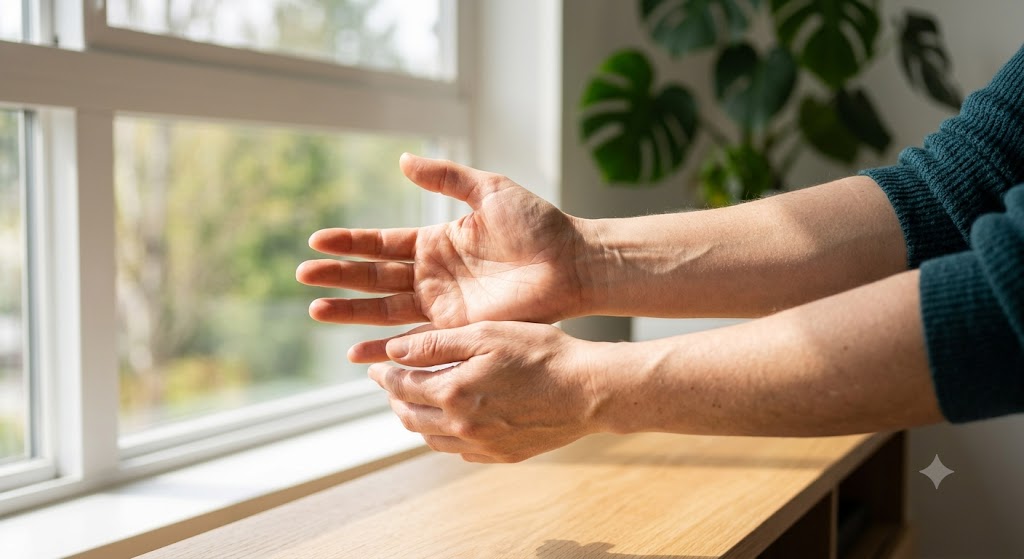
You wake up and your fingers feel like they belong to someone who slept in gloves. Making a fist is slow. Opening the hand feels rusty. Rings sit tighter. A few minutes of opening and closing, a warm tap, or the walk to the kettle and the stiffness usually thins out. By breakfast the hands look and feel like themselves again.
A brief morning “gel” in the fingers is extremely common. Most of the time it is not a diagnosis waiting to happen. It is what small joints do after hours without motion. Synovial fluid thickens when it sits still. Soft tissues cool and lose a little glide. Fluid that pooled in the hands overnight has not yet been pumped away. What matters is how long the rust lasts, whether both hands or one finger is involved, and whether true swelling, warmth, or night pain join the story.
What This Stiffness Feels Like
A typical benign morning-finger pattern is:
- A rusty, slow, “need to warm up” feeling in several fingers at once
- Tightness that is worst in the first minutes after waking
- Easier after you open and close the hands, make a fist, or run warm water
- Louder after a cold night, a still sleep posture, or a day of heavy gripping
- Not a locked finger that has to be snapped open with the other hand
- Not sausage-like swelling, heat, or redness that lasts through the morning
Clinicians sometimes call the short version the gel phenomenon. Verna Wright and colleagues who studied morning stiffness decades ago noticed that joints left still for a while feel more viscous until motion shears the fluid thin again. That is a mechanical property of synovial fluid and periarticular tissues, not a verdict on cartilage.
This is a different story from pins-and-needles that wake you at 3 a.m. or greet you when you first sit up. Overnight wrist flexion that compresses the median nerve is covered in Is It Normal for Your Hands to Tingle When You Wake Up?. A single finger that catches and then pops open is trigger finger at the A1 pulley, described in Is It Normal for Your Finger to Catch When You Bend It?. Whole-body morning joint rust that eases after a short walk is the broader pattern in Why You Wake Up Stiff Every Morning.
Why Still Joints Feel Thicker at Dawn
Finger joints are small, richly innervated, and packed with synovium. All day they get a continuous shear from typing, gripping, gesturing, and fidgeting. That motion keeps synovial fluid less viscous and keeps a thin film of hyaluronan moving across cartilage. Overnight the hands often rest in a loose fist or a slightly flexed posture. Motion drops toward zero for hours.
Synovial fluid is thixotropic. It behaves a little like ketchup in a bottle: it thickens when it sits and thins when it is sheared. Work on joint lubrication by Duncan Dowson, Charles McCutchen, and later hyaluronan researchers showed that warm, moving fluid is a better lubricant than cold, still fluid. After a still night the first few flexion cycles feel sticky. Then the fluid shears, local blood flow rises, and the rust fades.
There is also a small fluid shift. Lying down lets a little extra extracellular fluid settle in the hands and fingers. Rings feel tighter at dawn for the same reason they feel tighter on a hot afternoon, just from a different direction of pooling. Once you are upright and the hands are moving, the extra volume leaves.
Cooler bedroom air adds another layer. Distal joints lose heat faster than the torso. Cooler tissue is stiffer tissue. A warm tap or rubbing the palms together is not magic. It is temperature plus shear.
Desk Days, Grip, and a Night of Quiet Hands
Morning stiffness is often the last chapter of yesterday’s load. A long mouse day leaves wrist extensors and finger flexors shortened and a little swollen. Phone scrolling loads the thumb side. A weekend of gardening or a new kettlebell week leaves the same small joints asking for a longer warm-up the next morning.
Common amplifiers include:
- Sleeping with the hands curled tightly under a pillow or against the chest
- A cold bedroom or sleeping with the hands outside the covers
- A day of sustained grip — tools, a steering wheel, a heavy bag
- A day of sustained extension — mouse, laptop, piano
- Mild overnight swelling from salt, a long flight, or hormonal fluid shifts
- Osteoarthritis in a few finger joints that is quiet by afternoon but rusty at dawn
Office pointing and contact stress at the wrist often share the same week. That pattern is covered in Is It Normal for Your Wrists to Ache After Using a Mouse?. Thumb-side ache after scrolling is a related tendon load, described in Is It Normal for Your Thumb to Ache After Scrolling?.
Hidden Triggers That Make Morning Hands Louder
The same sleep can feel fine for months and then leave rusty fingers. Quiet contributors include:
- A colder week after a warm spell
- A new pillow that tucks the hands under the cheek
- A salty dinner or alcohol the night before, both of which can add a little distal puffiness
- A week of more typing than usual after a quiet stretch
- Under-using the hands all evening — screens instead of cooking, tools, or carrying
- Early osteoarthritis of the distal or proximal interphalangeal joints, which often speaks loudest after stillness
- A recent sprain or jammed finger that is still settling
Frederick Wolfe’s clinical work on morning stiffness in rheumatic disease is useful here for contrast, not for self-diagnosis. Inflammatory stiffness from rheumatoid arthritis tends to last much longer than a few minutes, often an hour or more, and comes with swelling, warmth, and fatigue. Brief rust that melts with movement is a poor match for that pattern. Josef Smolen and Daniel Aletaha’s work on classification of inflammatory arthritis likewise treats duration of morning stiffness as one clue among many — never as a standalone verdict from a rusty fist at 7 a.m.
When to Worry
See a clinician if morning finger stiffness comes with:
- Stiffness that lasts an hour or more every morning for weeks
- Visible swelling, heat, or redness of several joints
- Sausage-like swelling of a whole finger (dactylitis)
- Night pain that wakes you, not just rust when you first move
- Rapidly worsening grip weakness, dropping objects, or inability to make a fist
- A single hot, extremely painful joint (needs urgent exclusion of crystal or infection)
- Pits, nail changes, or a scaly rash that travels with the joint symptoms
- Morning stiffness plus unexplained weight loss, fever, or marked fatigue
One rusty morning after a cold night or a hard-grip day is not that list. Persistent, prolonged, inflammatory-looking change is.
Myths vs Facts
Myth: Morning finger stiffness always means rheumatoid arthritis. Fact: Most brief dawn rust is stillness, cooler tissue, and thicker fluid. Inflammatory disease has a longer duration and more swelling.
Myth: You should rest the hands completely until the stiffness is gone. Fact: Gentle motion is the treatment for gel. Complete rest keeps the fluid thick.
Myth: Cracking the knuckles will ruin the joints and cause the morning rust. Fact: The pop is usually cavitation. Large studies have not shown that habitual knuckle cracking causes arthritis.
Myth: If rings are tight in the morning, you are retaining dangerous amounts of fluid. Fact: A little overnight distal pooling is common. Sudden, painful, one-sided swelling is a different problem.
Myth: Warm water “cures” arthritis. Fact: Warmth and shear thin the morning gel. They do not reverse structural joint change. They do make the first hour kinder.
How to Manage Morning Finger Stiffness
You do not need a complicated routine. You need motion, a little warmth, and fewer all-night fists.
- Before you get out of bed, open and close the hands 20 times. Spread the fingers. Touch each fingertip to the thumb.
- Run warm — not scalding — water over the hands while you wash your face.
- Keep the bedroom from being icy on the hands. Gloves in bed are optional; tucking the hands under the covers is usually enough.
- Avoid sleeping with a tight fist under the pillow. A looser open-hand posture reduces both gel and overnight nerve compression.
- During the day, interrupt long mouse and phone blocks with fist-open cycles and a short hang or carry.
- If one finger catches rather than just feeling rusty, treat that as a pulley problem, not more of the same gel.
- After a heavy-grip day, a few minutes of gentle tendon glides in the evening reduce the next morning’s rust.
The goal is not perfectly silent joints at 6 a.m. The goal is rust that lasts minutes, not hours, and hands that work once they are warm.
When to See a Doctor
Book a visit if the stiffness lasts through the morning, if several joints look swollen, or if grip is fading. A primary-care clinician or rheumatologist can sort inflammatory arthritis, osteoarthritis, crystal disease, and overuse. Blood tests and imaging are tools, not the first sentence of every rusty-hand story. Bring a simple log: how many minutes the stiffness lasts, which joints, and whether swelling is visible. That timeline is more useful than a single tight fist on a cold morning.
Urgent care is for a single red-hot joint, rapidly spreading swelling, or a fever with an angry finger. Those are not “gel.”
FAQs
Is it normal for my fingers to feel stiff every morning? Yes, if the rust eases within minutes of moving. Nightly stiffness that lasts an hour or more deserves a look.
Why are my rings tighter when I wake up? A little fluid settles in the hands overnight. Upright time and motion usually bring the fit back.
Does cracking my fingers in the morning help? A gentle open-and-close is more useful than forcing a pop. The pop itself is usually harmless cavitation, not a reset button.
Can a cold bedroom make this worse? Yes. Cooler distal joints feel stiffer. Warmth plus motion is the usual fix.
Is this the same as trigger finger? No. Trigger finger is a catch-and-release of one tendon at the A1 pulley. Morning gel is a multi-joint rusty feel that thins with motion.
Could this be rheumatoid arthritis? Prolonged morning stiffness with swelling, warmth, and fatigue can be. Brief rust that melts with a warm tap usually is not. Duration and swelling decide, not fear.
Conclusion
Fingers that feel rusty at dawn are usually small joints that spent the night still, cool, and a little puffy. Synovial fluid thickens when it is not sheared. Soft tissues lose glide. A few minutes of motion and warmth typically bring the hands back. That is a mechanical morning, not a character flaw and not automatically a rheumatic disease.
Give the hands a brief wake-up, keep overnight fists loose, and interrupt the day’s grip and pointing with the same open-close the joints were built for. If the rust starts lasting the whole morning or the joints look swollen and hot, get it checked. Otherwise, the kettle and a few slow fists are doing what the night took away.