A painless click or pop when you turn your head is often joint cavitation or a tendon sliding over bone. Learn why it happens, when stiffness or dizziness changes the story, and how to keep cervical motion quiet and strong.
You look over your shoulder to change lanes, check a name on a whiteboard, or follow someone across a room — and your neck clicks. Sometimes it is a single clean pop. Sometimes it is a string of small cracks as you rotate. There is no stab of pain. The joint still moves. You just wonder whether the sound means something is wearing out.
For most people, a painless click when the head turns is a mechanical noise, not a diagnosis. Cervical joints, like knuckles and knees, can cavitate. Small tendons and the facet capsules can snap over a bony ridge after a still morning or a long screen session. The sound is common. What matters is whether motion stays free, whether pain or dizziness travels with the click, and whether the neck is being asked to live in one flexed posture all day.
What This Click Feels Like
Typical benign neck clicking is:
- A single pop or a short series of clicks at the end of a turn
- Painless, or only a brief “aware” sensation
- Easier to produce after sitting still, then quieter after you move
- Present on one side more than the other, or only in one direction
- Not followed by locking, weakness, or a spinning room
People often notice it while reversing a car, looking at a side monitor, stretching in a doorway, or rolling the head after a long call. The sound can feel loud inside your own skull because the joints sit close to the ear and the bones of the upper spine conduct vibration well.
A different pattern — grinding that never stops, a catch that blocks rotation, or a click that arrives with arm tingling or a drop-attack feeling — is not the same story.
Why a Neck Can Click Without Being Damaged
Several ordinary mechanisms make noise.
Cavitation in a facet joint. The small paired joints at the back of each cervical vertebra contain synovial fluid. When you rotate or side-bend quickly, the joint surfaces separate a fraction of a millimetre. Dissolved gas comes out of solution as a bubble and collapses. That collapse is the pop. Work on synovial joints by researchers including Unsworth and later Kawchuk showed that the sound is a rapid pressure change, not bone hitting bone. After a pop, that same joint usually will not recavitate for twenty to thirty minutes while gas redissolves.
A tendon or ligament sliding. The levator scapulae, splenius, and small suboccipital muscles change angle as the head turns. After hours of forward-head posture, a tendon can catch briefly on a transverse process or the posterior arch of the atlas, then snap free. The noise is drier than a cavitation pop and often repeats in the same few degrees of motion.
A stiff segment next to a mobile one. The seven cervical vertebrae do not share rotation equally. Desk flexion and a phone-down gaze tend to stiffen the mid-neck and ask C1–C2 to do extra turning. Extra motion at one level can click more than a well-shared turn.
Gas and fluid after stillness. Overnight and after long sitting, synovial fluid is cooler and a little more viscous. The first large rotations of the morning are the noisiest. Movement warms the fluid. That is why the click often fades by mid-morning if you actually use the range.
None of these mechanisms require arthritis on an X-ray. Crepitus — a finer, sandpaper quality — becomes more common with age and with prior sprain, but painless crepitus alone is a weak predictor of future disability.
Why Modern Days Make the Click Easier to Hear
Your neck still expects a moving horizon. Walking, talking face to face, and looking around a landscape spread rotation through the whole column. A day of screens does the opposite.
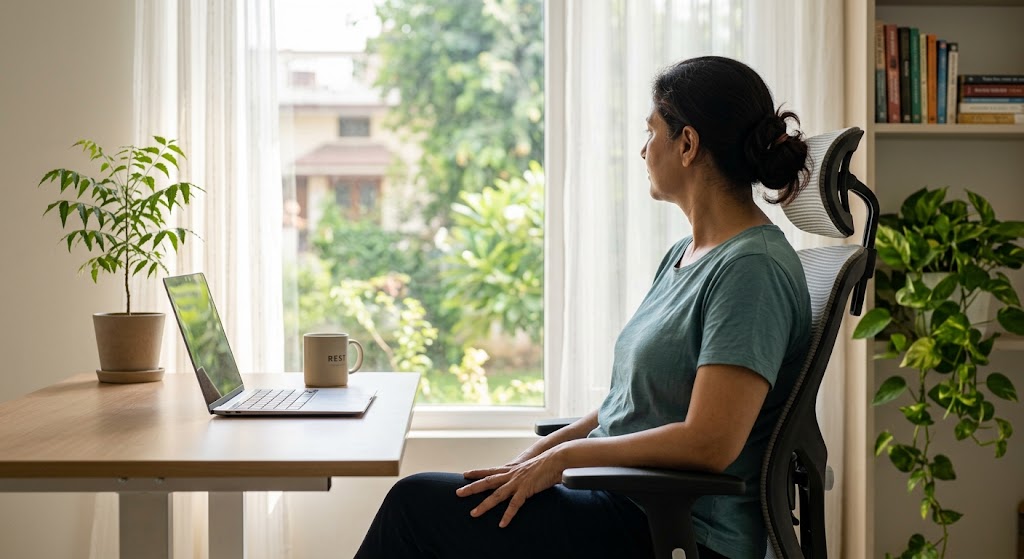
The head hangs a few centimetres forward. Deep neck flexors quiet. Upper trapezius and levator scapulae hold an isometric shrug. The facet joints sit in a slightly extended, compressed posture at the upper end and a flexed posture lower down. When you finally rotate to look at a colleague, the first free degrees happen in a joint that has been parked. That is a good recipe for a pop.
Phone flexion adds another layer. Holding a device in the lap shortens the posterior chain of the neck for minutes at a time. When you lift the head to look at traffic, the same joints that were compressed now open quickly. Related patterns show up in stiff necks after phone use and in desk-related shoulder tightness. The click is often the audible version of the same parked posture.
Shoulder popping on arm raise can share the same “unused range, then sudden slide” logic — a cousin of the cervical click rather than a separate disease. You can read that pattern in shoulder popping when you raise your arm.
Hidden Triggers That Make the Sound Louder
- Looking down at a laptop or phone for most of the day, then rotating suddenly
- Sleeping prone with the head cranked to one side
- A high, firm pillow that parks the neck in side-bend all night
- Clenching the jaw, which co-contracts the upper cervical muscles
- Cold rooms and morning stiffness before any warm-up rotation
- Carrying a bag on one shoulder and living in a slight head tilt
- Repeating the same “crack my neck” habit so the same joint is always the one that cavitates
Habitual self-cracking is usually not the cause of arthritis. It can, however, leave you feeling that the neck is “stuck” until it pops, which trains you to yank the same segment instead of sharing motion.
When a Click Is Not Just a Click
See a clinician promptly if neck noise travels with any of these:
- New spinning vertigo, especially when you look up or roll in bed
- Pain that shoots into the arm, with numbness or true weakness
- A click followed by the neck locking in one position
- Headache that is sudden, unlike your usual pattern, or worst of your life
- Trouble walking, clumsy hands, or electric shocks down the spine when you flex the neck (Lhermitte-type symptoms)
- Fever, unexplained weight loss, or a history of cancer or inflammatory arthritis
- Symptoms after a fall, collision, or sudden stop
Those features can point to nerve-root irritation, vascular issues, myelopathy, or fracture. Painless clicking without any of them almost never needs urgent imaging.
Anatomists including Bogduk mapped how cervical facet joints and the C2 nerve can refer pain to the head. That referred pattern is about pain, not about the pop itself. A click without pain does not mean the facet is “out.”
Myths vs Facts
Myth: Every neck click is bone grinding on bone.
Fact: Most single pops are gas cavitation or a soft-tissue snap. Bone-on-bone would hurt and usually grind rather than pop once.
Myth: If it clicks, you have early cervical arthritis that will fuse the neck.
Fact: Age-related disc and facet change is common on scans of people who never click and never hurt. Sound without pain is a poor crystal ball.
Myth: You should keep cracking the same spot so it “stays loose.”
Fact: Repeated end-range yanking on one segment can irritate the capsule. Spreading motion through the whole neck and the thoracic spine works better than chasing the pop.
Myth: A quiet neck is a healthy neck, so any sound is failure.
Fact: Joints make noise. Health is range, control, and the absence of neurologic red flags — not silence.
How to Make the Neck Quieter and Stronger
You do not need to stop turning your head. You need the joints to share the turn.
Raise the horizon. Lift screens so your gaze is closer to straight ahead. Hold the phone at chest height instead of in your lap. The less time the neck spends fully flexed, the less dramatic the first rotation feels.
Move before you yank. Before a long drive or a meeting, do five slow rotations each way, five chin tucks, and five gentle side-bends. Warm synovial fluid clicks less.
Share rotation with the upper back. Sit tall and turn the whole trunk a little when you look behind you. Thoracic stiffness forces the neck to do all the work. A few open-book rotations on the floor or doorway pec stretches help the mid-back contribute.
Train the deep flexors, not only the shrug muscles. A gentle chin tuck — lengthening the back of the neck without jutting the jaw — wakes the longus colli and capitis. Hold for five breaths. Do not chase a crack.
Change the night setup. A pillow that keeps the nose in line with the sternum beats a stack that side-bends the neck for eight hours.
Stop hunting the pop. If the joint wants to cavitate during a slow turn, let it. Do not add a thrust with your hands. The twenty-minute refractory period after cavitation is a hint that the joint already moved.
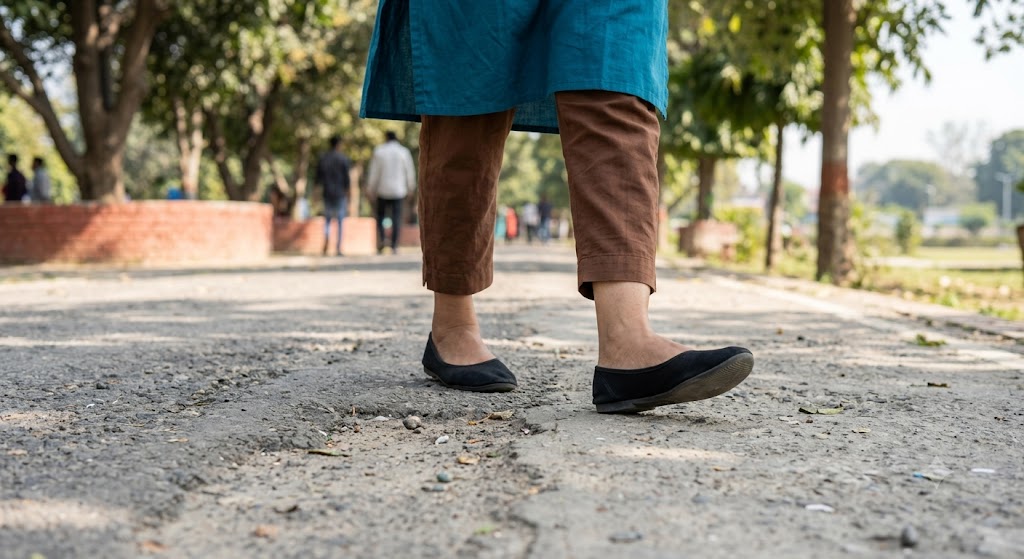
Walk with a turning gaze. Outdoor walking that includes looking at trees, signs, and people gives the cervical joints the varied end-range they were built for, without a treatment table.
When to See a Doctor
Book a visit if the click becomes painful, if rotation shrinks week by week, if arm symptoms appear, or if dizziness is more than a one-second light swirl. A clinician can sort facet irritation from radiculopathy and from the much rarer vascular causes of neck-motion dizziness. Physiotherapy that restores thoracic rotation and deep-flexor control often quiets both the stiffness and the noise.
Do not wait on progressive weakness, gait change, or a thunderclap headache.
FAQs
Is it normal for my neck to click every time I turn my head?
Yes, if the motion is free and painless. Many people have a “favourite” degree of rotation that pops after sitting. It often fades once you move more during the day.
Does cracking my own neck cause arthritis?
Large studies on knuckle cracking did not show a clear arthritis link, and cervical self-cracking has not been proven to wear joints away. It can still irritate a capsule and create a habit of needing the pop to feel “right.”
Why does it click more in the morning?
Fluid is cooler and the joints have been still. The first rotations change pressure quickly. After a walk and some gentle turns, the same motion is often silent.
Should I worry if only one side clicks?
Not by itself. Facet shape and muscle tightness are often asymmetric. Worry more if that side also hurts, goes numb, or loses range.
Can a neck click make me dizzy?
A painless pop should not spin the room. True spinning with position change is more often inner-ear BPPV than a facet noise. New dizziness with neck motion deserves an exam.
Will strengthening make the click go away?
Sometimes. Better deep-flexor endurance and thoracic motion reduce the sudden “catch-up” rotation that produces the sound. Strength will not silence every cavitation, and it does not need to.
Conclusion
A painless click when you turn your head is usually a facet joint releasing a gas bubble or a tendon sliding off a ridge after the neck has been parked in flexion. It is a common mechanical sound, not a verdict that the spine is failing. Raise the screen, share rotation with the upper back, warm the joints before you demand a full turn, and treat pain, locking, arm symptoms, or true vertigo as a different problem. Your neck was built to look around a moving world. Give it a horizon again, and the soundtrack often settles on its own.