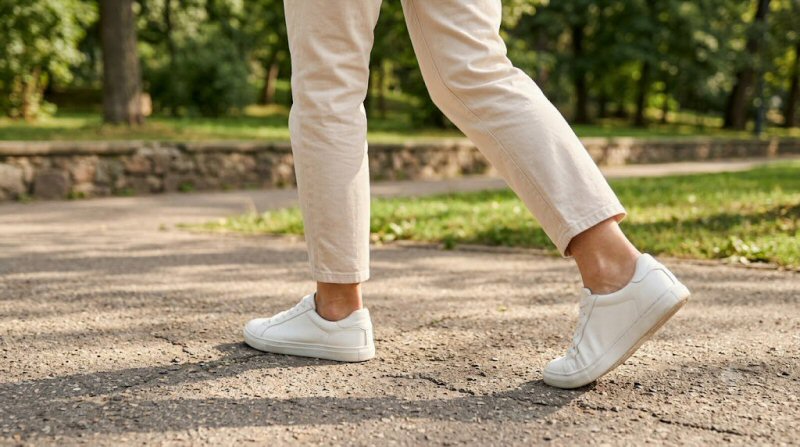
A painless click from a knee while you walk is often tendon glide, cavitation, or a plica folding after sitting — not automatically cartilage damage. Learn when the sound is benign and when to get it checked.
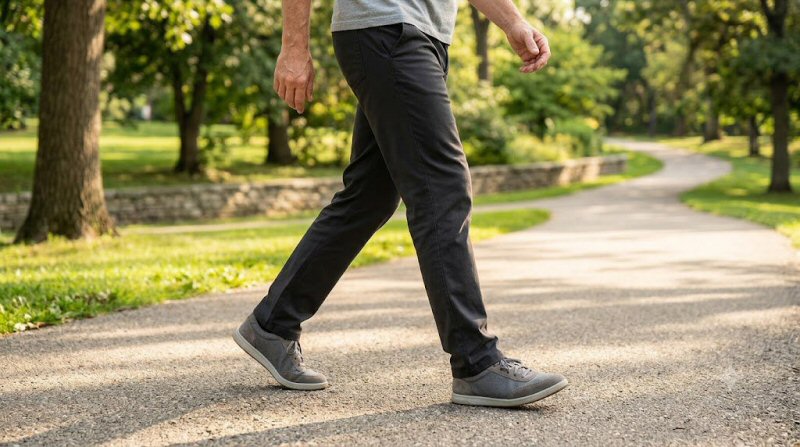
You stand up from a desk, take the first few steps down a hallway, and hear it: a small click, tick, or soft clunk from one knee as it swings through. Sometimes it is only the first stride after sitting. Sometimes you can feel a tendon skip on the outer side or a deeper pop under the kneecap. There is no sharp pain, the joint does not lock, and the next block of walking is quieter. Still, the sound is hard to ignore.
A painless knee click while walking is common. The knee is not a simple hinge. It is a rolling-and-gliding joint with a kneecap that tracks in a groove, two menisci that share load, several tendons that snap across the sides, and a fluid-filled capsule that has been parked in a chair for hours. When those parts start moving again, they can make noise. The sound is not, by itself, a diagnosis of “bone on bone” or a torn meniscus. What matters is whether the click comes with pain, swelling, giving way, or a catch that stops the step.
What This Symptom Feels Like
People describe it in a few overlapping ways:
- A single pop on the first step after a long sit
- A soft click on the outer knee as the foot leaves the ground
- A tick under the kneecap when the stride lengthens on stairs or a hill
- A fine grinding you can hear more than feel during a slow walk
- A click that is louder in the morning or after a cold commute with stiff joints
The sound often fades once the joint has moved through a few full ranges. Many people can reproduce it once after stillness and then cannot find it again until the next long stretch of sitting.
This is different from the louder sit-to-stand crack that happens as you rise from a chair — a pattern covered in our article on knees that crack when you stand up. Walking clicks tend to be smaller, more rhythmic, and tied to the swing or mid-stance of a step.
Common Causes
Most painless walking clicks fall into a short list.
Cavitation in the capsule. When you take the first strides after sitting, synovial fluid can form a brief gas bubble that collapses with a pop. Engineer A. Unsworth and later Gregory Kawchuk mapped this pattern in knuckles and other joints. The same physics applies at the knee. The joint is quiet for a short time afterward because the gas has to redissolve before another pop can form.
Tendon or band glide. The iliotibial band on the outer thigh and the hamstring tendons on the inner and outer sides can catch slightly on a bony ridge and then snap into line as the knee flexes and extends through a stride. After hours of sitting with the knee bent, the first few steps are a classic time for that skip. A similar extra-articular snap at the hip is described in our piece on hips that click when you walk.
Plica fold. A synovial plica is a leftover fold of lining inside the joint. Scott Dye and others have described how a medial plica can catch on the inner edge of the femur as the kneecap starts to track, then flip free with a click. After sitting, the fold is a little less mobile; the first walking cycles seat it.
Kneecap seating. The patella has to drop into the trochlear groove as you load the stance leg. After a long sit, the first few steps can let the cap slide a millimeter off-center and then snap into the groove. If that seating is painless and the cap does not grind through the whole stride, it is often tracking finding its path — not automatic cartilage wear.
Meniscus or fat-pad shift. The menisci move a little with each flex and extend. A mobile but intact rim, or the fat pad under the tendon, can fold and then flatten with a soft clunk. Pain, locking, or a true block of motion is a different story.
These mechanisms often stack. A flexed desk day plus a sudden brisk walk plus cold, thicker fluid is a classic recipe for one loud, painless click on the first block.
Why This Happens
Joints make less noise when they stay warm, well lubricated, and moving through their full range. Walking does that. Sitting does the opposite.
Nachemson-style load studies and later work on cartilage and synovial fluid show that stillness lets fluid settle and tissue cool. Hyaluronan in the joint fluid is shear-thinning: it flows better once you start moving. The first strides after a chair are the moment when a tendon, a fold, or a bubble is most likely to announce itself.
Modern life multiplies those first-stride moments. You sit for a meeting, stand, walk twenty meters, sit again. Each restart is a chance for a click. Flat indoor floors also reduce the small sideways and rotational demands that keep the band and cap tracking through varied angles — a theme that also shows up when ankles click on a walk.
Age changes the soundtrack a little. Fluid volume and cartilage surface change over decades. Crepitus — a more continuous sandpaper sound — becomes more common. Population work by Adam Culvenor and colleagues has shown that crepitus is frequent even in people without pain or radiographic osteoarthritis. Sound and structure are not the same measurement.
Less Common but Serious Causes
A minority of walking clicks are not just gas or a tendon skip:
- A torn meniscus that catches and then reduces with each step
- A loose body (a small cartilage or bone fragment) that clicks as it rolls
- Unstable kneecap tracking with true giving way
- Early inflammatory arthritis with morning stiffness that lasts more than an hour plus swelling
- Referred click from a snapping hip or ankle that you hear “at the knee”
These usually add pain, swelling, warmth, locking, or a sense that the joint will not trust a step. The sound alone does not make the diagnosis.
Hidden Triggers
A few everyday patterns make a walking click louder without meaning the joint is failing:
- Long sits with the knees bent past 90 degrees
- Crossing one leg so the top knee is twisted
- Cold commutes or air-conditioned offices that thicken joint fluid
- Sudden long strides after hours of short indoor steps
- Downhill or stair walking after a still morning (eccentric load on the cap)
- Shoes with a stiff sole that change how the tibia rotates under the femur
None of these prove damage. They change timing and viscosity.
When to Worry
Get a knee checked if any of these show up:
- The click is paired with sharp pain, swelling, or warmth
- The joint locks, will not fully straighten, or gives way
- You cannot trust the leg on stairs or uneven ground
- The sound started after a twist, squat, or sports injury
- Stiffness lasts more than an hour each morning and is getting worse
- One knee is rapidly changing size, color, or temperature
Painless, occasional, first-stride clicks that fade as you warm up are in a different category.
Myths vs Facts
Myth: A clicking knee means the cartilage is gone.
Fact: Painless clicks are often extra-articular (tendon or band) or cavitation. Imaging and symptoms have to match before anyone should talk about “bone on bone.”
Myth: If you can hear it, you should stop walking.
Fact: Walking is one of the better ways to warm synovial fluid and seat the kneecap. Stopping usually makes the next first-stride click louder.
Myth: Every click is a torn meniscus.
Fact: Meniscus tears that matter usually lock, swell, or hurt on a twist. Many intact knees click.
Myth: Oil supplements will silence the joint overnight.
Fact: Diet oils do not replace the shear-thinning effect of actually moving the joint.
How to Manage It
You do not need a complicated protocol for a painless walking click.
Warm the joint before you ask it for a long stride. A minute of easy marching in place, a few sit-to-stands, or a short indoor loop before you hit the pavement gives fluid time to flow.
Change the sit. Uncross the legs. Stand or walk for two minutes each half hour. Even a short loop to a window counts.
Use the full range later in the day. A few slow bodyweight squats to a comfortable depth, or sitting-to-standing from a slightly lower chair, reminds the cap and the plica how to travel.
Watch the first downhill. Stairs and slopes load the kneecap more. If clicks cluster there, shorten the step and use a rail for a few flights while the joint warms.
Keep walking. Varied terrain — a path, a gentle hill, a flight of stairs — is closer to what the joint expects than another hour in a chair. If stairs themselves make the front of the knee ache, that is a separate, load-related pattern described in our article on knees that ache going down stairs.
If a physical therapist or clinician has already given you a tracking or strength plan, the click is not a reason to abandon it.
When to See a Doctor
See a clinician if pain, swelling, locking, or giving way join the sound, if the click began after an injury, or if one knee is clearly changing. A good exam still starts with history and movement, not an automatic scan. Imaging is useful when the story and the joint do not match a benign first-stride click.
FAQs
Is a clicking knee while walking a sign of arthritis?
Not by itself. Arthritis is a pattern of pain, stiffness, and sometimes swelling over time. Many people with loud knees have quiet X-rays, and some people with worn cartilage walk quietly.
Why does it only click after I sit?
Stillness lets fluid settle and soft tissue rest in a flexed shape. The first strides reseat a tendon, a plica, or a gas bubble. After a few cycles the joint is usually quieter.
Should I wear a brace?
A sleeve can warm the joint and change proprioception. It does not fix a click and is optional. A tight brace that limits normal swing is not a long-term plan for a painless sound.
Can I keep running?
If there is no pain, swelling, or giving way, a gradual run after a walk warm-up is reasonable for most people. New pain on impact is the signal to back off and get advice.
Why is one knee louder than the other?
Slight differences in sitting habit, old sprains, shoe wear, and how the hip and foot share rotation are enough. Symmetry is not required for a healthy walk.
Will cracking it on purpose make it worse?
Forcing the joint into a click is unnecessary. Letting a natural stride produce one pop after sitting is not the same as habitually wrenching the knee.
Conclusion
A painless click from a knee while you walk is usually the joint waking up: a tendon skipping, a fold seating, or a brief bubble collapsing after a sit. The knee was built to roll, glide, and take steps, not to stay bent in a chair and then be judged by the first noisy stride. Treat the sound as information about stillness and warm-up, not as a verdict. Keep walking, vary the terrain when you can, and save the clinic visit for pain, swelling, lock, or a joint that no longer feels trustworthy.