Feeling your heart pound after a flight of stairs is common. Learn the normal physiology, how quickly it should settle, and the signs that need attention.
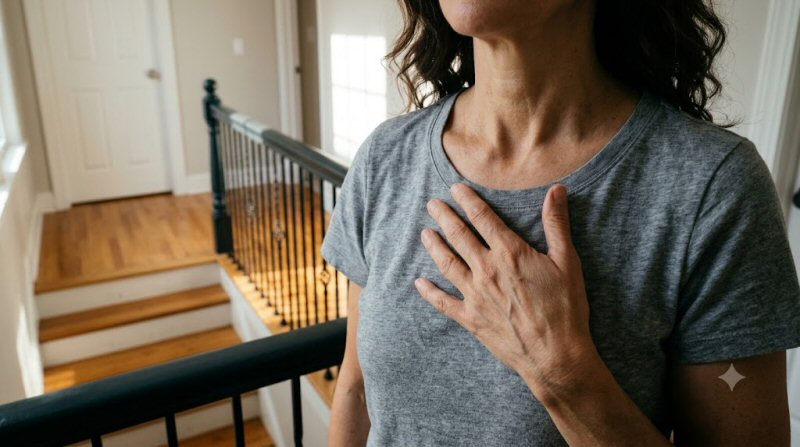
You reach the top of the stairs, stop for a second, and suddenly notice your heart thumping hard against your ribs. It feels faster than usual, maybe a little stronger, and for a moment you wonder if something is wrong. For most people this is an ordinary response. Climbing stairs asks your body to work against gravity in a short burst, and your heart answers by speeding up to deliver more oxygen-rich blood to the working muscles.
The sensation usually fades within a minute or two once you stop. That quick recovery is one of the clearest everyday signs that the system is doing what it was built to do.
What This Sensation Feels Like
Most people describe a rapid, pounding beat that starts during the climb and peaks just as they reach the landing. It can feel stronger than a normal resting pulse, sometimes noticeable in the chest, neck, or even the ears. Breathing often quickens at the same time. The whole episode is short-lived for a healthy person; the rate begins to drop as soon as the effort ends.
It is different from a resting tachycardia that appears for no clear reason, and different from the lightheaded feeling some people get simply from standing up quickly.
Common Causes
The main driver is simple physiology. Your leg and hip muscles need a rapid increase in blood flow when you lift your body weight step after step. The heart meets that demand by raising both rate and stroke volume. Cardiologist Marc Eisenberg has noted that the heart rate rises specifically to push more blood to the muscles required for the effort. Fitness level changes how dramatic the rise feels: people who climb stairs regularly usually see a smaller jump and a faster return to baseline. Dehydration, a warm room, caffeine, or a recent large meal can make the same stairs feel harder and the heart rate higher. Anxiety about the sensation itself can add a second, smaller bump once you notice it.
Why This Happens
Stair climbing is essentially a brief, vertical workout. Muscle oxygen demand rises quickly, sympathetic nerves release catecholamines, and the sinus node accelerates the heart. Researchers studying stair ascent have measured heart rates climbing well into the moderate-to-vigorous zone even for a few flights. A related observation, sometimes called the Bowditch staircase phenomenon, describes how successive beats can become stronger as rate increases, helping the heart move more blood per minute.
Once you stop, parasympathetic tone returns and the rate falls. Heart-rate recovery studies that use stair climbing as a natural test show that a healthy drop usually begins within the first minute. If your heart is still racing hard five or ten minutes later after only one or two ordinary flights, the recovery signal is slower than expected.
This response is closely related to the same systems that adjust when you stand up or start walking. You can read more about the sinus node’s preference for ordinary movement in our piece on why your sinus node still expects a walk, and about the blood-flow changes that can cause lightheadedness on standing in is it normal to get lightheaded when you stand up.
When to Worry
A fast heart that settles within a couple of minutes after ordinary stairs is usually benign. Pay attention if the racing continues well beyond five minutes, if you feel chest pressure or pain, if you become markedly short of breath, dizzy, or faint, or if the same short climb leaves you exhausted for a long time afterward. New or worsening symptoms, a history of heart disease, or a resting rate that is already high are also reasons to check with a clinician. Occasional skipped beats during the recovery period are common and usually harmless; persistent irregular rhythms are not.
Myths vs Facts
Myth: A racing heart after stairs always means poor fitness or hidden heart disease.
Fact: Even fit people notice the rise; the size of the jump and the speed of recovery matter more than the peak itself.
Myth: You should never let your heart rate climb above a certain number on stairs.
Fact: Short bursts into the moderate-to-vigorous range are normal and can be beneficial when recovery is prompt. The American Heart Association notes that resting rates of 60–100 bpm are typical; exercise rates are expected to be higher.
Myth: If it feels strong, it must be dangerous.
Fact: Stronger beats at higher rates are part of normal cardiac mechanics (the staircase phenomenon). The concerning features are prolonged duration or accompanying symptoms.
How to Manage It
Stay hydrated and avoid climbing immediately after a heavy meal if the pounding bothers you. Build the habit gradually: a few flights most days improves the heart’s efficiency so the same stairs later produce a smaller response. Slow your pace on the first few steps if you have been sitting a long time. After you reach the top, stand still for a minute and notice the rate falling; that observation itself is reassuring. Regular walking or other aerobic activity outside of stairs further improves recovery speed. If the sensation is new or worrying, a simple check of resting heart rate and a conversation with a clinician can rule out less common causes.
FAQs
How high is a normal heart rate after climbing one or two flights?
Most healthy adults see a rise into the 100–140 bpm range during the climb, depending on age, pace, and fitness. The exact number matters less than how quickly it comes back down.
Should my heart still be racing five minutes later?
After ordinary stairs it should have dropped substantially within one to two minutes and be close to baseline by five minutes. Persistent racing is worth mentioning to a doctor.
Can dehydration or caffeine make it worse?
Yes. Both can raise the starting rate and make the same effort feel more demanding, so the peak is higher and recovery a little slower.
Is this the same as POTS?
Postural orthostatic tachycardia syndrome involves an exaggerated rise mainly with standing still, often with other symptoms. A rise only during actual stair climbing that settles promptly is ordinary physiology, not POTS.
Will getting fitter stop the pounding completely?
It will make the rise smaller and the recovery faster, but a noticeable increase with stairs is still normal even in trained people. The heart is supposed to respond to sudden demand.
Conclusion
A heart that races after climbing stairs is, for the great majority of people, simply the cardiovascular system meeting a brief increase in oxygen demand. The key everyday clue is recovery: the rate should begin falling within a minute or two once you stop. Paying attention to that pattern, staying reasonably active, and noting any accompanying symptoms keeps the response in its proper place—as a normal, useful signal rather than a cause for alarm.