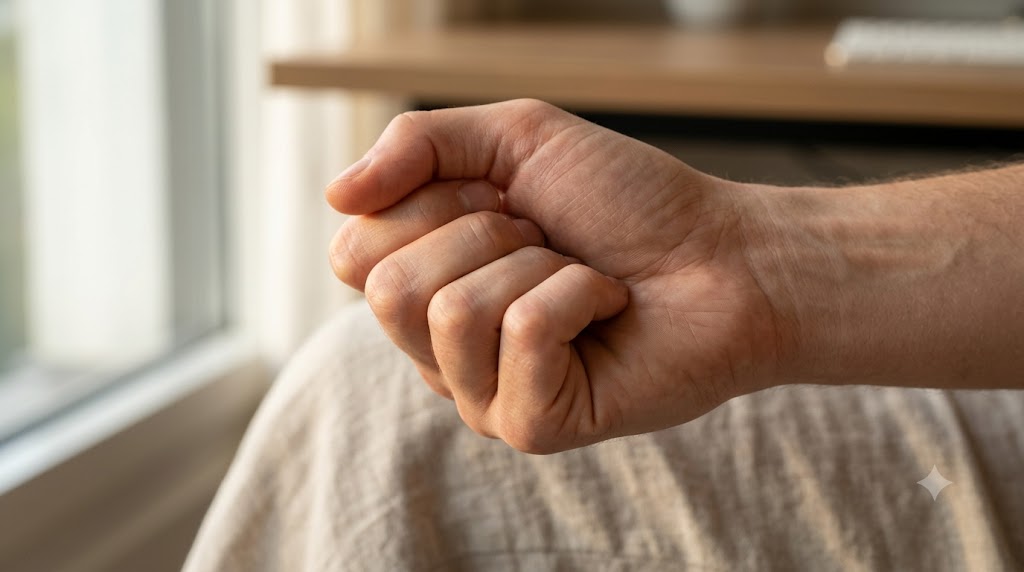
You start a fist and one finger hesitates. It catches halfway, then snaps through with a small pop. Sometimes it locks bent and you have to pull it straight with the other hand. The palm just proximal to the finger may feel tender, as if a pea is sitting under the skin.
That pattern has a name older than most clinic apps. In 1850 the French surgeon Alphonse Notta described a nodule on a flexor tendon that could not pass smoothly under a pulley at the base of the finger. Later surgeons called the condition trigger finger or stenosing tenosynovitis. Quinnell graded how badly the tendon catches. The joint is usually innocent. The problem is a cable and a tunnel.
A painless, occasional catch after a heavy gripping week is common and often settles when you stop repeating the same pinch. A finger that stays locked, a hot swollen palm, or catching that started after a wound is a different letter.
What This Symptom Feels Like
Typical trigger-finger language is mechanical, not vague ache.
- A catch or click as the finger flexes or extends, often at the same point in the arc
- A snap that you can feel more than hear
- Morning stiffness that eases after a few slow bends, then returns with tools or a phone
- A small, tender nodule in the palm at the distal palmar crease, in line with the affected digit
- The ring finger, thumb and middle finger most often; the little finger and index less often
- Sometimes the finger locks in flexion and needs the other hand to open it
- Pain more at the palm pulley than at the knuckle itself
What it usually is not, on its own: a finger “out of joint,” a broken bone, or an infection. The metacarpophalangeal joint can look a little swollen because the tendon bundle is bulky underneath. The joint line is not the primary site.
What Is Actually Catching
Each finger flexor tendon runs through a fibro-osseous tunnel held by pulleys. The A1 pulley sits over the metacarpophalangeal joint in the palm. It keeps the tendon from bowstringing when you make a fist.
Tendons are not dry rope. They glide in a thin synovial sheath. Repeat compression, a metabolic change in the pulley, or a small nodule on the tendon — Notta’s node — makes the cable too wide for the tunnel at one spot. The tendon jams under the A1 pulley on the way in or out. When the force finally wins, it pops through. That pop is the “trigger.”
Quinnell’s classic grades still help in clinic:
- Normal smooth glide
- Uneven movement without a lock
- Clicking that you can actively overcome
- Locking that you can unlock with the other hand
- A finger locked in flexion or extension that you cannot free
Ryzewicz, Wolf, Makkouk and others later reviewed the same anatomy with ultrasound and histology. The pulley thickens. The tendon can show a nodule or a fusiform swelling. The sheath may look irritated. The story is stenosis plus a mismatch of diameter, not a joint that slipped.
Diabetes, thyroid disease, rheumatoid arthritis and a recent spike in grip load raise the odds. Women in midlife see it more often than young men. The thumb’s flexor pollicis longus has its own A1 pulley and triggers in the same way.
Why a Modern Hand Meets This Tunnel More Often
The pulley system evolved for varied grip: hanging, pinching, twisting tools, opening, closing, rest. It did not evolve for eight hours of the same diameter — a mouse, a phone edge, a steering wheel, a scanner gun — with the tendon always under the same A1 angle.
Fingers still expect texture and tools, not only glass. Hands lost a varied daily workout and gained a narrow one. Tendons still expect gradual loading; a sudden week of pruning, gaming or new weights is a classic trigger-finger week because the A1 pulley sees a step-change in cycles before the tendon and pulley have adapted.
Metabolic context matters too. Higher circulating glucose changes collagen cross-linking and pulley compliance. That is one reason diabetes and trigger finger travel together in hand clinics, not because sugar “clogs” the tendon like grease in a pipe.
Common Causes and Hidden Triggers
Repeat power grip and pinch. Tools, weights, a phone held in one posture, a steering-wheel death grip, a new baby carried in the same arm.
A sudden load spike. The first week of a gym program, a garden weekend, a move.
Diabetes and metabolic syndrome. Stiffer collagen, more pulley thickening.
Hypothyroidism and rheumatoid or other inflammatory disease. Synovium that already swells has less room in the tunnel.
Local steroid or a prior procedure nearby is uncommon as a cause, but scar can narrow a sheath.
Occupational vibration and cold can add tendon irritation, though they are not the main story for most desk-and-phone cases.
Hidden triggers are often small: sleeping with a flexed fist, a too-small tool handle, a thumb drive-clicking all afternoon, carrying grocery bags with flexed fingers instead of a flat palm hook.
Less Common but Serious
Most catching fingers are trigger finger. A few patterns are not.
- A hot, red, exquisitely tender finger with fever can be infectious flexor tenosynovitis — Kanavel’s signs — and is urgent
- A locking finger after a laceration may be a partial tendon laceration catching on a pulley
- Sudden inability to extend after a jam can be a sagittal-band or extensor injury, not a flexor trigger
- Multiple triggering digits plus morning joint stiffness in many joints raises inflammatory arthritis
- A painless locked finger in a child can be pediatric trigger thumb; the timetable and treatment differ
- Numbness in the same fingers with night waking is more median nerve at the wrist than A1 pulley — though the two can coexist
When to Worry
Seek care promptly if:
- The finger will not unlock
- Redness, heat, spreading swelling or fever appears
- Catching followed a cut, bite or puncture
- Several digits trigger in weeks and other joints are stiff and swollen
- You have diabetes and the palm nodule is growing or the finger is losing motion
- Weakness, not just a catch, is the main complaint
A single painless morning catch that eases after coffee and a few slow fists can wait a few days of load change. A locked digit should not wait for “it to work itself out” for weeks.
Myths vs Facts
Myth: The finger is out of joint and needs to be cracked back in.
Fact: The joint is usually seated. The tendon is jamming under a pulley.
Myth: You caused it by cracking your knuckles.
Fact: Knuckle cavitation is a different structure. Trigger finger is pulley and tendon.
Myth: Resting the hand in a fist overnight will “stretch it out.”
Fact: A flexed sleep fist keeps the nodule on the wrong side of the pulley. A night splint that keeps the MCP joint closer to extension is the usual conservative logic.
Myth: If it clicks it must be arthritis.
Fact: Osteoarthritis lives in the joint. Trigger lives in the flexor sheath. They can overlap in midlife hands; they are not the same lesion.
Myth: Surgery is inevitable.
Fact: Activity change, a brief splint, and sometimes a pulley-region corticosteroid injection resolve a large share of Quinnell grade 2–3 cases. Release of the A1 pulley is reserved for persistent locking.
How to Manage It
This is not medical advice for a locked or infected finger. It is the conservative pattern hand clinics have used for ordinary triggering.
Change the cycle, not only the stretch. Reduce the repeated pinch for one to two weeks. Use a larger handle. Switch hands. Put the phone down. Let the pulley see fewer identical cycles.
Keep the tendon gliding, gently. Slow, full, pain-limited fists and hook fists a few times a day keep the nodule from parking permanently proximal or distal to the pulley. Do not force a locked digit through.
Night position. A simple MCP-blocking splint that keeps that joint nearer extension while allowing IP motion is a common first tool. The aim is to stop sleeping in a clenched fist.
Load the hand in other ways. Open-hand carrying, hanging if shoulders allow, and varied texture keep the rest of the kinetic chain from rusting while the A1 pulley calms down.
Treat the metabolic background. If you have diabetes, glucose control is part of the hand’s briefing, not a separate project.
Know the next rungs. A short-acting steroid placed around the A1 pulley, done by someone who knows the digital nerves, helps many adults. Percutaneous or open A1 release is a small, well-studied operation when locking persists. The tendon still needs gradual loading afterward.
When to See a Doctor
See a clinician — primary care, a hand therapist, or a hand surgeon — if the catch lasts more than a couple of weeks, if the finger locks, if the palm nodule is enlarging, or if you have diabetes, rheumatoid disease or a recent injury. Urgent care is for heat, fever, a puncture, or a finger you cannot open.
Bring the story in mechanical language: which digit, whether it locks, whether you can unlock it, what you were gripping in the weeks before it started. That history is often enough to separate trigger finger from joint arthritis and from nerve compression.
FAQs
Is a catching finger the same as a trigger finger?
Usually yes, when the catch is at the same point in flexion or extension and a palmar nodule sits over the A1 pulley. A catch at the fingertip or at the wrist is a different pulley or a different diagnosis.
Why is it worse in the morning?
Overnight the hand often rests in flexion and fluid sits in the sheath. The first few glides have to push a slightly swollen tendon under a thickened pulley. Motion and warmth reduce the mismatch for a while.
Can I just stretch it out?
Gentle tendon-glide is useful. Yanking a locked finger straight can irritate the sheath and, rarely, injure the tendon. Unlock slowly or have a clinician help.
Does cracking the knuckle make trigger finger?
No. The pop of a knuckle is usually cavitation in the joint. The pop of a trigger is a tendon leaving or entering a tight A1 pulley.
Which fingers get it most?
Ring, thumb and middle. Index and little less often. Multiple digits raise the chance of a systemic contributor such as diabetes or inflammatory disease.
Will an injection fix it permanently?
Many people get months to years of relief from one pulley-region steroid injection, especially early. Recurrence happens. Repeat injections have diminishing returns and a small risk to tendon and skin. Persistent locking often moves to pulley release.
Is trigger thumb in a toddler the same disease?
Pediatric trigger thumb is a related pulley-tendon mismatch, often with a Notta node, but the natural history includes a real chance of spontaneous resolution in young children. Do not copy adult injection timetables onto a toddler without a pediatric-hand opinion.
Can I keep lifting weights?
Often yes, if you shrink grip diameter, avoid a full locked-finger hanging week, and keep the triggering digit out of a painful snap. Painful triggering through a session is not “working through it.” It is more stenosis cycles.
Why do I also have tingling at night?
Carpal tunnel and trigger finger coexist more than chance in midlife and in diabetes. Night tingling in thumb, index and middle is median-nerve territory. Treat both stories; freeing the A1 pulley does not decompress the carpal tunnel.
Is surgery a big operation?
A1 pulley release is usually a brief outpatient procedure. The work afterward is tendon glide and gradual grip, not a long immobilization. Infection, nerve irritation and bowstringing are uncommon when the release is limited to A1.
Conclusion
A finger that catches when you bend it is usually a tendon meeting a thickened A1 pulley — the lesion Notta saw as a node and Quinnell later graded — not a knuckle that slipped out of place. Varied grip, fewer identical pinch cycles, a night that does not clench, and early care for a locked digit give the cable and the tunnel a chance to match diameters again. The hand was built to close and open many ways. It was not built to live in one handle size.