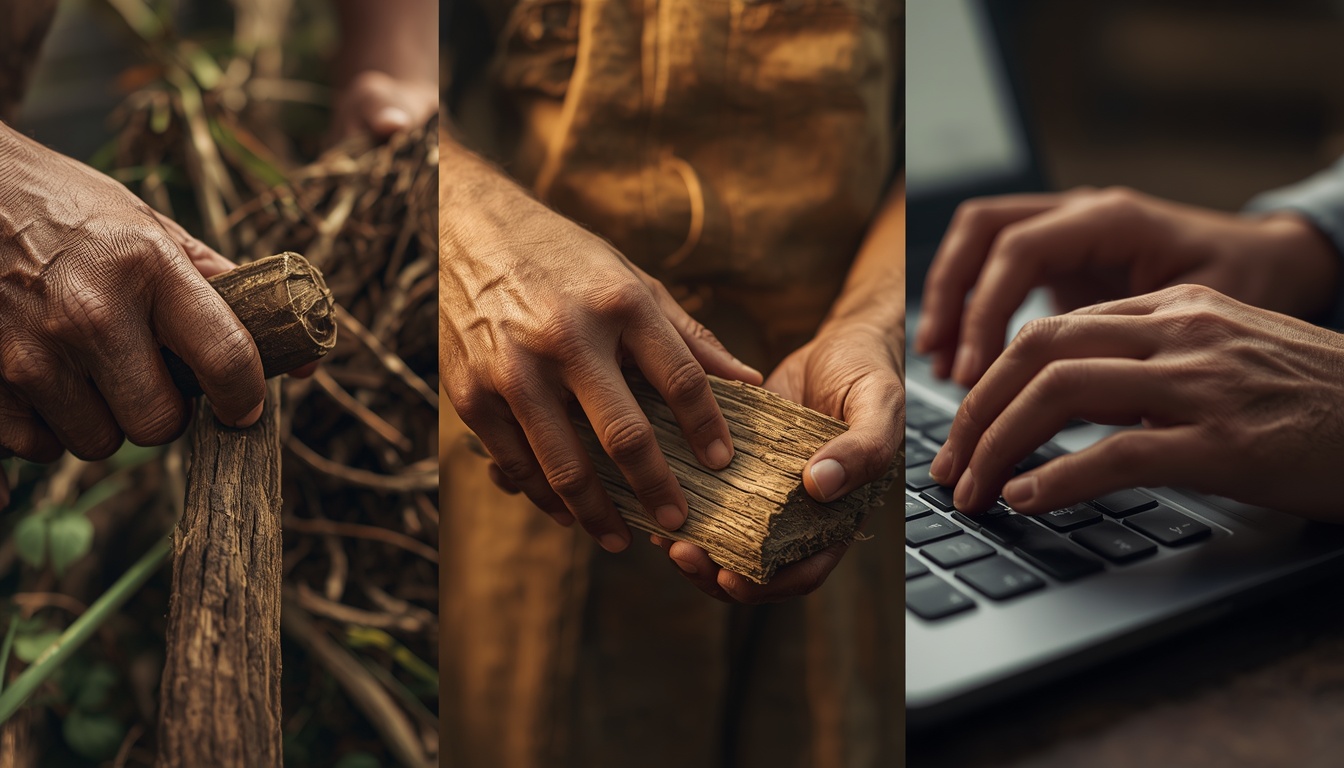
For most of human evolutionary history, the hands were among the most heavily worked parts of the body. They gripped rough tools, processed tough foods, climbed, carried loads, scraped, twisted, and stabilized in countless varied ways every day. That constant mechanical loading shaped not only muscle and tendon strength but also bone density, joint resilience, and the rich sensory feedback that makes skilled manipulation possible.
Today those demands have largely vanished for many people. Keyboards, touchscreens, soft plastic grips, and powered tools replace forceful, varied hand use with light, repetitive, low-load movements. Grip strength has declined measurably across recent generations. Proprioception and endurance in the hands and forearms receive far less training. Certain overuse problems and degenerative changes appear earlier or more frequently.
Declining grip strength is not only a story of aging or individual inactivity. It also reflects the near-disappearance of the physical demands human hands evolved under.
What the Loss of Loading Feels Like
Many people notice weaker grip when opening jars, carrying grocery bags, or hanging from a bar. Others experience earlier fatigue in the hands and forearms during tasks that once felt ordinary, reduced dexterity under fatigue, or a vague sense that the hands are less “capable” than they should be. Wrist and hand discomfort from repetitive light work is common, even while overall forceful capacity remains under-trained.
Grip strength itself has become a widely used marker of overall health and biological age. Lower values correlate with higher risk of functional decline and certain health outcomes later in life. Part of that signal is general fitness; part of it tracks the specific loss of the mechanical environment hands were built to inhabit.
How Hands Were Shaped by Daily Work
The human hand is a derived structure optimized for both power and precision. Relative thumb length, joint orientations, muscle architecture, and tendon arrangements support forceful precision grips and power grips that other primates use less effectively or less often. Fossil and experimental evidence links many of these features to the stresses of tool making and tool use over hundreds of thousands of years.
Daily life in ancestral and traditional settings kept those capacities trained. Processing food, working wood or stone, carrying children or resources, climbing, and using handheld tools produced repeated high loads across a wide range of joint angles and grip types. The result was not only stronger muscles but thicker cortical bone in key areas, robust connective tissue, and highly tuned sensory discrimination.
Grip strength in populations still engaged in heavy manual work remains higher, on average, than in sedentary office-based groups. The difference appears early; studies comparing recent generations of young adults have documented noticeable drops in average grip strength within a few decades as manual demands declined.
What Modern Hand Use Changed
Contemporary environments invert the loading pattern:
- Low-force, high-repetition movements. Typing, swiping, and clicking demand precision and endurance at very low absolute forces.
- Soft, uniform grips. Tool and device handles are designed for comfort rather than the varied, high-friction, high-force demands of natural materials and traditional tools.
- Reduced variety. The hands spend long periods in similar postures and grip widths instead of constantly changing shape and load.
- Powered assistance. Many tasks that once required sustained grip and forearm strength are now performed by machines or levers.
- Early specialization. Children and adults may spend hours daily on devices while receiving little forceful or varied manual play and work.
The hands still possess the anatomical capacity for strength and skill. They simply receive far less of the stimulus that once maintained it.
Consequences Beyond Simple Weakness
Under-loading has several downstream effects:
- Reduced grip strength and endurance. The most direct and measurable outcome.
- Diminished proprioception and sensory acuity. Skilled force control and object discrimination improve with varied, attentive use; they decline with under-use.
- Altered tissue resilience. Tendons, ligaments, and joint surfaces adapt to the loads they experience. Chronically low loading can leave them less prepared for sudden higher demands.
- Overuse in the wrong pattern. Light, repetitive movements performed for hours can irritate tissues that lack the robustness produced by broader loading, contributing to common wrist, thumb, and elbow complaints.
- Loss of a whole-body signal. Grip strength is a convenient proxy for overall musculoskeletal condition. Its decline tracks broader reductions in physical capacity.
These changes interact with aging. Hands that enter later decades already under-trained have less reserve when age-related loss of muscle and connective-tissue quality begins.
Common Drivers and Hidden Triggers
Factors that accelerate the loss of hand capacity include:
- Predominantly screen- and keyboard-based work
- Minimal carrying, climbing, or tool-based activity in daily life
- Children’s environments that emphasize devices over varied manual play and outdoor physical tasks
- Over-reliance on tools and packaging that require almost no grip force
- Neglect of intentional grip and forearm training even among people who exercise
- Injuries or pain that lead to further protective under-use
Less obvious is the cultural shift that treats strong hands as optional rather than expected. In environments where most objects are designed for minimal effort, the feedback loop that once maintained strength disappears.
When to Pay Closer Attention
Consider the role of under-loading if you notice:
- Difficulty with jars, bottles, or bags that once felt easy
- Rapid forearm fatigue during ordinary tasks
- Declining performance in activities that require sustained grip
- Early onset of repetitive-strain symptoms despite relatively light work
- A large gap between dominant and non-dominant hand strength that has widened over time
- Children or adolescents with notably low grip strength relative to body size
These signs often respond well when varied, progressive loading is restored.
Myths vs Facts
Myth: Grip strength decline is purely an inevitable part of modern aging.
Fact: Large differences exist between populations and generations with different manual demands. Age interacts with lifelong loading history.
Myth: Office work and light daily activity are enough to maintain functional hand strength.
Fact: The forces involved are typically far below those that built and maintained ancestral and traditional hand capacity.
Myth: If you don’t feel pain, hand strength doesn’t matter.
Fact: Grip strength is a marker of broader resilience. Low values predict functional limitations even before local pain appears.
Myth: Special grip gadgets are the main solution.
Fact: Varied real-world loading — carrying, hanging, tool use, climbing, and progressive resistance — trains the hands more completely than isolated squeezes alone.
Myth: Only athletes or manual workers need strong hands.
Fact: Basic grip capacity supports independence in daily life at every age, from opening containers to preventing falls and maintaining overall physical function.
Practical Ways to Give Hands Their Workout Back
The goal is progressive, varied loading rather than punishment:
- Carry things deliberately: grocery bags, a backpack, or a suitcase instead of always using wheels or making multiple light trips.
- Hang from a bar or sturdy branch for short periods; build toward longer holds and varied grips.
- Use hand tools for household and garden tasks that machines or services usually handle.
- Incorporate farmer carries, towel pulls, or thick-grip work into existing training.
- For desk workers, add short daily sessions of progressive grip work (squeezes, extensions, wrist movements) and frequent breaks that open and load the hands differently.
- Encourage children to climb, dig, build, and handle varied objects rather than spending all free time on screens.
- Address pain early so protective under-use does not become permanent.
Start within current capacity and progress gradually. Tendons and connective tissues adapt more slowly than muscles.
When to Seek Professional Guidance
Persistent pain, numbness, tingling, visible swelling, or sudden loss of strength warrant evaluation. A clinician or hand therapist can distinguish simple under-use from nerve compression, tendon problems, joint issues, or other conditions. After injury or surgery, guided rehabilitation is essential before returning to heavier loading.
People with arthritis or connective-tissue disorders need individualized advice on safe loading ranges.
Frequently Asked Questions
How much has grip strength actually declined?
Studies comparing young adults across recent decades have found reductions on the order of 10–20% or more in some cohorts, with larger gaps when comparing highly sedentary groups to those still engaged in manual work.
Is grip strength training enough on its own?
It helps, yet varied real-world use — different objects, angles, and durations — develops more complete capacity and proprioception than isolated grip work alone.
Do women and men experience the same mismatch?
Both are affected by reduced manual loading. Absolute strength differences exist, but the relative loss of ancestral-type demands applies across sexes.
Can older adults still improve grip strength?
Yes. Progressive loading produces meaningful gains at any adult age, improving function and resilience even if peak youthful values are not recovered.
Does this relate to the posture and foot articles?
Yes. The same principle of under-loading applies across the musculoskeletal system. Hands, feet, and the trunk all adapted to higher and more varied mechanical demands than most modern lives provide.
Conclusion
Human hands were refined over evolutionary time for forceful, skilled, varied work. They maintained their strength, resilience, and sensory precision through daily use that modern life has largely eliminated. Keyboards and screens demand dexterity at the cost of load; soft grips and powered assistance remove the very stresses that once kept tissues robust.
The quieter hands of the present are not a sign of inevitable decline so much as a sign of missing stimulus. Restoring some of that stimulus — through carrying, hanging, tool use, climbing, and deliberate progressive work — does not require returning to a pre-industrial existence. It simply gives the hands a version of the daily workout they were built to expect. Strength, confidence, and resilience in the hands remain trainable long after the original environment has changed.