
A sore big toe after a long walk is usually push-off load in a narrow shoe, not a broken joint. Wider toeboxes and shorter strides settle most of it.
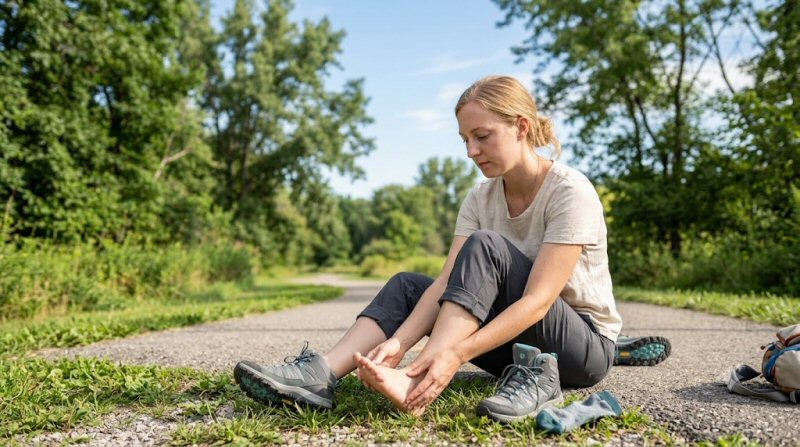
The walk felt fine for the first hour. Then the inside of the forefoot started to complain, and by the time the shoes came off the big toe joint was hot, stiff, and unwilling to bend. It is an ordinary complaint after a long day on hard paths, and it is easy to misread as a sprain or the start of a bunion. Most of the time it is the first toe doing the job it was built for, under shoes and surfaces that make that job harder than it needs to be.
The big toe, the hallux, is not a spare digit. During the last part of a step it takes a large share of body weight and has to bend upward so the foot can roll off. John Hicks described the windlass mechanism: as the toe extends, it tightens the plantar fascia and raises the arch, turning a flexible foot into a stiffer lever. Finn Bojsen-Møller mapped how that push-off uses the first ray, the chain from the big-toe bones back into the midfoot. A long walk simply repeats that lever thousands of times.
What This Ache Feels Like
The usual spot is the ball of the foot under the big toe, or the joint itself where the toe meets the foot. Some people feel it along the inner edge of the toe. It is often dull during the walk and sharper when the shoe comes off and the toe is bent. The joint can look a little puffy. The skin may be red if the shoe rubbed. Morning stiffness the next day is common and usually eases after a few steps.
A related pattern is pain under the two small bones beneath the joint, the sesamoids, which act like a kneecap for the toe. That ache sits more under the ball than on top of the joint. A numb or tingling toe is a different story, closer to a squeezed digital nerve than to push-off load. That pattern is covered in the piece on toes going numb in tight shoes.
The ordinary walk ache is worse on the longer foot if one shoe is slightly short, worse in downhill sections where the toes jam forward, and worse the day after a sudden jump in distance. It should not come with fever, a joint that will not bear any weight, or pain that wakes you from sleep for nights on end.
Why the First Toe Takes the Load
Gait studies put peak pressure under the big toe and the first metatarsal head near the highest values anywhere on the sole during late stance. The toe has to extend, often toward 50 to 60 degrees or more in a brisk walk, while the calf pushes the body forward. If the shoe will not allow that bend, the joint grinds at the end of its available range instead of rolling through it.
Michael Coughlin and Roger Mann’s work on forefoot disorders made the shoe part of this plain. A toe box that tapers, a sole that does not bend where the joint bends, and a heel that pitches the foot forward all crowd the hallux. Hylton Menz’s population studies of older walkers found big-toe deformity and limited dorsiflexion tightly linked with foot pain and with the shoes people had worn for years. The joint does not need a dramatic injury. It needs repetition in a shape it cannot quite finish.
Hard, flat pavement adds another layer. The foot cannot sink and share load the way it does on dirt. Daniel Lieberman’s work on barefoot and minimally shod walking has argued that modern stiff, cushioned shoes change where the foot loads, even when they feel protective. A flat-shoe ache across the whole forefoot is the broader version of the same mismatch. The big toe is simply the part that speaks first in many people.
Common Causes on an Ordinary Walk
Shoe length is the first suspect. Toes should not touch the end when you are standing, and a thumb’s width of spare room is a practical check, because feet swell over a long walk. A shoe that fit in the shop in the morning can be short by late afternoon.
A stiff sole that bends behind the ball, instead of under the toe joints, forces the hallux to hinge on a shorter lever. Fashion shoes with a narrow pointed toe do the same by pushing the big toe toward the second toe, so the joint no longer lines up with the direction of push-off. Downhill and cambered roads load the inner foot. A sudden increase in distance, a new pair of shoes, or a long day of standing-then-walking in the same pair can all start the ache in people who were fine the week before.
Mild osteoarthritis at the first metatarsophalangeal joint is common with age. A little dorsal bump, some lost bend, and an ache after distance can be hallux rigidus in an early form, or hallux limitus if the toe simply will not extend enough. Coughlin described the stiff-toe end of this spectrum. Early on, the joint still moves, it just protests after a long day. That is different from a sudden locked toe after a twist.
Sesamoid irritation sits under the joint. Turf toe, a sprain of the capsule from a forced upward bend, is more a sports injury than a stroll, but a steep downhill in flexible shoes can mimic a mild version. Gout can land in this joint too, but gout is usually dramatic: a joint that is hot, exquisitely tender, and often night-time, not a gradual walk ache that eases with rest.
Hidden Triggers
A short calf or a stiff ankle shifts the job forward. If the ankle cannot dorsiflex enough in late stance, the foot compensates by loading the forefoot earlier and longer. The big toe pays for a calf that never sees hills. The piece on why calves still expect hills and stairs is the upstream version of that bargain.
A bunion, hallux valgus, changes the line of pull of the tendons. The toe drifts outward, the sesamoids shift, and the same walk loads a joint that is no longer centered. Not every bump is a bunion, and not every bunion hurts, but a toe that is already angled will complain sooner in a narrow shoe.
Body weight, a heavy pack, and a fast pace all raise peak pressure. So does walking with a short stride and a hard heel strike, which dumps load onto the forefoot later in the step. Nail shape matters more than people expect: a thick or curved nail that hits the shoe roof makes the toe ache from above and is easy to blame on the joint.
When to Worry
Most post-walk toe ache settles over a day or two of easier shoes and less distance. See a clinician sooner if you cannot bear weight, if the toe is deformed after a twist, or if swelling and redness arrive overnight with fever or a joint too tender to touch. That pattern needs gout, infection, and fracture ruled out, not another day in the same shoes.
Pain that is only under the ball, with a bruise-like spot and no recent long walk, can be a stress injury of a metatarsal or a sesamoid. Numbness into the toe, night pain, or ache that keeps worsening over weeks despite wider shoes deserves an exam. A toe that has slowly stopped bending, with a dorsal bump and pain at the end of every longer walk, is worth assessing for hallux limitus before the joint stiffens further.
Sudden calf swelling, chest pain, or breathlessness with a sore foot is not a toe problem. Those belong in urgent care. An isolated big-toe ache after a known long walk almost never is.
Myths vs Facts
Myth: A sore big toe after walking means a bunion is starting.
Fact: Crowding and push-off load cause most one-day aches. A bunion is a change in alignment over months or years, not a souvenir of one hike.
Myth: You should walk through it so the joint loosens.
Myth-adjacent fact: Gentle motion helps a stiff joint the next morning. Repeating the same long distance in the same short shoe is how a mild irritation becomes a week of pain.
Myth: Cushioning under the ball always fixes it.
Fact: A soft pad can unload a sore sesamoid. If the shoe still blocks toe bend, the joint keeps jamming at the end of the step. Bend and width matter as much as cushion.
Myth: Flat feet are the only reason the big toe hurts.
Fact: Both a collapsed arch and a very high arch can raise forefoot pressure. Shoe shape and walking dose explain more day-to-day episodes than arch type alone.
How to Manage It
Take the shoe off and look. Redness at the inner joint, a nail mark on the toe tip, or a crease across the toe box tells you where the contact was. Swap to a pair with a wider toe box and a sole that bends at the ball of the foot, not behind it. A short walk later the same day in those shoes is a useful test. If the ache drops, the original pair was doing most of the work.
Ice for ten minutes can calm a hot joint. Avoid freezing the skin. Gentle toe bends, pulling the big toe up only as far as is comfortable, keep the joint from stiffening overnight. A towel toe-curl or simply spreading the toes while sitting reminds the small foot muscles they have a job. The windlass still needs the fascia to be able to tighten, which is why a springy first step and a mobile big toe belong together.
For the next few walks, shorten the distance, avoid long downhills, and loosen the laces over the forefoot so the foot can swell without the toe being driven into the end of the shoe. A thin forefoot pad just behind the sore spot, not under the toe itself, sometimes unloads a tender sesamoid. Do not add a rigid carbon plate unless a clinician has suggested it for a known stiff toe. Stiff plates change load. They are not a default fix for a one-day ache.
If calf tightness is obvious, a slow ankle dorsiflexion stretch with the knee straight, after the walk rather than before a cold start, often reduces the next day’s forefoot complaint. Build distance back by about ten percent at a time once the joint is quiet in ordinary shoes.
When to See a Doctor
Book a visit if the joint stays swollen beyond a few days, if bend is clearly less than on the other foot, or if you are altering your walk to spare it. A clinician can tell sesamoid pain from joint-line pain, check for gout when the story is explosive, and image the toe if a stress injury is plausible. Early hallux limitus is easier to manage with shoe changes and activity dosing than a joint that has already lost most of its upward bend.
Urgent care is for a toe that will not take weight after trauma, spreading redness, fever, or pain out of proportion to a walk. Recurring ache in the same shoe is a footwear problem until proven otherwise, and a shoe fitter or podiatrist is often more useful than another week of anti-inflammatory tablets.
FAQs
Is it normal for only one big toe to ache?
Yes. Feet are not identical, and one shoe is often slightly shorter or more worn. Downhill camber and a dominant push-off side also load one hallux more. Compare the two shoes end to end before assuming the joint is the only difference.
Should I stop walking until it is gone?
You do not need total rest for a mild post-walk ache. You do need a shoe that lets the toe bend, and a few shorter outings. Pain that rises with every step is a reason to stop that walk, not a reason to abandon walking.
Can flip-flops cause the same ache?
They can. The toe grips to keep the shoe on, so the joint and the tendons under it work overtime. A long day in thin flip-flops on hot pavement is a classic setup for ball-of-foot and big-toe soreness.
Does cracking the toe help?
A painless click is usually a pressure change in the joint, not a reset. Forcing a sore hallux to crack can irritate a swollen capsule. Gentle range is enough.
Why is it worse the morning after?
The joint gel stiffens with rest, and any low-grade swelling from the day’s load is more noticeable on the first steps. It should ease within several minutes of walking in a roomy shoe. Stiffness that lasts hours, every morning, is worth mentioning to a clinician.
Is this the same as gout?
Usually not. Gout in the big toe tends to arrive fast, often at night, with a joint that is hot and too tender for a sheet. A gradual ache that tracks distance and shoes is mechanical until a clinician says otherwise.
Conclusion
A big toe that aches after a long walk is usually reporting a job done too many times in a shoe that would not let it finish the step. The windlass Hicks described still needs upward bend, a fascia that can tighten, and a toe box that does not shove the hallux sideways. Width, a sole that bends at the ball, and a slower return to distance settle most of these days. A joint that locks, a night of explosive pain, or swelling that does not fade is the point where the ordinary walk story ends and an exam begins.


