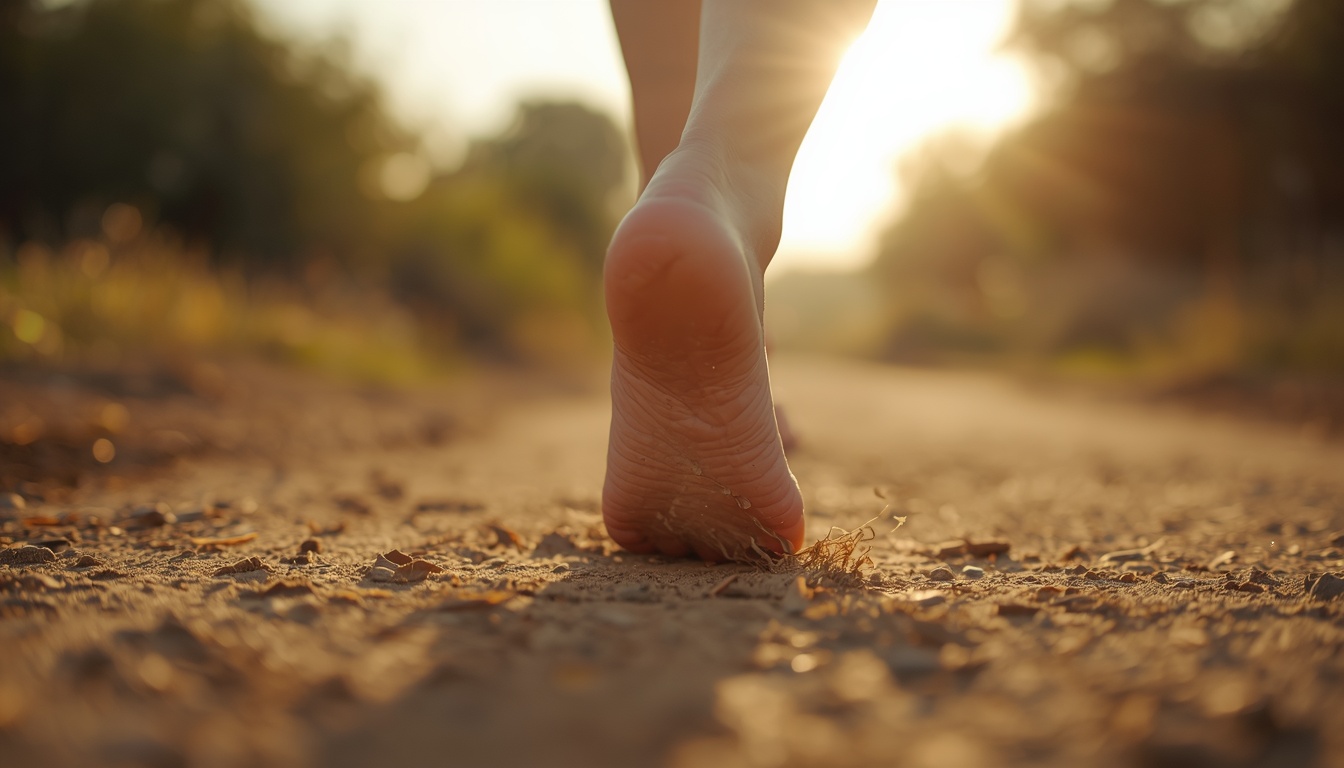
The first step out of bed can feel like a thumbtack under the heel. By the time you reach the kettle, the stab has often faded to a dull tightness. That pattern is so common that many people assume the band under the foot is simply “worn out.”
It is not worn out. It is under-used in the way it was built to be used, then suddenly asked to behave like a spring after eight hours of stillness.
The plantar fascia is a thick, layered sheet of connective tissue that runs from the heel bone to the bases of the toes. In a walking, barefoot, varied-terrain life it stores and returns energy with every step. In a chair-and-cushioned-shoe life it spends most of the day slack, then meets a hard kitchen floor at 6 a.m. The mismatch shows up as that famous first-step wince.
What the Plantar Fascia Actually Is
The fascia is not a thin ribbon. It is a multilayered aponeurosis — a broad tendon-like sheet — with deep fibers that blend into the heel fat pad and superficial fibers that fan toward the five toes. It is continuous, in a mechanical sense, with the Achilles tendon and the calf. When the calf shortens, the fascia feels it. When the big toe lifts, the fascia tightens.
In 1954 the British anatomist J. H. Hicks described the windlass mechanism: as the big toe extends at push-off, the fascia winds around the metatarsal heads like a winch, shortening the distance between heel and toes and raising the arch. That windlass turns a floppy midfoot into a rigid lever for propulsion. Without it, push-off would collapse into a sloppy shuffle.
Modern imaging has confirmed what Hicks inferred from cadavers. Work by Dr. Scott C. Wearing and colleagues treated the fascia as an energy-storing spring, not a passive strap. During walking it lengthens a little under load, then recoils. That recoil is cheap propulsion — energy you do not have to pay for again with calf muscle.
Pathologist Dr. Harvey Lemont examined tissue from people with chronic heel pain and found something that changed the name of the problem. The fascia was not primarily inflamed. It showed degeneration — disorganized collagen, more ground substance, few inflammatory cells. He argued the common label “plantar fasciitis” is often a misnomer. Plantar fasciosis, a failed healing response in overloaded collagen, fits many chronic cases better. That distinction matters for treatment: ice and rest treat a fire. Loading treats a tissue that has forgotten how to remodel.
The Life the Fascia Evolved For
Human walking is a controlled fall onto a spring. For most of our history that spring met:
- Uneven ground that loaded the fascia from slightly different angles each step
- A first-ray (big-toe side) that could extend fully at push-off
- Hours of accumulated low-level strain, not one burst at the gym
- Barefoot or thin-soled contact that let the toes spread and the windlass engage
Your big toe still expects that push-off. Your toes still expect to spread and grip. The fascia is the cable that ties those jobs to the heel.
A day of hunting, gathering, carrying, and standing on dirt did not spare the fascia. It dosed it. Collagen in fascia and tendon adapts to the last few months of strain, a principle tendon researchers such as Professor Jill Cook and Dr. Craig Purdam have mapped in other tissues. Too little strain and the matrix gets quieter and less organized. Too much, too soon, after months of quiet, and the same matrix complains.
What Modern Life Changed
Cushioned shoes, raised heels, narrow toe boxes, and all-day sitting quietly retired the spring.
A shoe with a thick midsole and a stiff shank reduces how much the arch has to work. A heel lift shortens the calf and leaves the fascia starting the day from a less lengthened position. A pointed toe box stops the big toe from extending fully, so the windlass never quite winds. Hours in a chair leave the calf and fascia in a shortened rest length.
Then morning arrives. After sleep the fascia has had no cyclic load. The first few steps on a hard floor apply a sudden tensile spike. People describe it as walking on glass. After a few minutes of walking the tissue warms, fluid shifts, and the pain eases — which is why “it gets better once I am moving” is such a reliable story.
Standing jobs on concrete without variation create the opposite problem: long static load without the cyclic spring. The fascia is a better spring than it is a hammock.
Why First-Step Pain Is So Common
Overnight, two quiet things happen.
Fluid redistributes in the heel pad and fascia. Without the muscle pump of walking, the tissue can feel stiffer at the first load. Second, the calf and fascia spend the night in a relatively shortened position, especially if you sleep with pointed toes under a heavy duvet. The first stretch of the day is then a lengthening under body weight — the exact combination that stings a deconditioned spring.
That is why a calf stretch before standing, or simply sitting on the edge of the mattress and pulling the toes toward the shin for thirty seconds, often takes the edge off. You are pre-tensioning the windlass instead of asking it to wake up under 60 or 80 kilograms.
Dr. Benedict F. DiGiovanni’s research group showed that a tissue-specific stretch — pulling the toes back while the ankle is dorsiflexed, so the stretch targets the fascia rather than only the calf — reduced chronic heel pain more than a standard Achilles stretch in a randomized trial. The fascia responds to the right vector, not to stretching in general.
Hidden Triggers
A few modern habits load the spring the wrong way:
- A sudden jump in walking or running volume after a quiet winter
- New minimal shoes without a gradual barefoot transition
- Long days on hard floors in worn-flat indoor slippers
- Tight calves from sitting, which tug the fascia via the Achilles
- A rapid weight gain that increases every-step tension before collagen has adapted
- High-arched rigid feet that do not share load well, or very flexible flat feet that share too much stretch
None of these mean the fascia is fragile. They mean the dose changed faster than the tissue.
People with a recent spike in lower-back stiffness from sitting instead of hinging and walking often have the same week of extra standing and extra heel pain. The whole posterior chain is one conversation.
When the Pain Is Not “Just Fascia”
Most first-step heel pain that eases with walking is mechanical fascia or the nearby heel fat pad. A few patterns deserve a different look:
- Pain that is worse with rest and better with walking can be an inflammatory arthritis rather than overload
- Numbness, burning into the toes, or night pain that does not ease may be nerve entrapment (Baxter’s nerve) or tarsal tunnel
- A bruise-like feeling after a jump, with swelling, can be a plantar plate or fat-pad injury
- Redness, warmth, and fever are not fascia problems
- Pain in both heels plus other joints in a young adult can point toward an enthesitis-related condition that needs a clinician, not only stretches
Sudden inability to push off after a pop is not fascia stretch pain. That is a reason to be examined.
Myths vs Facts
Myth: Heel pain means you must stop walking.
Fact: Complete rest often makes the spring quieter and more irritable when you start again. Relative rest plus graded walking is the usual path.
Myth: The problem is always inflammation, so anti-inflammatories are the fix.
Fact: Many chronic cases look like failed collagen remodeling. Loading, not only pills, changes that tissue.
Myth: A custom orthotic is required for every case.
Fact: Some people feel better with temporary cushioning or a slight arch support while they rebuild capacity. Others do well with a wider toe box and a more flexible sole. The shoe should let the windlass work, not permanently replace it.
Myth: Barefoot is always the cure.
Fact: Barefoot on varied ground is closer to the original dose — if you build up. Jumping from a cushioned trainer to a 10-kilometer barefoot walk is a spike, not a return to nature.
How to Give the Fascia the Spring It Expects
Think in months, not mornings.
Wake the windlass before you stand. Sit, loop a towel around the ball of the foot, and pull the toes toward you for 30 seconds, two or three times, before the first trip across the room.
Load it on purpose. Short bouts of standing calf raises, progressing toward slow heel drops off a step, give the fascia a controlled tensile dose. Pain during a session that settles within a day is often acceptable; pain that climbs for days means the dose was too large.
Walk on purpose. Easy walking is cyclic spring work. Add minutes before you add speed or hills.
Let the big toe extend. Choose shoes with a toe box that does not pinch the first ray. In safe indoor spaces, spend part of the day in socks or barefoot so the toes can spread.
Unshorten the calf. Sitting shortens the posterior chain. A few minutes of standing calf stretches after sitting blocks, plus regular walking, do more than one heroic stretch at night.
Change surfaces sometimes. A dirt path, a slightly uneven lawn, a gentle slope — these restore the varied vectors the fascia evolved under, which is the same logic behind feet that still expect uneven ground.
Cushioned shoes are not the enemy. They are a tool. Use them when you need volume or recovery. Do not let them be the only surface the fascia ever meets.
When to See a Doctor
See a clinician if heel pain lasts more than a few weeks despite graded loading, if you cannot take a full stride, if there is numbness or swelling, if both heels flare with other joint pain, or if a sudden pop preceded the pain. Imaging is not required for every first-step ache, but it is useful when the story does not match simple mechanical fascia.
A physiotherapist or sports-medicine clinician who treats fascia as loadable tissue — rather than as a fire to extinguish — is usually the right first stop.
Frequently Asked Questions
Why does it hurt most with the first steps in the morning?
Overnight the fascia and calf rest in a shortened position and lose cyclic load. The first steps apply a sudden stretch under body weight. After a few minutes of walking the tissue warms and the pain often eases.
Is plantar fasciitis the same as a heel spur?
Not exactly. A heel spur on an X-ray is a bony reaction at the fascia’s attachment. Many people have a spur and no pain; many people have pain and no spur. The painful tissue is usually the fascia or fat pad, not the spur itself.
Should I ice it every night?
Ice can settle a sharp flare after a long day on concrete. It does not remodel collagen. If mornings keep repeating, add loading and a pre-stand stretch rather than relying on ice alone.
Do I need to stop running?
Usually you need to change the dose, not abandon running forever. Cut volume, keep easy walks, add calf and fascia loading, and return by minutes rather than by pride.
Will losing weight fix it?
Extra body mass increases every-step tension, so a gradual reduction can help if weight has recently risen. It is not a moral requirement and it is not the only lever. Shoe shape, calf length, and walking variety still matter at any size.
Can stretching make it worse?
Aggressive end-range stretching on an already angry morning can irritate the attachment. A gentle pre-stand windlass stretch is different from forcing a deep stretch through sharp pain. Stop if pain climbs instead of easing.
Conclusion
The band under your foot is not a decorative arch support. It is a spring that evolved to wind with the big toe, store a little energy, and hand it back at push-off. Chairs, cushioned soles, and still nights did not destroy that spring. They left it under-dosed, then surprised it at dawn.
Give it a reason to stay organized: a few seconds of toe-up stretch before the first step, walking that actually happens, a shoe that lets the first toe extend, and a gradual return of the loads a human foot was built to store. The thumbtack feeling is not a life sentence. It is a reminder that the spring still expects to be used.