
You are slightly taller in the morning than you were at bedtime. The difference is not imagination and it is not bone growth. It is water leaving and re-entering the cushions between your vertebrae. Those cushions — the intervertebral discs — have almost no blood supply of their own. They eat and breathe by diffusion across the vertebral endplates, and that diffusion is paced by load. Sit all day in one shape and the pump stalls. Walk, change posture, then lie down for a real night, and the same tissue does what Jill Urban’s group at Oxford spent decades showing it was built to do: squeeze fluid out under daytime pressure, then drink it back when the load drops.
Alf Nachemson put pressure needles into living lumbar discs and mapped how sitting, standing, walking and lying change the hydrostatic force inside the nucleus. Hans-Joachim Wilke later repeated the measurement with a more modern sensor and confirmed the pattern: lying is quiet, standing is a step up, unsupported sitting is often higher still, and a relaxed walk is a rhythmic middle. Michael Adams and colleagues in Bristol showed that the same cycle of compression and recovery is not optional decoration. It is how an avascular organ stays alive in the middle of a loaded column.
The modern day is a poor version of that script. Hours of chair flexion, then a gym hour that may or may not include walking, then a night that starts late and is interrupted. The discs still expect the older pair: varied upright load while the sun is up, and a long unload while it is not.
What a Disc Actually Is
A disc is not a mini shock absorber from a catalogue. It is a pressurized bag of proteoglycan gel — the nucleus pulposus — wrapped in concentric collagen rings, the annulus fibrosus, and capped above and below by thin cartilaginous endplates. The nucleus holds water because its glycosaminoglycans carry a fixed negative charge. Ions follow the charge. Water follows the ions. That swelling pressure is what gives the disc height and what turns axial load into hoop tension in the annulus.
Adult discs are among the largest avascular structures in the body. Capillaries stop at the bony endplate. Glucose, oxygen and amino acids must diffuse inward. Lactic acid and other waste must diffuse out. The distances are long. The matrix is dense. Urban and colleagues showed that cells in the center of a lumbar disc live near the edge of what diffusion can support. Anything that thickens the endplate, clogs its pores, or flattens the daily fluid tide makes that margin thinner.
Cells in the nucleus and inner annulus sense hydrostatic pressure, osmolarity and stretch. Moderate cyclic load tends to keep matrix synthesis in a healthy range. Static high compression, static unloading, or a day with almost no change all push the same cells toward a quieter, more catabolic state. The tissue does not need heroics. It needs a tide.
The Evolutionary Job
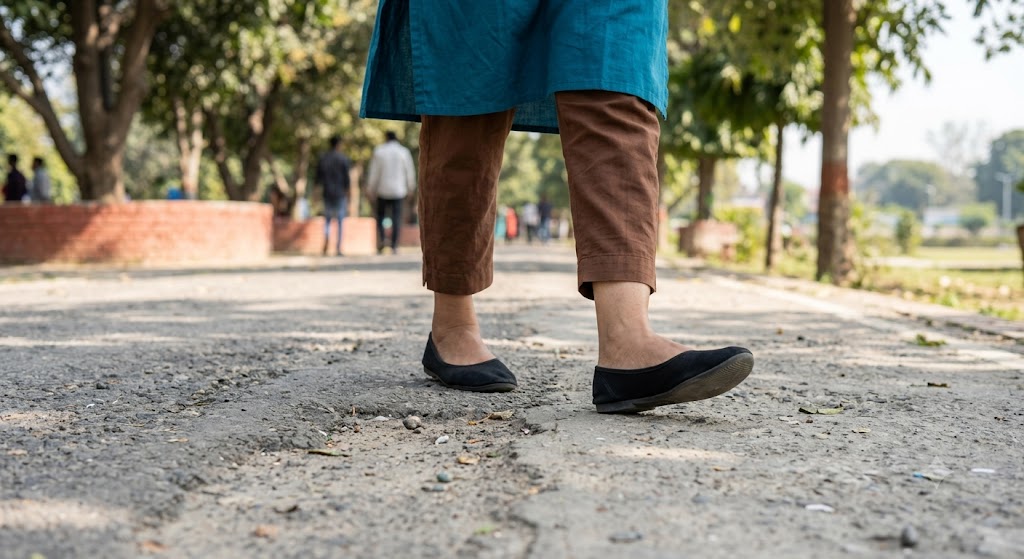
A bipedal spine carries the head and trunk over a narrow base. Discs take a share of that load on every step. Walking is not a gentle hobby in that design. It is a cyclic compressor at roughly one hertz, with brief peaks as the heel lands and the opposite limb swings. Between steps there is a short unload. Over a day of foraging, carrying and standing, the nucleus loses a portion of its water — commonly estimated around a fifth to a quarter of disc fluid across the diurnal cycle — and recovers it lying down at night when muscle tone drops and the hydrostatic pressure falls.
That pattern does two jobs at once. Mechanical work keeps the matrix organized and the cells briefed. Fluid flow helps larger solutes move in a tissue where pure diffusion is slow. Sivan, Neidlinger-Wilke, Maroudas and Urban described how the osmotic environment of disc cells itself swings with the day: concentrated and pressured while you are up, more dilute and less pressured while you sleep. The cells are tuned to that swing, not to a flat line.
Hunter-gatherer days were not gym days. They were hours of mixed walking on uneven ground, occasional lifts, squats, and rest on the floor. The night was long and dark. No one designed a lumbar disc for eight hours of 90-degree hip flexion in a chair followed by a late, short sleep. The tissue still runs the older firmware.
What Changed
Unsupported sitting often raises intradiscal pressure above relaxed standing. Nachemson’s classic figures made that uncomfortable fact famous; Wilke’s in-vivo recordings kept it from being dismissed as an artifact of older needles. A slouched sit flexes the lumbar spine, shifts load toward the posterior annulus, and holds the pressure high without the cyclic pumping of gait. Hours of that posture are now the default workday for a large fraction of adults.
Static standing is not the rescue. A locked-knee stand is still a relatively constant load. What the disc wants is change: walking, brief sits, a squat to the floor, a reach, then walking again. The article on why the lower back still expects a hinge and a walk is the muscle-and-joint version of the same story. The disc is the hydraulic chapter.
Night has changed too. A short or fragmented sleep shortens the unload window. Lying with the hips flexed on a soft couch is not the same as a flat, relaxed recumbency. People who wake stiffer every morning, a pattern described in why you wake up stiff every morning, are often meeting a disc that did not get a full re-imbibe, plus joints that spent the night still. Height loss across a waking day is normal. Failure to recover that height overnight is a quieter warning that the tide is incomplete.
Heavy one-off lifts on a disc that has been dehydrated by a long sit are a different mismatch. Adams and Dolan showed that a flexed, compressed disc is more vulnerable to posterior annular strain after it has already lost fluid. The “I just bent to pick up a pen” story is often the last straw on a day of sitting, not a mysterious fragility.
What the Research Mapped
Nachemson’s intradiscal pressure studies, beginning in the 1960s, gave the first living map of posture versus nucleus load. Lying supine was lowest. Standing was higher. Sitting unsupported was often higher than standing. Walking sat in a usable middle with a pulse. Holding a weight in front of the body raised pressure further, as anyone who has carried a child on one hip already knows in their back.
Wilke’s 1999 recordings in a volunteer with an implanted sensor remain the cleanest modern confirmation. They added nuance — lying prone, laughing, and lifting all have signatures — but they did not overturn the sit-versus-walk ranking that made Nachemson famous.
Urban’s laboratory work explained why the numbers matter biologically. Discs live by transport. Load changes hydration. Hydration changes pore size, diffusivity and the osmotic cue the cells hear. Dynamic loading in a physiological range, on the order of the pressures Wilke recorded during ordinary upright life, supports matrix synthesis. Overload, immobilization and endplate sclerosis do the opposite. Chan, Ferguson and others later framed a “safe window” of magnitude and frequency: not zero, not crushing, and not a single frozen posture.
Stadiometry and MRI have shown the geometric side. You lose disc height from morning to evening. Volume falls. Some of that water leaves through the endplates, some through the annulus. Overnight, if the load drops, most of it returns. Vergroesen, Smit and colleagues argued that inflow and outflow have different time constants, which is why a shorter night can still leave you a little shorter at dawn after a heavy day.
None of this research recommends a life without chairs. It recommends not letting the chair be the only load the disc ever feels.
Hidden Modern Triggers
The quiet villains are not dramatic. They are repetitive and small.
A commute that begins in a car seat, continues in an office chair, and ends on a sofa is three versions of the same flexed, static compression. Walking meetings, a lunch loop, and a standing phone call are not wellness theater. They are the missing half of the diurnal curve.
Very soft beds and all-evening recliner living keep the hips flexed and the lumbar curve flattened. The unload is incomplete. A firmer surface that lets the spine rest closer to its unloaded shape is closer to the night the disc was built for, without turning sleep into an orthopedic project.
Sudden weekend heroics after five dehydrated weekdays — a long drive then a garden dig, a first hike of the season with a heavy pack — catch the annulus when fluid is low and the safe strain range is narrower. Gradual loading across the week, the same principle that tendons expect, is kinder to discs than a Saturday binge.
Smoking, poorly controlled diabetes and endplate damage from old injury all shrink the already thin nutritional margin. They do not create a new disease so much as they make the old pump less forgiving of a chair-heavy day.
When the Mismatch Becomes a Problem
Most back pain is not a slipped disc in the cinematic sense. It is often a sensitive segment that has been loaded in one direction for too many hours, plus a nervous system that has turned up the volume. Disc degeneration on an MRI is common in people who feel fine. Imaging is not a moral verdict.
That said, the mismatch has a real mechanical plot. A nucleus that has lost water and proteoglycan shares load less evenly. The annulus takes more shear. Endplates can micro-fracture under peak load. A true herniation — nucleus material pushing through a fissured annulus — is more likely when flexion and compression stack on a dehydrated disc. Sciatica is the nerve-root version of that event, not a personality trait.
Red flags are the usual ones and they are not subtle: new bowel or bladder loss, saddle numbness, progressive leg weakness, fever with back pain, a history of cancer, or pain that wakes you every night and does not change with position. Those are reasons to be seen promptly, not reasons to fear every morning stiffness.
Myths vs Facts
Myth: Discs need rest, so the best treatment is the sofa.
Fact: Short rest after a flare can calm a hot segment. Days of unloading starve an avascular tissue. Walking is usually the first medicine that matches the organ’s design.
Myth: Sitting is always worse than standing, so a standing desk solves the spine.
Fact: Static standing is still static. The signal is change. Alternate sit, stand and walk. The pressure maps reward the mix, not the furniture brand.
Myth: You should never flex your spine.
Fact: The spine flexes for a living. What it handles poorly is flexed plus compressed plus dehydrated, held for hours, then asked to lift. Hinge at the hips for heavy picks, as described in the lower-back article, and keep ordinary bending in the daily diet.
Myth: If an MRI shows disc degeneration, the back is ruined.
Fact: Degenerative findings rise with age in pain-free people. Treat the person and the pattern of load, not the adjective on a radiology report.
Myth: Inversions and gadgets rehydrate discs better than sleep.
Fact: The proven unload is lying down for hours. Gravity-defying equipment can change comfort. It does not replace a night.
How to Give Discs the Day They Expect
Walk. Not as a weekend identity — as plumbing. Several bouts that add up to the tens of minutes most circulation research already asks for will pulse the lumbar segments in the range Wilke recorded. If the day is a desk day, a five-minute loop every hour is closer to ancestral loading than a single exhausted evening session.
Change shape on purpose. Sit on the sit bones, then stand, then walk, then squat to a low shelf. The disc reads the difference between those postures more than it reads your intention to “have good posture.” Varied loading is the same principle joints still expect when they ask for motion rather than rest.
Protect the night unload. A dark, long-enough sleep on a surface that lets the hips extend is the re-imbibe. Late heavy meals, short nights and a curled-couch finale all shrink that window.
Load gradually if you have been sedentary. Disc cells and annular collagen adapt, but they adapt on a tissue schedule, not a New Year schedule. Add walking minutes before you add a maximal deadlift. Carry groceries on alternating sides. Take stairs. These are compressive cycles with a pulse, which is what the endplate-to-nucleus path evolved to see.
After a long sit, stand and walk a minute before you bend to lift. You are giving a dehydrated nucleus a small chance to share load again. It is a humble habit and it matches the biomechanics better than a warning poster.
When to See a Doctor
See someone promptly for back pain with fever, unexplained weight loss, a history of cancer, new saddle numbness, bowel or bladder change, or rapidly worsening leg weakness. Those are not disc-tide problems. They are medical problems that happen to live near discs.
See someone soon if pain runs below the knee with numbness or weakness, if night pain is relentless, or if you cannot walk a reasonable distance after a few days of ordinary movement. Most episodes settle with time and walking. Persistent nerve symptoms and true loss of function deserve a proper exam rather than another week of hoping the sofa will finish the job.
FAQs
Why am I taller in the morning?
Overnight, with muscle tone down and spinal load low, discs re-imbibe water they lost during the day. Height follows hydration. By evening you have given some of that water back. The swing is normal. A missing morning recovery after a heavy, short-slept day is the more useful observation.
Is walking really better for discs than lying down all day?
For an acute flare, brief recumbency can feel better. As a lifestyle, lying down removes the cyclic pressure and fluid movement the cells use as a cue. Walking at an easy pace sits in the pressure band most in-vivo studies treat as physiologic. It is maintenance, not punishment.
Do standing desks save the discs?
They help if they break a six-hour sit. They fail if they become a six-hour freeze. Alternate. The disc is a pump. Pumps need strokes.
Can I “rehydrate” a disc with extra water?
Drinking matters for the whole body. It does not force water into a nucleus against a high sitting pressure. Hydration of the disc is a mechanical and osmotic event more than a glass-count event. Walk, then lie down at night. That is the refill protocol the tissue already knows.
Does a herniated disc mean I should stop moving?
Often the opposite, once red flags are excluded. Many herniations shrink or become quiet while people keep walking. Immobilization is a short tactic, not a career. A clinician can help match the first weeks to your symptoms. The long game is still load plus unload.
Why does bending after sitting feel worse?
After a long sit the nucleus has lost fluid and the disc is less pressurized, so the annulus takes more of a flexion moment. Standing and walking for a minute before a deep bend is a small way to change that starting condition.
Conclusion
Your discs are old hydraulic organs living in a chair-shaped century. They still expect a day of walking and posture change so fluid and metabolites can move, and a night of genuine unloading so the same fluid can return. Nachemson measured the pressures. Urban explained the transport. Wilke confirmed the map in a living spine. Adams showed what happens when you flex a disc that has already given its water away.
You do not need a prehistoric schedule. You need the two halves of the original contract: a pulse of upright life while you are awake, and enough hours off the column while you sleep. Give the pump both strokes. The height you lose by evening is supposed to come back by dawn.