A stiff or aching low back after a long drive is often sustained sitting, a quiet lumbar curve, and whole-body vibration — not instant disc damage. Learn why car seats load the spine, when pain is a red flag, and how to recover after the trip.
You park after two hours on the highway, swing the door open, and your low back announces the trip. It may feel thick, tight, or dull across the belt line. The first few steps are careful. After a short walk and a stretch against the car, the protest often fades. The question that lingers is whether the ache means the discs took real damage — or whether a car seat simply asks your spine to do something it was never built to do for hours.
A post-drive low-back ache is extremely common. Sitting already raises pressure inside the lumbar discs compared with standing or walking. A car adds a fixed hip angle, a quiet core, pedal work that never quite lets the pelvis move, and a low rumble of whole-body vibration through the seat. For most people the result is a reversible stiffness pattern, not a sudden injury. What matters is how fast the ache settles, whether a leg starts to go numb, and whether the same drive keeps stacking days of pain.
What This Ache Feels Like
A typical benign post-drive backache is:
- A dull band or one-sided tightness across the lower lumbar area
- Stiffness that is worst in the first minute out of the seat
- Easier after standing, walking a few minutes, or extending slightly
- Not accompanied by foot drop, saddle numbness, or fever
- More noticeable after highway miles than after a short errand
Some people feel it more on the side that works the accelerator. Others notice it when they reach for the seatbelt or twist to look over a shoulder. The sensation can travel a little into the top of the buttock without meaning a nerve is trapped. A true nerve story usually adds pins and needles below the knee, weakness, or pain that shoots farther as you cough or sit longer.
The same pattern shows up after long flights and desk days, which is why a related sitting backache is covered in Is It Normal for Your Back to Hurt After Sitting All Day?. Driving is sitting plus vibration, a locked gaze, and almost no chance to change position without leaving the lane.
Why a Car Seat Loads the Low Back
In the 1960s and 1970s, Swedish orthopedist Alf Nachemson measured pressure inside lumbar discs in living volunteers. Sitting produced higher intradiscal pressure than standing. Forward-leaning sitting was higher still. Later work by Hans-Joachim Wilke and colleagues with a modern pressure sensor confirmed the pattern: relaxed sitting and slouched sitting load the disc more than upright standing, and walking sits in a healthier middle range.
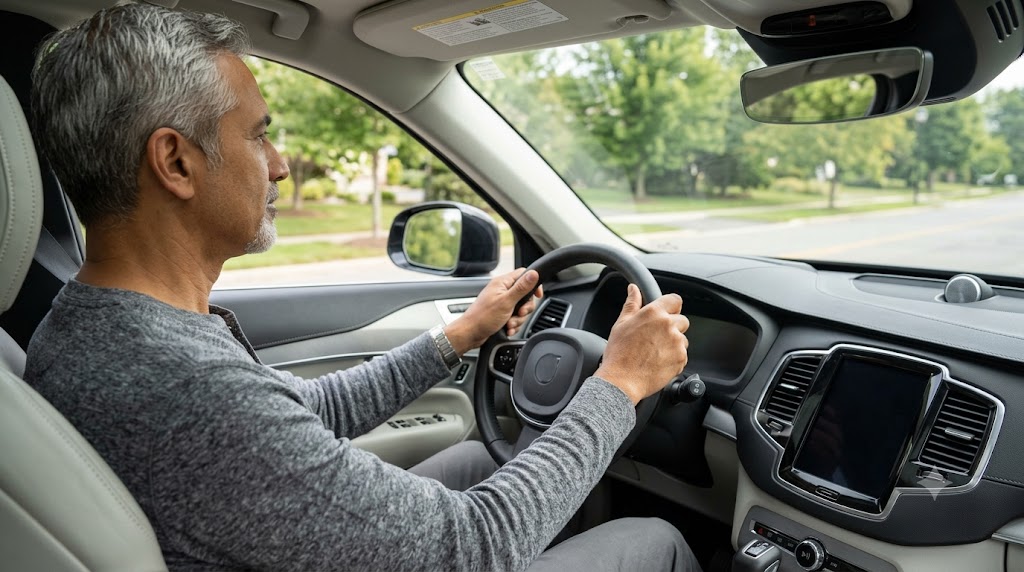
A car seat is a particular kind of chair. The hips stay flexed. The lumbar curve often flattens against a bolster that is either too high, too low, or too far forward. The feet are occupied by pedals, so the pelvis cannot rock. The arms reach a wheel that keeps the upper back slightly rounded. Over an hour, the multifidus and deep abdominal muscles that normally make small corrections go quiet. The ligaments and the back of the disc take more of the hold.
Michael Adams and colleagues at the University of Bristol showed that discs are living tissues that lose a little fluid under sustained compression and regain it when load changes. A long drive is a long compression bout. The first steps afterward can feel “thick” because the disc and the surrounding muscles have been held in one geometry. That thickness is usually a fluid and stiffness story, not a tear you can hear.
Vibration, Pedals, and a Quiet Core
Driving is not only posture. Whole-body vibration — the low-frequency bounce that travels from road to seat to spine — has been studied for decades in truckers, bus drivers, and tractor operators. Researchers including Malcolm Pope and colleagues found that certain vibration frequencies overlap the spine’s natural resonance. The tissues do not get a clean rest. They get a small, repeated jiggle on top of a flexed sit.
Even a smooth highway is not zero vibration. Cheap seat foam bottoms out. A sports car with a stiff chassis transmits more of the road. A tall SUV with a soft seat can let the pelvis sink until the lumbar curve disappears. None of this is automatically harmful for a single trip. It is a reason a two-hour drive can feel different from two hours in a well-fitted office chair.
Pedals add a second layer. The right ankle stays slightly extended on the accelerator. The hip flexors stay short. The opposite hip does almost nothing. After a long trip the front of the hips can feel as locked as the low back, the same pattern described in Is It Normal for Your Hips to Feel Tight After Sitting?. When you finally stand, the lumbar spine is asked to extend while the hips are still reluctant to open. The low back does extra work for a few steps and complains.
Stuart McGill’s laboratory work on spinal stability is useful here without turning every commute into a biomechanics seminar. The lumbar spine likes modest motion and a braced but not clenched cylinder of muscle. A car seat invites the opposite: a long isometric hold with almost no change in angle. Muscles that hold still fatigue. When they fade, passive tissues pick up the tab.
Hidden Triggers That Make a Drive Worse
The same highway can feel fine on Tuesday and miserable on Saturday. Common amplifiers include:
- A wallet or phone in the back pocket that twists the pelvis
- A seat reclined so far the lumbar support misses the curve
- Cruise control that lets you slump because the right foot no longer “works”
- A cold cabin that makes the back muscles guard
- A previous night of poor sleep, which lowers pain thresholds
- Dehydration on a long trip, which does not “dry out” a disc in an hour but can make stiffness feel louder
- Jumping straight from the car into lifting a suitcase or a sleeping child
Climate and clothing matter more than people expect. A thick winter coat bunches behind the low back and flattens the curve. A slick leather seat lets the pelvis slide forward into a slouch. Heated seats can feel wonderful and still leave you in a collapsed posture if you melt into them for three hours.
When the Ache Is Usually Harmless
Reassuring features:
- The ache started during or right after a long sit and eases with walking
- Both legs work. Toes move. You can rise on your heels and toes
- There is no new loss of bowel or bladder control
- Pain does not wake you every night or march down a whole leg
- You have had this exact pattern after other long sits and it faded
Most post-drive backaches behave like a muscle-and-disc-stiffness protest. They do not require imaging on day one. They do require a few minutes of walking before you decide the spine is “out.”
When to Worry
Seek prompt medical care if driving-related back pain comes with:
- Numbness in the saddle area, or new trouble starting a urine stream
- Progressive weakness in a foot or a knee that buckles
- Pain after a crash, a hard pothole jolt, or a fall getting out of the car
- Fever, unexplained weight loss, or a history of cancer
- Night pain that is worse lying still than sitting
- Pain that keeps worsening for days even after you stop driving
Those are not typical “I sat too long” features. A single severe electric zap down the leg after a twist can still be a disc irritation that settles, but weakness and saddle changes are not wait-and-see symptoms.
Myths vs Facts
Myth: If your back aches after a drive, a disc has slipped out of place.
Fact: Discs can bulge and can irritate a nerve, but most post-drive aches are stiffness and raised sitting pressure, not a disc that has left its slot.
Myth: A firm “orthopedic” seat is always safer.
Fact: Support that matches your lumbar curve helps. A board-hard seat that lets the pelvis roll back can be worse than a well-shaped softer one.
Myth: You should stay perfectly still so the spine can “heal” during the trip.
Fact: Small, safe posture changes — a pelvic rock at a light, a brief stand at a rest stop — are closer to what discs and muscles expect than a frozen sit.
Myth: Lumbar rolls fix every driver.
Fact: A roll helps when it restores a gentle inward curve. A roll that is too fat or too high can extend the spine into a new ache.
Myth: Only truck drivers get this.
Fact: Anyone who sits in traffic, rides in the passenger seat for a road trip, or commutes an hour each way can feel the same pattern. Occupational vibration studies simply made the physics easier to measure.
How to Make the Drive Kinder
You do not need a new career. You need a few changes that restore motion and a better curve.
Before you start. Scoot the hips all the way back into the seat so the lumbar support actually meets the low back. Raise or lower the seat so the hips sit level with or slightly above the knees if the car allows it. Bring the wheel closer so the shoulders can drop. Empty the back pockets.
During the trip. Change something every 20–30 minutes: a tiny pelvic tilt, a shoulder-blade squeeze, a different mirror check that rotates the trunk. Use rest stops as movement, not only fuel. A three-minute walk around the car does more for disc fluid and muscle perfusion than another stretch from the seat.
Support, used modestly. A small rolled towel at the belt line is enough for many people. If the car has adjustable lumbar support, start low and small. The goal is a gentle inward curve, not a hard push into the spine.
After you park. Stand, walk, then extend slightly — hands on the low back, gentle lean, not a forced backbend. Hip flexors that sat short appreciate a short half-kneeling stretch before you lift cargo. The spine still expects walking more than sitting, which is the larger theme in Why Your Spine Still Expects You to Walk More Than You Sit.
On days you drive a lot. A short walk after you arrive is not a luxury. It is the unload the disc was waiting for. Evening extension work and a night of ordinary sleep usually finish the reset.
When to See a Doctor
See a clinician if the post-drive ache lasts more than a week of ordinary activity, if a leg symptom is progressing, or if you cannot find a comfortable position even after you stop commuting. A physical therapist who looks at hip extension, how you get out of a chair, and how you sit in a mock seat is often more useful than an early MRI in a person with no red flags. Imaging is important when weakness, trauma, or systemic signs are in the story.
If you drive for work, mention hours and vibration. Occupational guidelines for whole-body vibration exist because the dose can add up. A single weekend road trip is not the same as a decade of bus routes, but both use the same tissues.
FAQs
Why does the passenger sometimes ache less than the driver?
The passenger can fidget, recline a little, and put both feet on the floor. The driver cannot abandon the pedals or the wheel. The extra stillness and the slightly twisted reach toward the wheel add up.
Is cruise control better for the back?
It can be, if you use the extra freedom to change foot position and un-slump. It can be worse if it becomes permission to melt into the seat for an hour.
Should I use a back brace on long drives?
A rigid brace for a routine ache is usually a poor trade. It can remind you not to slouch for a short trip, but it also teaches the deep muscles to stay quiet. Better to fix the seat and take walking breaks.
Why is the first morning after a long drive stiffer than the evening I arrived?
Discs take on fluid overnight. A spine that was compressed all afternoon can feel tighter on the first getting-out-of-bed bend, then ease after you walk. That diurnal pattern is normal unless pain is severe or neurologic.
Can a heated seat hide a problem?
Heat relaxes muscle guarding and feels good. It does not unload a flexed disc. Enjoy the warmth and still stand every hour or so.
Does a standing desk the next day fix a driving backache?
Standing helps some people and irritates others if they lock their knees. Walking is the more reliable reset. Alternate sit, stand, and short walks rather than swapping one long static posture for another.
Conclusion
A low back that aches after a long drive is usually a spine that spent too long in one flexed, slightly vibrating chair. Nachemson and Wilke’s pressure work, Adams’s disc-fluid research, Pope’s vibration studies, and McGill’s stability work all point to the same practical message: sitting in a car is a real load, and motion is the antidote. Walk when you park. Set the seat so the lumbar curve exists. Treat shooting pain, weakness, or saddle numbness as a different story. For everyone else, the highway did not break the back. It just asked it to hold still longer than a walking animal prefers.