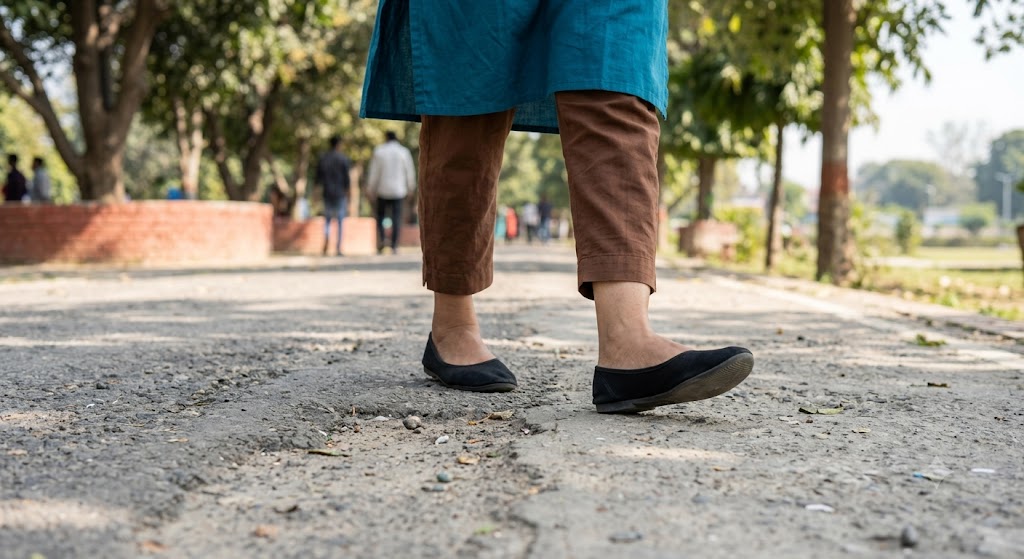
Your spine still expects walking load and frequent posture change, not hours of chair flexion. Discs, ligaments and back muscles were built for a day that moved.

A chair feels like rest. After an hour it often does not feel like rest to the low back. The lumbar curve flattens. The discs sit in a flexed, loaded hush. The small muscles that should flick on and off with each step hold a quiet isometric instead. You stand up and the first few steps feel stiff, then the spine remembers how to move.
That sequence is not a character flaw. It is a mismatch. Human vertebral columns were shaped by walking days — thousands of light, rhythmic compressions with rotation and an overnight unload — not by a single seated angle from morning coffee to evening lamp.
What This Pattern Feels Like
People notice:
- A dull lumbar ache that builds after 40–90 minutes in a chair
- A “folded” feeling at the belt line when they finally stand
- Stiffness that eases after a short walk and returns at the next meeting
- One side of the low back tighter after a mouse-heavy afternoon
- A sense that the mid-back has locked between the shoulder blades
- Better mornings after a walking commute than after a full remote day
- A first-step catch that fades once the stride finds its rhythm
The complaint is rarely a single dramatic lift. It is the day that never quite stood up.
What Walking Actually Does to a Spine
An intervertebral disc is a pressurized, living cushion. It has no dedicated blood supply of its own. Fluid, nutrients and waste move by load and unload — the same pump that cartilage and other avascular tissues use.
Classic intradiscal-pressure work by Alf Nachemson, later refined with instrumented measurements by Hans-Joachim Wilke and colleagues, showed a consistent pattern. Quiet standing loads the lumbar disc less than slumped sitting. Walking sits in a middle band: enough compression to move fluid, not the static peak of a flexed chair. Lying down drops the pressure further and lets the disc re-imbibe water overnight.
Michael Adams and colleagues mapped how that daily cycle works. Daytime load squeezes fluid out through the endplates. Nighttime unload lets the disc swell again. A spine that walks gets many small load-unload cycles. A spine that sits gets one long squeeze in flexion, then a sudden stand.
Walking also adds the ingredients sitting deletes:
- Axial rotation and side-bend. Each step rotates the pelvis a few degrees. Facet joints and the outer disc annulus see a changing vector, not a single crease.
- Hip hinge and arm swing. The lumbar spine is not meant to be the only mover. A walking gait shares work with hips, thoracic rotation and the opposite arm.
- Muscle on-off, not muscle on. Multifidus and the deep abdominal wall flicker with gait. In a chair they often hold a low, continuous tone or go quiet and then complain when asked to stand.
Stuart McGill’s lab work on spinal stability makes the same point in a different language. The back is robust when load is shared, varied and brief. It is irritable when one posture, one flexion angle and one set of motor units do all the hours.
A related story lives in the discs themselves. You can read how they still expect a night of unloading in Why Your Discs Still Expect Walking and a Night Unload.
Why Sitting Is a Different Job
Sitting is not “the spine at rest.” In many chairs it is lumbar flexion plus hip flexion plus a still thorax.
The hips are parked short of the deep fold they still expect. The lumbar curve flattens. The posterior annulus of the disc is under sustained tension while the front of the disc is relatively compressed. Ligaments that like occasional end-range see mid-range for hours. The calf pump is quiet, so even venous return from the legs is duller — a cousin of the same stillness problem that shows up as evening ankle puffiness.
Jack Callaghan and others who study occupational sitting have shown that people do not hold one perfect posture. They fidget. That fidgeting is the nervous system trying to change the load vector. It is a clue, not a failure of discipline.
Standing desks help only if they restore change. Standing still in one lock is a different static load, not a walking day. The spine’s request is not “never sit.” It is “do not make sitting the only habitat.”
If the end of a desk day leaves a specific belt-line ache, the practical cousin of this article is Is It Normal for Your Back to Hurt After Sitting All Day?.
The Evolutionary Brief
Before chairs were furniture, sitting happened on the ground, on heels, in a squat, on a rock, or against a tree — and it did not last a workday. The default transport was walking. Endurance walking and a springy gait are part of the human specialty Daniel Lieberman and Dennis Bramble have described: a trunk that can stay relatively upright while the legs and pelvis cycle underneath.
That brief trained:
- Discs that eat through cyclic compression
- Facet joints that see a little twist with each step
- Deep back muscles that stabilize in motion, not in a hover
- A lumbar curve that is a walking spring, not a chair decoration
Modern life inverted the ratio. Many adults sit more hours than they sleep. Walking is a block on the calendar instead of the medium of the day. The tissues did not get a memo.
The lower back’s version of the same brief — hinge and walk, do not fold and stay — is unpacked in Why Your Lower Back Still Expects You to Hinge and Walk.
Hidden Modern Triggers
A few everyday habits make the mismatch louder:
- One chair, one height, all day. The disc sees one flexion angle until you stand.
- Laptop on a sofa. Extra thoracic flexion stacked on lumbar flexion.
- Wallet or phone in the back pocket. A small pelvic tilt held for hours.
- Driving plus desk plus evening screen. Three flexed habitats with no walk between them.
- Weekend warrior surge. Five still days and then a long hike or a sudden deadlift session. Discs and ligaments like load. They like it introduced, not dumped.
- Skipping the night unload. Late sitting on a soft couch keeps the disc in the daytime squeeze closer to lights-out.
None of these is a moral failure. Each is a missing walk in disguise.
When to Worry
Most chair-stiff spines ease with standing, a short walk and a night of decent sleep. Get prompt care if you have:
- Pain after a fall, a crash, or a sudden twist with a pop
- Pain that travels below the knee with numbness, tingling or foot weakness
- Loss of bladder or bowel control, or numbness in the saddle area
- Unexplained weight loss, night pain that does not change with position, or a history of cancer
- Fever with a new, severe back pain
- Progressive weakness — a foot that slaps, a knee that buckles
Those patterns are not “you sat too long.” They need a person, not a standing desk.
Myths vs Facts
Myth: The perfect ergonomic chair will fix a sitting spine.
Fact: A better chair can reduce peak load. It cannot replace cyclic walking load or disc fluid exchange.
Myth: Standing all day is the ancestral posture.
Fact: The ancestral posture was change — walk, squat, carry, lie, then walk again. Locked standing is another static job.
Myth: If imaging shows a disc bulge, sitting ruined the disc.
Fact: Bulges are common on scans of people with no pain. Pain that tracks with sitting time and eases with walking is often load and sensitivity, not a unique tear.
Myth: You should avoid all flexion forever.
Fact: Spines flex. They just do not need to flex in one angle for six hours. McGill-style advice is about sparing the spine during heavy lifts and adding variety the rest of the day, not about never tying a shoe.
Myth: Core workouts replace walking.
Fact: Bracing drills can teach timing. They do not recreate the thousands of light axial cycles a walk provides.
How to Give the Spine the Day It Expects
You do not need a wilderness trek. You need more change than a single lunch lap.
- Stack short walks onto existing transitions. Call on foot. Park farther. Walk the first ten minutes after a meal. The after-meal walk also helps glucose, which is a bonus the spine does not mind.
- Change the chair angle before the ache starts. A timer at 30–40 minutes beats a heroic stretch at 3 p.m.
- Use a footstool or a squat for short ground tasks. Hips share the fold the lumbar spine is otherwise asked to hold.
- Walk before you train. A ten-minute easy walk is the warm-up synovial fluid and discs were built to receive.
- Keep one daily bout of real distance. Twenty to thirty minutes of easy walking does more for disc cycling than an isolated set of back extensions.
- Unload at night. Finish the last long sit earlier. A spine that lies down after a walk, not after a slump, gets a cleaner fluid rebound.
- Carry something occasionally. A grocery bag in one hand asks the obliques and the opposite side of the spine to work — a tiny version of the load the trunk still understands.
The goal is not a perfect step count. It is a day in which sitting is one habitat among several.
When to See a Doctor or Physio
See a clinician if walking no longer eases the ache, if symptoms travel into a leg, or if stiffness is new after 50 and worse at night. A good assessment looks at hips, thoracic rotation and how you get out of a chair — not only at a lumbar MRI. Imaging is a tool when red flags or true radicular signs are present. It is a poor first explanation for an afternoon that never stood up.
FAQs
How much walking does a spine actually want?
There is no magic number that fits every disc. What shows up again and again in occupational and disc-nutrition research is interruption: minutes of walking scattered through the sitting day beat a single heroic walk after eight still hours.
Is a standing desk enough?
It is a useful tool if you shift weight, take steps in place and still walk. Frozen standing is just a taller sit.
Why do I feel worse the first minutes after I stand?
Fluid has shifted, motor units have gone quiet, and the first load after flexion can feel sticky. That usually fades as gait returns. Pain that worsens after a few steps, or a leg that goes numb, is a different story.
Can walking worsen a known disc herniation?
Easy walking is often tolerated and helpful. Sharp, traveling leg pain, foot drop, or pain that builds with every stride needs a guided plan, not a step-count challenge.
Does core strength protect me from sitting?
A timed, breathing core helps you lift and carry. It does not exempt the disc from needing cyclic load. Walk anyway.
Why is morning sometimes the stiffest point if night unloads the disc?
The disc is fuller after a night’s re-imbibing, so the first flexion of the day can feel tight. A few easy minutes upright before a long slump is kinder than an immediate sofa fold.
Conclusion
Your spine is not broken because a chair makes it ache. It is a walking column living in a sitting economy. Discs still eat through load and unload. Ligaments still like a changing angle. Deep muscles still expect the on-off of gait. Give the day a few more strides than the furniture suggests, and the stiffness that felt like damage often turns out to be a brief that never got delivered.