
The vastus medialis helps track your kneecap and stabilizes the joint. Modern chair sitting rarely asks for the deep bends it still expects.
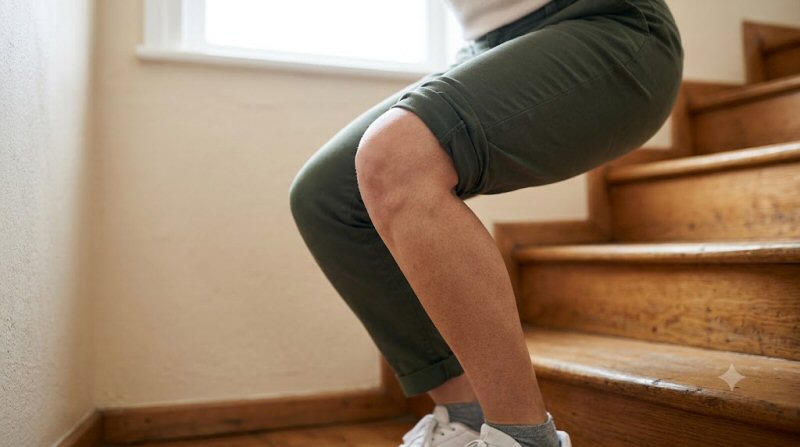
Your vastus medialis is the teardrop-shaped muscle on the inner side of your thigh, just above the knee. It is part of the quadriceps group and plays a quiet but important role in keeping the kneecap tracking smoothly in its groove as the knee bends and straightens. Most of the day, however, that muscle sees only the modest knee angles of sitting in chairs, standing, or walking on flat floors. It rarely gets the deeper flexion it appears to have been shaped by.
What This Muscle Does
The vastus medialis has two functional parts. The more distal fibers, often called the vastus medialis oblique, run more horizontally and help pull the kneecap medially during the final degrees of extension. The longer fibers contribute to knee extension throughout the range. Together they stabilize the patella against the pull of the vastus lateralis on the outer side.
Christopher Powers and others have shown that timing and relative activation of these fibers matter for patellofemoral contact stress. When the inner muscle lags or is under-used, the kneecap can drift slightly laterally, increasing pressure on the cartilage under it. The muscle is not isolated easily; it works with the rest of the quadriceps. Yet its relative contribution changes with joint angle.
Why Deeper Bends Matter
Electromyography studies, including work by Jaberzadeh and colleagues, found higher vastus medialis to vastus lateralis ratios during semi-squats at 50° and 80° of knee flexion compared with shallower 20° bends. Terminal knee extension still recruits the oblique fibers strongly, but the deeper positions appear to load the muscle under conditions closer to how it was used when people regularly lowered and rose from the ground or climbed uneven slopes.
Ancestral rest postures often involved squatting or kneeling rather than chair sitting. David Raichlen and colleagues measured higher lower-limb muscle activity, including in the vasti, during squatting postures used by hunter-gatherers compared with modern chair sitting. The knee spends more time in greater flexion, and the quadriceps must control both the descent and the rise. Modern office chairs and car seats keep the knee near 90° or less for long stretches, with little dynamic loading through the deeper range.
Scott Dye’s “envelope of function” idea for the knee suggests that tissues stay healthier when loaded inside a familiar range and frequency. Prolonged static sitting followed by sudden deeper bends (getting up from the floor, deep lunges, or steep stairs) can feel stiff or awkward precisely because the vastus medialis and surrounding tissues have not been asked to work that way recently.
What Happens With Too Little Deep Flexion
Over weeks and months of mostly chair-based days, the muscle can adapt to the narrower range. People sometimes notice:
- A feeling of weakness or fatigue when climbing stairs or rising from a low seat
- Mild inner-knee discomfort after unusual deeper activity
- The sense that the kneecap “doesn’t sit right” until the knee has moved a few times
- Greater reliance on the outer quadriceps or hip muscles to compensate
None of these is automatically a problem. They are common signals that the familiar loading pattern has narrowed. The related experience of needing full extension after sitting is covered in why your knees still expect frequent full extension. The patella’s preference for occasional deeper loading is discussed in why your patella still expects a deep bend.
Simple Ways to Give It What It Still Expects
You do not need heavy weights or long sessions. Short, controlled exposures to greater knee flexion, repeated across the day, are usually enough to keep the muscle responsive.
- Sit-to-stand from a slightly lower chair or with a slow, controlled descent every hour or two.
- Controlled step-ups or step-downs on a single stair, focusing on even pressure through the foot and a smooth rise.
- Supported partial squats to a comfortable depth (holding a counter if needed), pausing briefly near the bottom before standing.
- Occasional full-range movements such as getting down to the floor and back up, or gardening postures that involve deeper knee bend.
Keep the motion smooth. A sharp pinch under the kneecap is a signal to reduce depth or volume that day. Consistent moderate loading tends to be more useful than occasional extreme efforts. Stair climbing, which loads the quadriceps through a useful range, is explored in why your quadriceps still expect stair climbing.
When to Pay Closer Attention
Most people can safely add these small movements. See a clinician if you notice:
- Persistent swelling or warmth around the knee after modest activity
- Locking, giving way, or sharp pain that stops you from bearing weight
- Pain that wakes you at night or is clearly worsening over weeks
- A recent injury followed by lasting inner-knee weakness
These can point to issues beyond simple under-use of the vastus medialis, such as meniscal irritation, significant patellofemoral irritation, or other structural problems.
Myths vs Facts
Myth: You can isolate the vastus medialis with one special exercise and fix knee tracking overnight.
Fact: Preferential activation is hard to achieve reliably. Full-range, closed-chain movements that include both deeper flexion and terminal extension tend to be more practical.
Myth: Deep squats are always bad for knees.
Fact: For healthy knees, controlled deep flexion within your current tolerance is a normal loading pattern. Pain-free progressive exposure is different from forcing depth.
Myth: If your knees feel fine in chairs, the muscle is getting everything it needs.
Fact: Chair sitting can leave the deeper-range capacity under-stimulated even when daily pain is absent.
FAQs
Does sitting with my legs crossed weaken the vastus medialis?
Prolonged cross-legged sitting can alter quadriceps activation patterns during later step tasks, according to some EMG studies. Occasional crossing is unlikely to matter; hours of it every day may contribute to the narrower loading pattern.
Should I do terminal knee extensions every day?
Short sets of terminal extensions can be useful, especially if you already do deeper movements. They complement rather than replace loading through greater flexion.
Can weak vastus medialis cause kneecap pain?
It can contribute when combined with other factors such as tight lateral structures, reduced hip control, or sudden increases in activity. Strengthening the whole quadriceps through a useful range is usually more helpful than chasing isolation.
Is it normal for the inner knee to feel tired after the first deep squat in a while?
Yes. The muscle and surrounding tissues are adapting to a range they have not used recently. Gradual reintroduction usually reduces that feeling within days to weeks.
Do I need to squat all the way to the floor?
No. Partial ranges that still go deeper than ordinary chair sitting are often sufficient. Progress only as far as you can control smoothly without pain.
Conclusion
Your vastus medialis still carries the expectation of occasional deeper knee bends—the kind that came with rising from the ground, climbing, or resting in a squat. Modern chairs and flat walking surfaces rarely supply that stimulus. Short, regular exposures to controlled deeper flexion keep the muscle and the kneecap’s tracking system familiar with the full range they were built to handle. Most people notice the difference as easier stair climbing and less stiffness after sitting, without needing dramatic changes to the rest of the day.


