
Your quadriceps evolved for frequent stair and hill climbing that loaded the knee through full range. Modern elevators and flat floors leave them underused, which can show up as tightness, fatigue, or ache after ordinary stairs.
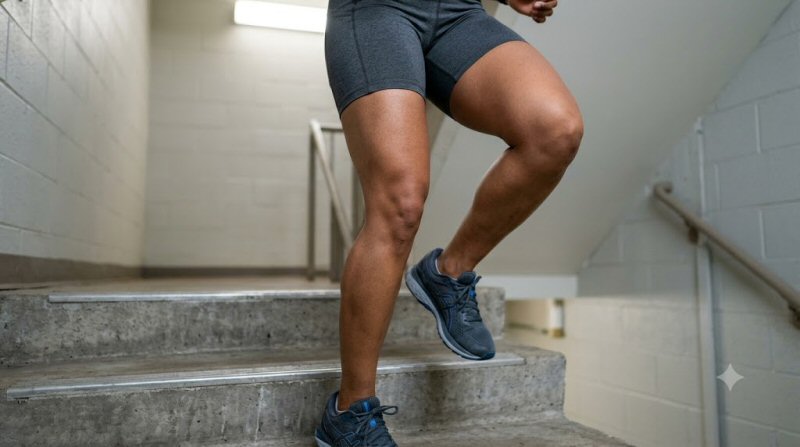
Stairs used to be ordinary terrain. Hills, rocky paths, and the occasional climb into a shelter asked the front of the thigh to work through a long range of motion many times a day. Elevators, escalators, and single-level living have removed most of that load. The muscle group still “expects” it, and the mismatch can appear as unexpected tightness, early fatigue, or a dull ache the first few times you take a real flight of stairs.
What This Feels Like
The sensation is usually a heavy or burning feeling across the front of the thigh that shows up partway up a staircase and eases once you reach the landing. Some people notice the knees feel less stable or slightly achy on the way down. Others simply feel the muscles are “out of practice” even if daily walking feels fine. It is rarely sharp or sudden if the cause is simple underuse.
Common Causes
The most frequent reason is straightforward disuse. When most of the day is spent sitting or walking on level surfaces, the quadriceps rarely reach the deeper knee-bend angles that stair climbing demands. The muscle shortens a little, the nervous system becomes less efficient at recruiting it, and the first real stair session feels harder than it should. Reduced daily step count and reliance on elevators amplify the effect. Mild deconditioning after illness or a period of less activity produces the same pattern.
Why This Happens
Human legs are built for varied terrain. The quadriceps (vastus medialis, lateralis, intermedius, and rectus femoris) straighten the knee and help control descent. Stair climbing requires roughly 60–90 degrees of knee flexion on the way up and even more controlled eccentric work on the way down. Work by researchers such as Christopher Powers on patellofemoral mechanics and earlier electromyography studies by John Basmajian showed how heavily these muscles are recruited once the knee bends past everyday walking angles. In environments with frequent hills or multi-level shelters, that recruitment happened many times daily. Flat modern floors and mechanical lifts remove the stimulus, so the tissue adapts downward. When the stimulus returns, the muscle and the joint surfaces around it register the difference.
Related everyday patterns appear in why your calves still expect hills and stairs and in how knees respond to deeper bends.
Less Common but Serious Causes
True muscle strain, significant patellofemoral irritation, or early cartilage changes can produce similar fatigue or ache. These are less common when the only trigger is ordinary stairs after a period of underuse. Persistent swelling, locking, or pain that does not ease with a short rest are not explained by simple disuse.
Hidden Triggers
Long hours of sitting keep the rectus femoris and hip flexors shortened, so the first stair climb starts from a disadvantaged position. Very soft or unsupportive footwear changes how force travels through the knee. Rapid increases in stair volume (moving to a walk-up apartment, for example) without gradual exposure also reveal the gap. Low overall daily movement compounds the effect even if formal exercise occurs a few times a week.
When to Worry
Seek assessment if pain is sharp, localized to one spot, accompanied by swelling or warmth, or if the knee gives way. Pain that wakes you at night, lasts more than a few days after modest stair use, or is paired with significant loss of range needs professional review. Simple muscle fatigue that resolves within a day or two of ordinary activity is usually the underuse pattern.
Myths vs Facts
- Myth: Stairs are inherently bad for knees.
Fact: Controlled stair climbing loads the quadriceps and joint in a way they are well adapted to handle; the problem is usually the sudden return after long absence, not the stairs themselves. - Myth: You should avoid stairs if your thighs feel tired.
Fact: Gradual re-exposure is one of the most direct ways to restore the capacity the muscles still expect. - Myth: Only older adults notice this.
Fact: Desk-based adults of any age can feel the difference after weeks or months of elevator living.
How to Manage
Reintroduce the missing load gradually. Start with one or two flights at a comfortable pace, then increase over days rather than jumping to many floors. Short sets of sit-to-stand from a chair or slow step-ups onto a low platform rebuild the same pattern without needing a staircase. Keep the knee tracking roughly over the foot and avoid letting the knee collapse inward. Daily walking on varied surfaces helps the nervous system stay ready. If sitting dominates the day, stand and take a short walk every hour so the muscles do not stay shortened for long stretches.
Strength work that includes both the straightening (concentric) and lowering (eccentric) phases prepares the tissue more completely than level walking alone. Most people notice the “out of practice” feeling diminish within one to two weeks of consistent, modest exposure.
When to See a Doctor
See a clinician if the ache is accompanied by swelling, instability, or does not improve after a week or two of gradual activity. Anyone with known knee injury, significant arthritis, or pain that limits ordinary walking should get individualized guidance before increasing stair volume. Early assessment prevents a simple deconditioning issue from becoming a longer irritation.
FAQs
Why do stairs feel harder than flat walking even when I am otherwise active?
Level walking uses a smaller knee-bend range. Stairs demand deeper flexion and more eccentric control, so muscles that have adapted to flat floors notice the difference immediately.
Is it normal for the front of the thigh to burn on the way up?
Yes, when the quadriceps have had little recent practice at that angle. The sensation usually lessens as the tissue adapts.
Should I stretch before climbing stairs?
A brief warm-up walk is more useful than aggressive stretching. The muscles respond better to gradual loading than to being lengthened forcefully when cold.
Can elevators make this worse over time?
They remove the daily stimulus the muscles evolved with. Occasional deliberate stair use keeps the capacity available.
Does this mean my knees are wearing out?
Not by itself. Fatigue from underuse is common and reversible. Persistent joint-line pain or swelling is a different signal and worth checking.
Conclusion
The quadriceps still carry the expectation of regular stair and hill work that once formed part of ordinary movement. Modern level living quietly removes that load, so the first real climb can feel surprisingly demanding. Gradual reintroduction of the missing range restores the capacity without drama, and most people find ordinary stairs become unremarkable again within a short time.


