
The kneecap still expects brief deep bends and full-range glide, not hours parked near a right angle. Sitting load, cartilage fluid, and a simple way back.
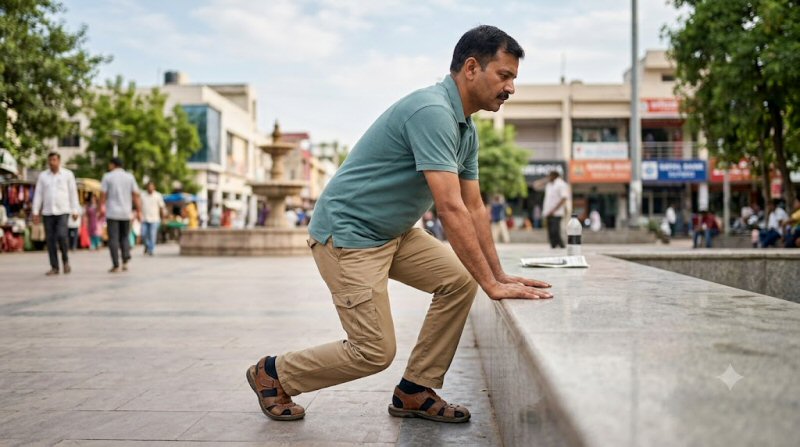
The movie is fine. The chair is the problem. Twenty minutes in, a dull ache starts behind one kneecap, a little off-center, as if the bone is being pressed into the groove. Standing up in the aisle eases it before the credits finish. The same ache shows up on a long flight, in the back seat of a car, and after an afternoon of desk work with the knees tucked under the table. Stairs the next morning can feel gritty even though nothing twisted and nothing swelled.
That is the patella complaining about a job it was not given. The kneecap is a sesamoid bone buried in the quadriceps tendon. It was built to slide, share load, and visit the deep end of the bend for short spells — a squat to the ground, a heel-sit, a rise from the floor. A modern day often parks it near ninety degrees and leaves it there. The joint still expects the deep bend. It mostly gets a long, shallow hold.
What a Bored Kneecap Feels Like
The ordinary version is a front-of-knee ache that arrives with sustained flexion and fades once the knee is straight and moving. People point to the kneecap itself, or just under its lower edge. It can feel like pressure, a warm bruise, or a band that tightens when they stand after sitting. Going down stairs is often worse than going up, because the quadriceps are working eccentrically and the patella is being pulled hard into the groove.
A click on the first few bends after sitting is common and, by itself, not a diagnosis. Grinding that is painless is also common. What marks this pattern is the timing: still for a while, then sore; moving, then quieter. Both knees can do it. One knee often does it more, usually the side you tuck, cross, or sit on.
It is different from a swollen knee after a twist, a locked knee that will not straighten, or pain that wakes you from sleep without a flexed position. Those belong in a different chapter.
What the Patella Was Built to Do
The patella is not a spare part. It sits in the trochlear groove of the femur and lengthens the lever of the quadriceps. Orthopedic surgeon Harold Kaufer showed that removing it shortens that lever and costs extension strength, especially near the straight knee. The bone exists so the thigh muscles can straighten the leg without an impossible tendon angle.
It does not sit in one spot. John Goodfellow and David Hungerford mapped the contact zones and found that the meeting place moves as the knee bends. Near full extension there is little true contact. By about twenty degrees the lower patella meets the groove. As flexion deepens, the contact patch climbs the back of the kneecap and widens. Past a right angle, the quadriceps tendon itself begins to share load against the femur, and a smaller odd facet on the patella comes into play. Deep flexion is not simply “more pressure on the same spot.” It is a different map.
John Insall and later John Fulkerson described how that map goes wrong in patellofemoral pain: a joint asked to hold compression where cartilage and the soft tissues under the tendon are least happy, often with a tracking line that is slightly off. Christopher Powers, at the University of Southern California, added the hip and the foot to the story. A knee that collapses inward on stairs raises the sideways pull on the patella even if the kneecap itself is shaped normally. Kay Crossley and colleagues in Melbourne pulled the clinical picture together: front-of-knee pain is common, often bilateral, and driven more by load and control than by a single “worn out” X-ray.
Scott Dye, at the University of California, San Francisco, framed the practical limit as an envelope of function. Tissues accept a range of load and keep their chemistry steady. Step outside that envelope — a new hill repeated, or a chair that never lets the joint move — and the same kneecap that was quiet yesterday starts a deep ache. The envelope can shrink after illness, a sudden mileage jump, or months of stillness. It can widen again. That is a more useful picture than “bad cartilage” for a knee that looks ordinary on a scan and hurts in row 12.
Why a Chair Is the Wrong Angle
Level walking asks relatively little of the patellofemoral joint, on the order of half a body weight of compressive force in classic estimates from Reilly and Martens. Stairs and a deep squat ask several times that. The surprise is that the chair, which feels like rest, is not neutral. It holds the knee in the middle of the bend, often near sixty to ninety degrees, for hours. Contact is real. Glide is not.
Articular cartilage has no blood vessels of its own. It eats and drinks by being squeezed and released, the biphasic behavior described by Van Mow and colleagues: fluid leaves under load, then returns when the load shifts. A kneecap that slides through a range gets a pump. A kneecap parked under the desk gets a clamp. The ache after a film is that clamp announcing itself. The relief on standing is the first glide of the evening.
Chairs also steal the deep end. Many adults no longer sit on the floor, heel-sit, or squat to rest. The odd facet and the high contact zones visit the groove only on a rare deep bend, then complain when a weekend garden or a low toilet asks for the range all at once. The joint still expects that bend as a normal, brief, repeated event. Modern life made it a novelty.
There is a second mismatch in the muscles. The quadriceps were built to lower you to the ground and stand you back up, not to hold a quiet isometric while you type. A thigh that still expects the floor loses easy control of the last part of the bend. The hip that no longer folds deeply lets the knee drift inward. The patella feels both.
Hidden Triggers That Shrink the Envelope
A few ordinary habits make the same angle hurt sooner.
Tucking both feet under the chair, or sitting on one heel, loads the lower pole and the fat pad for the length of a meeting. Crossing the same leg rotates the tibia and changes the tracking line. A wallet is a pelvic problem first, but the knee often pays the second bill because you sit twisted.
Soft sofas are worse than firm chairs. The hips sink, the knees ride high, and the bend gets deeper without any of the muscle work that would have come from a real squat. A low car seat does the same thing for the drive home.
Sudden hills, stadium stairs, or a new squat program after months of flat walking jump the load faster than cartilage fluid flow and tendon capacity can follow. Downhill is the classic provocateur. So is kneeling on a hard floor, which is a different tissue — the prepatellar bursa — but often blamed on the kneecap.
Shoes with a very stiff sole and no rock can make the knee do extra flexion to clear the foot. A collapsed arch that lets the tibia rotate inward raises the sideways vector Powers described. None of this requires a torn cartilage. It requires a joint held still, then asked for a bend it no longer visits.
Myths vs Facts
Myth: Front-of-knee pain means the cartilage is worn out. Fact: Many painful patellae have smooth cartilage on imaging. Dye’s homeostasis model fits the movie-seat ache better than an arthritis label. Worn cartilage can hurt, but it is not required.
Myth: You should never squat. Fact: A deep bend is part of the original job, in short doses, with control. The problem is hours at one angle, or a sudden return to the bottom of the range. Fear of any squat often shrinks the envelope further.
Myth: The vastus medialis must be isolated with a special squeeze. Fact: The whole quadriceps, the hip, and the way the knee tracks on a step matter more than one small muscle exercise. Powers and Crossley both pushed the field past the isolated-VMO story.
Myth: Clicking means damage. Fact: A painless click after sitting is usually a seating sound as the patella enters the groove. Pain, swelling, or a click with giving way is the part worth reporting.
Myth: Rest is the treatment. Fact: Relative rest from the aggravating angle helps. Total rest deconditions the lever the patella exists to serve.
How to Give the Kneecap Its Bend Back
Start with the chair, not the gym. Every thirty to forty-five minutes, straighten the knees fully for a few breaths. Stand, walk to a window, and let the patella glide. A small range, repeated, beats one long stretch at the end of the day. If the seat is low, a cushion that raises the hips reduces the parked angle. Uncrossing the legs is free.
Then restore a little depth, only inside the current envelope. A sit-to-stand from a normal chair, slow on the way down, ten times, teaches the quadriceps to control the bend they already own. If that is easy and pain-free the next morning, lower the target an inch. A supported squat to a low bench, heels down, knees tracking over the mid-foot, is enough depth for most people returning from a chair life. Heel-sitting and a full floor squat are later options, not the first week, and not if the knee swells.
Stairs are training if you treat them that way. A handrail, a slower descent, and a knee that does not dive inward reduce the sideways pull. Walking on varied ground still feeds the joint more honestly than a static hold. The same logic sits behind cartilage that expects compression and glide and a hip that still expects a deep fold. The patella is the hinge between those two stories.
Ice after a long flexed day can settle an angry fat pad. It does not replace the glide. Strength work for the quadriceps and the hip abductors, two or three days a week, widens the envelope Dye described. Add load by a little, not by a weekend. Pain that spikes during the set and is worse the next morning is a signal to shorten the range, not a badge of effort.
When to Worry
Most movie-seat ache is a load problem. Some front-of-knee pain is not.
Seek care promptly if the knee swells within hours of a twist, locks so it will not fully straighten, or gives way on level ground. A hot, red knee with fever is urgent. Pain after a fall onto the kneecap, with trouble lifting the straight leg, needs an exam — the tendon and the bone can fail even when the ache feels familiar. Night pain that is not explained by a flexed sleeping posture, pain with unexplained weight loss, or a single knee that is stiff for more than an hour every morning deserves a clinician, not another cushion.
Teenagers with a persistent limp, and adults with known inflammatory arthritis, should not be folded into the chair story without a look. Patellofemoral pain is common. It is not the only thing a kneecap can do.
When to See a Doctor
Book a routine visit if the ache has lasted more than a few weeks despite breaks from prolonged flexion, if one knee is clearly swelling, or if stairs have become a daily limit. A clinician can sort tracking pain from a meniscus tear, a fat-pad pinch, bursitis, and referral from the hip. Imaging is often normal and often unnecessary on the first visit. Treatment that matches the envelope — load advice, hip and thigh strength, a short course of taping in the style Jenny McConnell described — helps more people than a promise to avoid bending forever.
FAQs
Is it normal for the kneecap to ache after sitting?
Yes, often. A dull ache behind the patella that eases once you stand and walk is a classic response to prolonged flexion. Goodfellow and Hungerford’s contact maps and Dye’s envelope of function both fit that pattern. Swelling, locking, or pain at rest in a straight knee is not part of the normal version.
Does a deep squat ruin the kneecap?
Not by default. Deep flexion changes which part of the patella and which part of the tendon carry load. A brief, controlled deep bend is what the joint still expects. Hours at ninety degrees, or a sudden return to the bottom of a squat after months away, is the more common problem.
Why are stairs worse than walking?
Walking uses a small knee bend and a modest patellofemoral force. Stairs demand more flexion and a hard quadriceps contraction, especially on the way down. If the knee also drifts inward, Powers’ tracking work suggests the sideways pull rises even further.
Should I stop kneeling and squatting completely?
Only while a flare is hot. Long-term avoidance shrinks the range the odd facet and the upper contact zones still need. Return with a higher seat, a slower lower, and a next-day check. Pain that lingers into the next morning means the dose was too deep or too many.
Can this become arthritis?
Sustained overload and poor tracking can irritate cartilage over time, but a movie-seat ache is not arthritis by itself. Many people with this pattern have unremarkable scans. Keeping the glide, the strength, and the breaks from the parked angle is the practical protection.
Do I need a brace?
Most people do not. A simple patellar tape job can calm a flare for stairs, as McConnell showed, while strength catches up. A brace that lets you sit still for longer is solving the wrong problem.
Conclusion
The patella is a moving lever, not a paperweight for the desk. It still expects short visits to a deep bend, full straightening between them, and a quadriceps that can lower you and bring you back. Chairs gave it a single angle and called that rest. Straighten often, stand up before the ache arrives, and give the deep end back in small pieces. The kneecap usually recognizes the job.


