
Your outer thigh muscle is built for the small sideways adjustments of uneven ground and varied movement. Straight-line modern life leaves it under-stimulated and often tight.
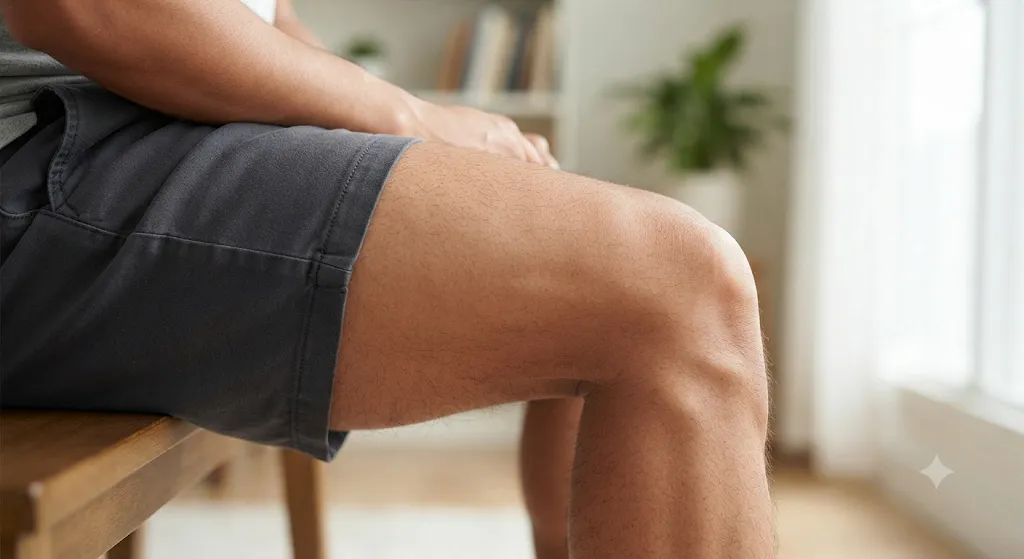
Most people never think about their vastus lateralis until the outer thigh feels oddly tight after a long day of walking on flat sidewalks or sitting at a desk. This large muscle on the outside of the thigh is one of the four quadriceps, and it is quietly involved every time you take a step. What it rarely gets anymore is the occasional sideways load it was shaped for.
What the Vastus Lateralis Actually Does
The vastus lateralis runs along the outer front of the thigh from the hip area down to the kneecap. It is the biggest of the quadriceps and helps straighten the knee. It also plays a stabilizing role, keeping the kneecap tracking properly and resisting forces that try to push the leg inward or outward during movement.
Electromyography work going back to researchers such as John Basmajian showed that the vastus lateralis is highly active during ordinary walking and especially during any step that involves a slight lateral shift. It does not only power straight-ahead steps. It helps control the small side-to-side corrections that keep you balanced when the ground is not perfectly flat.
Why It Still Expects Side Steps
Human walking evolved on varied terrain. Trails, hillsides, rocky ground, and open grassland all required frequent micro-adjustments. A step that is mostly forward often still contains a small sideways component when the surface changes or when you need to dodge an obstacle or change direction. Those moments load the outer thigh in ways a perfectly straight treadmill belt or a smooth city sidewalk does not.
The vastus lateralis, along with its neighbors such as the gluteus medius, developed the capacity for those occasional lateral loads. When the loads disappear for long stretches, the muscle can become relatively under-used in its stabilizing role even while it still works hard during ordinary walking. The result is often a sense of tightness or fatigue on the outer thigh that feels out of proportion to how much “exercise” you think you did.
This is a classic evolutionary mismatch. The muscle still expects the varied loading patterns of ancestral movement, but modern environments supply mostly linear, predictable steps.
What Modern Life Does to It
- Long periods of sitting leave the quadriceps in a shortened position and reduce the natural demand for lateral stability.
- Walking on concrete, treadmills, or even tracks keeps nearly every step in the same plane.
- Desk work and driving keep the hips and knees in relatively fixed angles for hours.
- Even many gym routines emphasize straight-line squats, leg presses, or running without deliberate side-to-side work.
Over months and years the outer thigh can feel chronically tight. Some people notice the tightness more after standing or walking on hard floors. Others feel it when they finally do something that requires a quick side step, such as dodging a person on a crowded sidewalk or playing with kids. The muscle is not weak in the absolute sense; it simply has not been asked to handle the sideways component it still expects.
Related patterns appear in neighboring muscles. The gluteus medius is often discussed for the same reason, and the vastus medialis on the inner side has its own set of expectations around deeper knee bends. When one part of the system is under-loaded in certain directions, the whole thigh and knee can feel less coordinated.
Everyday Signs That Are Usually Benign
- Outer thigh tightness that eases after a short walk or gentle stretch
- A mild ache on the outside of the knee after a day of mostly straight walking
- Feeling that your legs are “locked” into forward motion and stiff when you suddenly need to move sideways
- Temporary fatigue in the outer thigh after standing in one place (for example in a kitchen or at a standing desk)
These sensations are common and usually reflect ordinary under-use of a stabilizing pattern rather than injury. They tend to improve when the muscle is given occasional sideways loading and when overall sitting time is reduced.
When the Pattern Deserves Attention
Most outer-thigh tightness is harmless. Still, certain features are worth checking:
- Sharp or increasing pain on the outside of the knee or thigh that does not settle with a few days of lighter activity
- Swelling, warmth, or bruising after a specific twist or fall
- Weakness that makes stairs or getting out of a chair noticeably harder on one side
- Numbness, tingling, or pain that travels below the knee in a clear pattern
- Symptoms that wake you at night or are accompanied by fever or unexplained weight change
In those cases a clinician can sort out whether the issue is simple muscle fatigue, an IT-band irritation, a knee-tracking problem, or something less common. Early evaluation is more useful than waiting for a minor pattern to become a longer-term irritation.
Myths vs Facts
Myth: Outer-thigh tightness always means the muscle is “too strong” and needs to be stretched aggressively.
Fact: The vastus lateralis is often simply under-stimulated in the sideways direction. Gentle stretching can feel good, but adding controlled side steps or lateral lunges usually addresses the underlying mismatch more effectively than stretching alone.
Myth: Only runners or athletes need to worry about lateral thigh loading.
Fact: Anyone who spends most of the day sitting or walking in straight lines can develop the same pattern. The muscle’s expectation does not disappear just because you are not training for a sport.
Myth: If the knee looks fine, the outer thigh cannot be contributing to discomfort.
Fact: The vastus lateralis influences how the kneecap tracks. Subtle changes in its activity can create a sense of pressure or fatigue around the knee even when imaging is normal. Researchers such as Christopher Powers have documented how quadriceps balance affects patellofemoral mechanics in everyday movement.
Practical Ways to Meet the Expectation
You do not need a complicated program. A few minutes of deliberate sideways loading a few times a week is usually enough to remind the muscle of its full job.
- Side steps or lateral band walks: Place a light resistance band above the knees and take slow steps sideways, keeping the knees softly bent. Ten to fifteen steps each direction is a reasonable start.
- Lateral lunges or curtsy variations: Step out to the side and lower gently, then return. Focus on control rather than depth.
- Single-leg balance on a slightly uneven surface (a folded towel or balance pad) for 20–30 seconds per side. The small corrections recruit the outer thigh.
- Short walks that deliberately include direction changes—crossing a room diagonally, stepping around furniture, or walking on grass instead of only pavement.
- Reducing long unbroken sitting periods so the muscle is not held in one length for hours.
These movements complement the straight-ahead work already described in pieces such as why your quadriceps still expect stair climbing. Together they restore a broader range of the loads the thigh evolved to handle.
If you already have knee pain, start with very small ranges and stop if anything sharpens. Most people notice the outer thigh feels less “stuck” within a couple of weeks of adding even modest side-to-side work.
Frequently Asked Questions
Is outer-thigh tightness the same as IT-band syndrome?
Not always. IT-band irritation is one possible result of the same under-loading pattern, but many people feel simple muscle tightness without the classic sharp lateral knee pain of IT-band syndrome. The two can overlap, yet they are not identical.
Will side steps make my thighs bigger?
Occasional body-weight or light-band side steps are unlikely to produce noticeable size changes. They mainly improve the muscle’s ability to stabilize. If hypertrophy is a goal, heavier loading would be required; for everyday comfort, light consistent work is sufficient.
Can I just stretch the outer thigh instead?
Stretching can reduce the sensation of tightness in the moment. It does not replace the stabilizing demand the muscle expects. Combining a short stretch with a few sets of side steps tends to work better than stretching alone.
Does this matter if I already walk a lot?
Yes, if almost all of that walking is in a straight line on flat surfaces. Volume of steps and variety of direction are different things. Adding even a few minutes of lateral movement changes the stimulus.
How soon should I feel a difference?
Many people notice less end-of-day tightness within one to two weeks. Knee-related symptoms, if present, may take longer and sometimes need additional assessment.
Is there any reason to avoid side steps?
Recent knee surgery, acute swelling, or sharp pain with lateral movement are reasons to check with a clinician first. For ordinary tightness without those features, gentle side steps are generally well tolerated.
Conclusion
The vastus lateralis is not a muscle that only wants to walk forward. It still carries the expectation of occasional sideways adjustments that once came automatically from uneven ground and varied daily movement. Modern environments remove most of those adjustments, leaving the outer thigh under-stimulated in one of its natural roles. The resulting tightness is common and usually responsive to simple changes: a few deliberate side steps, less unbroken sitting, and walking surfaces that are not perfectly flat. Giving the muscle the small lateral loads it still expects is often enough to make the outer thigh feel less stubborn by the end of the day.


