
Your gluteus medius evolved for single-leg balance on uneven ground. Flat modern surfaces leave it quiet—learn why that shows up in hips and knees, and simple ways to give it the motion it still expects.
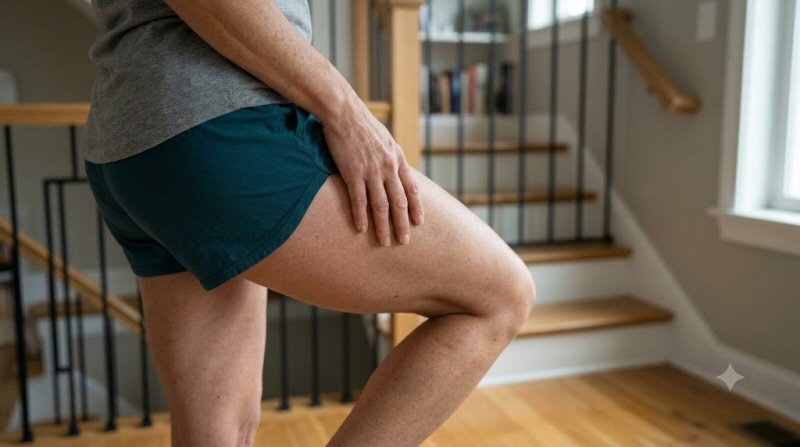
You finish a long desk day, stand up, and notice a dull ache along the outside of one hip. Or your knee feels a little unstable the next time you walk downhill. Nothing dramatic—just a quiet sense that the side of your pelvis is not as steady as it used to be. That sensation often traces back to a small but hardworking muscle that modern life almost never asks to do its real job.
What the Gluteus Medius Actually Does
The gluteus medius sits on the outer surface of the pelvis, just below the crest of the hip bone. Its main task is hip abduction—lifting the leg out to the side—but its more important daily role is keeping the pelvis level while you stand on one leg. Every ordinary step contains a brief single-leg stance. During that moment the gluteus medius of the supporting leg contracts so the opposite side of the pelvis does not drop. This is the classic function described in kinesiology texts by Donald Neumann and demonstrated in classic electromyography work by John Basmajian.
When the muscle is strong and timed well, walking feels effortless. When it is under-recruited, the pelvis tilts a little with each step (the Trendelenburg pattern), the knee drifts inward, and the tissues along the outside of the hip and thigh take extra strain. Over months that quiet inefficiency can show up as outer-hip tightness, IT-band discomfort, or even front-of-knee pain—connections documented by researchers such as Christopher Powers.
Why Ancestral Life Used It Constantly
For most of human history the ground was rarely flat. Trails, hillsides, stream banks, and rocky campsites demanded constant small adjustments in the frontal plane. Carrying a child on one hip, a basket on one shoulder, or a load in one hand further required the gluteus medius to stabilize against asymmetric weight. Sideways steps—stepping over a log, shifting weight while gathering, climbing a slope at an angle—were ordinary. Those movements kept the muscle’s motor units active across a wide range of lengths and speeds.
The same demand appears in modern sports that still involve lateral movement (soccer, tennis, trail running), but it has largely disappeared from daily life. Related muscles that share the lateral stability job, such as the tensor fasciae latae and the adductors, also expect more varied loading than most of us now provide. You can read more about the adductors’ expectation of a wide stance in our article on why your adductors still expect a wide stance, and about the larger pelvic motion in why your pelvis still expects the motion of walking.
How Modern Surfaces Quiet It
Flat concrete, smooth floors, and predictable sidewalks reduce the need for fine lateral corrections. Sitting for hours keeps the hip in a flexed, slightly adducted position that shortens the opposite tissues and leaves the gluteus medius in a lengthened, under-loaded state. Even ordinary walking on level ground uses the muscle, but at a lower intensity and with less variety than ancestral terrain. Over time the nervous system simply recruits it less often; the muscle does not vanish, but its endurance and timing decline.
This is an evolutionary mismatch: the hardware for single-leg balance on uneven ground is still present, yet the daily software of modern movement rarely runs the full program. Similar mismatches appear in neighboring structures. The IT band, for example, still expects the sideways hills that once loaded it differently—see why your IT band still expects sideways hills.
Common Signs It Is Underused
Most people do not feel the gluteus medius itself complaining. Instead they notice secondary effects:
- A vague ache or tightness on the outer hip after sitting or after a longer walk
- The knee drifting slightly inward when you step down or when you stand on one leg
- Difficulty balancing on one foot for more than a few seconds without the opposite hip dropping
- A sense that one hip “gives” more than the other during ordinary stairs or uneven pavement
These are not injuries; they are signals that the lateral stabilizer has been on reduced duty. Strength testing in clinics often finds the side-lying leg-lift or single-leg squat limited long before pain becomes obvious.
Why That Matters for Knees and Hips
When the gluteus medius cannot hold the pelvis level, the femur tends to rotate and adduct under the pelvis. That changes the tracking of the kneecap and increases pressure on the outer hip structures. Powers and colleagues have shown that improving hip abductor strength can reduce knee pain in people with patellofemoral problems. The same principle applies to ordinary daily life: a muscle that is only rarely asked to stabilize will not be ready when you suddenly need it—stepping off a curb, carrying a heavy bag on one side, or walking on a soft trail.
Simple Ways to Restore the Motion It Expects
You do not need a full gym program. Small, frequent lateral demands are enough to remind the muscle of its job.
- Stand on one leg while brushing your teeth or waiting for the kettle; keep the pelvis level and the knee tracking over the foot. Thirty to sixty seconds per side is useful.
- Take a few deliberate sideways steps in each direction during a walk or while moving around the kitchen. Step wide enough that you feel the outer hip working, then bring the feet back together.
- When you walk, occasionally choose a slightly uneven surface—grass verge, gravel path, or gentle slope—rather than always the smoothest pavement.
- Lie on your side and lift the top leg a few inches while keeping the pelvis stacked (no rolling backward). Ten to fifteen slow repetitions remind the fibers without fatigue.
These movements are low-load and can be done daily. The goal is not exhaustion; it is to reintroduce the single-leg and sideways loading that the muscle still expects.
When to Worry
Outer-hip discomfort that is mild and improves with movement is usually the underuse pattern described above. Seek assessment if you notice:
- Pain that wakes you at night or prevents ordinary walking
- Sudden weakness, limping, or a clear pelvic drop that does not improve with simple practice
- Swelling, redness, or pain that radiates sharply down the leg
- Symptoms after a fall or direct blow to the hip
Most cases of “my outer hip feels tired” resolve with restored movement. Persistent or worsening signs deserve a clinical look to rule out tendon irritation or other issues.
Myths vs Facts
Myth: Outer-hip tightness always means the IT band is too tight and needs aggressive stretching.
Fact: Often the tightness is protective because the gluteus medius is not stabilizing well. Strengthening the abductor and adding sideways steps frequently reduces the sensation more effectively than stretching alone.
Myth: You only need strong glutes for sports.
Fact: Every step you take is a single-leg balance task. The gluteus medius works in ordinary walking; it simply works harder and more variably when the ground is not perfectly flat.
Myth: Sitting all day permanently weakens the muscle.
Fact: The muscle remains capable. Reduced daily demand lowers its endurance and timing, but both respond quickly once lateral and single-leg loading returns.
FAQs
Is it normal for one outer hip to feel tighter than the other?
Yes. Most people have a preferred stance leg and slight differences in how they carry loads or sit. The tighter side is often the one that has been under-recruited. Simple single-leg practice usually evens the sensation within a few weeks.
Will sideways steps help knee pain?
For many people with mild knee discomfort linked to hip control, yes. Restoring gluteus medius function improves pelvic stability and reduces inward knee drift. If pain is sharp or progressive, have it checked first.
How often should I do single-leg balance?
Daily is ideal, even for short periods. The nervous system responds to frequent, brief practice more than to one long session once a week. Thirty seconds per side while doing something else is enough to start.
Can I strengthen the gluteus medius without equipment?
Yes. Side-lying leg lifts, standing sideways steps, and single-leg balance are all body-weight movements that match the muscle’s ancestral demands. No machines are required.
Does walking on flat ground count as enough?
Flat walking uses the muscle, but at a lower and more predictable intensity. Adding occasional sideways steps or uneven surfaces supplies the variety it still expects and keeps its endurance higher.
Conclusion
Your gluteus medius is not broken; it is simply under-asked. For hundreds of thousands of years it stabilized the pelvis on one leg across uneven ground and during sideways shifts. Modern flat surfaces and long sitting periods have removed most of that stimulus. The result is a quiet loss of lateral control that can show up as outer-hip tightness or knee tracking issues. Giving the muscle brief, regular sideways steps and single-leg moments restores the motion it still expects—and usually quiets the secondary aches that come from its absence.


