
The deep inner-calf muscle still expects to lower and lift a springy arch with every step. Flat shoes and long sitting leave the tendon quiet, then a walk aches behind the inner ankle.
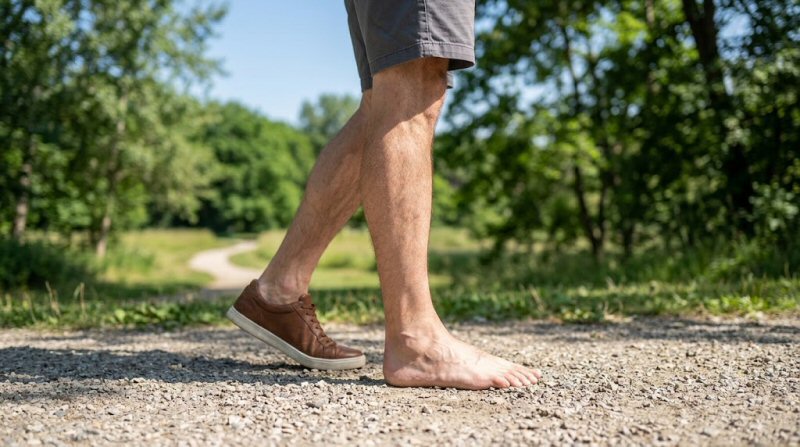
The ache shows up behind the inner ankle, not in the meat of the calf. It starts after a long walk in flat shoes, a day on hard floors, or the first hike of the season. Press just behind the bony knob on the inside of the ankle and the spot is tender. The arch looks a little lower than it did a few years ago. By evening the shoe feels tight across the midfoot.
That line of tendon belongs to tibialis posterior, the deepest muscle of the calf. It still expects a springy arch that lowers a little as the foot accepts weight, then rises again as you push off. Chairs, cushioned shoes, and perfectly flat pavement ask almost nothing of it for hours, then hand it a sudden job. The tendon is built for that job. It is not built for years of quiet followed by one overloaded weekend.
What This Ache Feels Like
The usual complaint is a dull pull along the inside of the ankle that can travel into the arch or up a few inches into the lower leg. It is worse after walking, standing, or rising onto the toes, and easier after sitting. Some people notice the heel tipping outward, more toes visible from behind on the sore side, or a new roll toward the inside of the foot. Shoes that used to fit start creasing in a different place.
A single stiff morning that fades in ten minutes is common when the tendon has been still overnight. Swelling that stays behind the inner ankle, a foot that will not rise onto the toes, or an arch that is visibly collapsing over weeks is a different story. Pain on the outer ankle can appear later, when the flattened foot jams the outside of the joint. That outer ache is often the compensation, not the original problem.
What the Muscle Still Expects
Tibialis posterior begins on the back of the tibia and fibula and on the membrane between them. Its tendon hooks behind the medial malleolus, the inner ankle bone, and fans into the navicular, the cuneiforms, and the bases of the middle metatarsals. That path is a sling under the arch.
In a normal step the muscle works mostly on the way down, not only on the way up. As the foot lands, it lengthens under load and slows the drop of the arch. As the heel lifts, it helps invert the heel so the forefoot can stiffen for push-off. Electromyography work by John Basmajian and G. Stecko in the 1960s already showed tibialis posterior active in quiet standing, not only in a dramatic toe raise. Later gait studies, including work by George Murley and Hylton Menz, found its timing tied to the controlled pronation of midstance. The arch was never meant to be a rigid stone bridge. It was meant to be a spring with a muscle on the winch.
Uneven ground, barefoot hours, hills, and a day of varied steps kept that winch in a moderate range. A short load, a recovery, another short load. The tendon’s collagen turns over slowly. It likes repetition it has already met.
Why Modern Days Leave It Quiet, Then Overloaded
A seated morning is a near-zero day for this muscle. The foot is parked, the arch is held by the shoe, and the tendon glides little. Standing still is not a great substitute. Locked standing loads the tendon in one length, without the shortening and lengthening of a step. The calf-pump article on these pages makes the same point for the soleus: posture muscles expect a stroll, not a pose.
Then the walk happens in shoes that do part of the job. A firm midsole, a raised heel, and a narrow toe box change how much the arch is allowed to drop and rise. Daniel Lieberman’s barefoot work has argued that modern cushioning alters the landing the foot evolved to manage. For tibialis posterior the mismatch is specific. The shoe braces the midfoot so the muscle can stay quieter on easy days, then a long museum afternoon, a cobbled street, or a new pair of unsupportive flats asks the tendon to control a larger drop than it has trained for.
Weight gain, a sudden return to running, and walking only on cambered roads all raise the inversion demand. So does a foot that already rolls in. The peroneals on the outside still expect a sideways catch. When they and tibialis posterior stop sharing the step evenly, the inner tendon takes the extra share.
How a Quiet Tendon Becomes a Flat Foot
Kenneth Johnson and David Strom described the clinical stages of posterior tibial tendon dysfunction in 1989. Stage I is pain and swelling along the tendon with the arch still present. Stage II is a flexible flatfoot: the arch drops, the heel tips out, but the joints can still be lined up by hand. Stage III is a stiffer deformity. Mark Myerson later added a stage in which the ankle joint itself drifts. Adult acquired flatfoot, reviewed by Julie Kohls-Gatzoulis and colleagues, is the everyday name for this progression. It is more often reported in middle age, and more often in women, with associations that include higher body weight and conditions that affect tendon quality.
The single-leg heel raise is the simple clue Johnson emphasized. Stand on the sore foot and try to rise. A working tibialis posterior helps the heel swing inward as you go up. If the heel stays tipped out, or you cannot rise more than a tremor, the tendon is no longer doing its spring job. That test is a prompt for an exam, not a home diagnosis. A tear, a ligament sprain, and an arthritic midfoot can mimic the same limp.
The spring is shared. The plantar fascia, the spring ligament under the talar head, and the bony fit of the midfoot all carry load. When the tendon tires, those partners take more. A first-step arch pain that belongs to the plantar fascia can sit next to an inner-ankle ache that belongs to the tendon. Treating only one of them often leaves the walk unfinished.
Hidden Triggers
A few patterns show up more often than a single unlucky step.
Long sitting, then a long walk with no ramp-up. The tendon’s last hard day was months ago. Collagen does not keep a reserve of strength it never uses.
Very flat shoes or worn-out shoes on hard floors. The heel sits low, the arch is asked to drop farther, and the tendon’s lever behind the malleolus works at a longer length.
The same shoe on the same camber. Roads and sidewalks slope toward the curb. The downhill foot spends the day in more pronation.
A recent change in weight, a steroid course, or a flare of a tendon-affecting condition. These do not cause every case. They lower the load the tendon can tolerate.
Sleeping with the foot pointed down, then stepping straight onto tile. The first shortening of the morning is also the first load.
Skipping the smaller foot muscles. The arch article on this site describes the windlass of the big toe. If the toes never push, tibialis posterior becomes the only worker left on the sling.
When to Worry
Most inner-ankle fatigue after a new walk settles in a few days of easier steps. Get it checked sooner if you cannot perform a single-leg heel raise, if swelling sits behind the inner ankle and does not fade overnight, or if the arch is visibly lower than the other foot and changing over weeks.
A pop, sudden giving way, fever, redness streaking up the leg, or pain that wakes you and is not changed by position needs a clinician, not a new insole. Numbness in the sole, night pain that is constant, or a hot swollen joint can be nerve, infection, or inflammatory arthritis rather than a simple overuse tendon. Pain after a fall, or pain that is worst on the outer ankle from the start, may be a sprain or a fracture. Progressive flatfoot with ankle tilting is the stage at which bracing or, sometimes, surgery is discussed. Waiting until the foot is rigid narrows the options.
Myths vs Facts
Myth: A falling arch is just genetic, so exercise cannot matter.
Fact: Foot shape has a family pattern, but Johnson and Strom’s stages describe a tendon that can go from sore-and-intact to elongated. Load still changes symptoms and, early on, the height you can hold.
Myth: The arch should never drop.
Fact: A springy arch lowers under load and rises at push-off. A rigid arch is not the ancestral target. The target is a drop you can control.
Myth: Pain behind the inner ankle is always a shin splint.
Fact: Shin-splint pain usually sits higher, on the inner tibial border. Tenderness that follows the tendon behind the malleolus into the navicular is a different structure.
Myth: Soft shoes are always kinder.
Fact: A cushioned shoe can feel kind and still let the heel collapse inward. What helps is a shoe that matches the heel and the forefoot, plus a tendon that has been trained, not softness alone.
Myth: Orthotics weaken the muscle permanently.
Fact: A brace or insole can unload a swollen tendon while it calms. Staying in a brace and never retraining the heel raise is what leaves the muscle quiet. The brace is a cast for a phase, not a personality.
How to Give the Tendon Its Spring Back
Start with the test you can feel. If a double-leg heel raise is comfortable and a single-leg raise is shaky, practice the double-leg version slowly, letting the heels drift slightly inward at the top. Kornelia Kulig’s group has used resisted foot adduction, a band pulling the forefoot outward while you draw the foot inward, to bias tibialis posterior without a huge calf jump. Short sets, every other day, beat a single brutal session.
Walk on mild uneven ground once the acute tenderness fades. A lawn, a trail, a low curb used for slow step-ups. The peroneals want the sideways catch. Tibialis posterior wants the return from that catch. Ten minutes counts.
Shorten the sitting blocks. Two or three minutes of easy walking each hour keeps the tendon gliding. Gliding is not strength. It is how a tendon avoids the stiff first step.
Check the shoes you actually wear. A heel that is crushed inward is already doing the deformity’s work. Replacing a collapsed shoe often changes the ache before any exercise does. A medial posting or an over-the-counter arch support can help a stage I tendon calm down. It should not be so high that the arch is cranked into a cramp.
Rise from chairs without pushing the knees together and the feet flat-out. A soft knee bend and a foot that can grip spreads the load into the hip and the toes. The hip-flexor and arch pieces on this site are the neighbors of this one. A tired tibialis posterior is often standing in for a hip that is not sharing stance.
If swelling is obvious, relative rest for several days, a lace-up brace that limits heel collapse, and ice after walks are reasonable first aid. Stretching an angry tendon hard into dorsiflexion and eversion on day one usually picks the fight you do not need. Ease the calf only when the tendon is no longer hot to the touch.
When to See a Doctor
See a clinician if the single-leg heel raise fails, if the arch is dropping, or if pain has lasted more than a couple of weeks despite easier shoes and shorter walks. Early posterior tibial tendon dysfunction is the stage most likely to settle with a brace, a shoe change, and progressive strengthening. An exam, and sometimes an ultrasound or MRI, separates a swollen intact tendon from a split or an elongated one.
Mention any steroid use, a recent antibiotic course that coincided with tendon pain, inflammatory joint disease, or diabetes. Those details change how aggressive the unloading should be. Sudden inability to bear weight, fever, or a foot that is cold or numb is urgent care, not a next-month appointment.
FAQs
Why does the inside of my ankle ache after walking but not while I sit?
Tibialis posterior is loaded when the arch is asked to control pronation. Sitting parks the foot. The ache after the walk is the tendon reporting a job it has not been training for.
Can this muscle really hold up the arch?
It is the main dynamic supporter. Basmajian’s standing recordings and later flatfoot EMG studies put it on the arch during stance. Bones and the plantar fascia share the static load. Lose the muscle and the arch often lowers over months, not minutes.
Is a fallen arch permanent?
A flexible drop, Johnson and Strom’s stage II, can often be braced and retrained. A rigid midfoot is harder to change without procedures. Earlier is easier. A painless low arch you have had since childhood is not the same as a new collapse.
Do barefoot shoes fix it?
A thin shoe can restore some arch motion if the tendon is healthy and the transition is slow. A thin shoe on an already failing tendon can be the overload. Health of the heel raise matters more than the marketing category of the shoe.
Why did my outer ankle start hurting too?
As the heel tips out, the outer ankle and the sinus tarsi get compressed. That pain is often secondary. Treating only the outside leaves the inner tendon unaddressed.
Should I stop walking?
Complete rest usually makes the next walk worse. Short, flat, supported walks keep the tendon gliding. Stop the walk that causes swelling or a limp, and rebuild the heel raise before you add hills.
Conclusion
Tibialis posterior still expects a springy arch on a varied step, the kind of day a foot got when ground was uneven and shoes did not do the bracing. Modern life gives it long quiet hours and then one hard demand. The inner-ankle ache is the tendon saying the demand arrived before the training. A shoe that is not already collapsed, a heel raise that lets the heel turn in, and walking that comes in doses rather than in weekends are the conditions it still recognizes. A foot that can no longer rise, or an arch that is leaving, deserves an exam while the spring is still flexible.
Related reading: why your arches still expect a springy step, why your peroneals still expect a sideways step, and why your plantar fascia still expects a springy first step.


