
The outer ankle muscles still expect camber, curbs, and side steps. Flat sidewalks leave them quiet, then a single uneven landing asks too much.
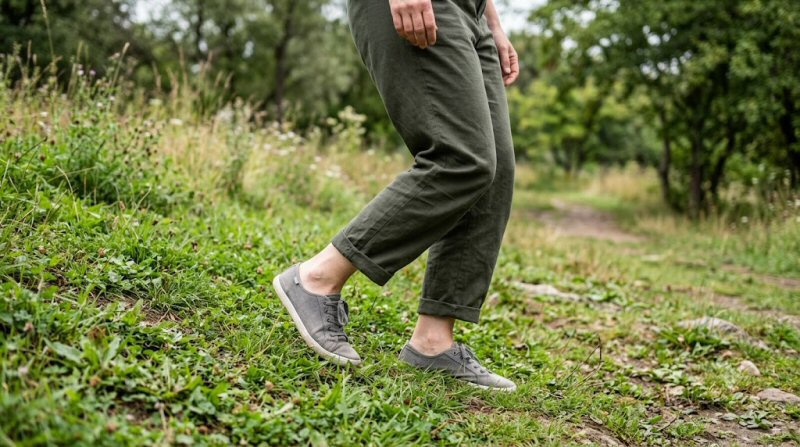
You walk a straight sidewalk for weeks, then step off a curb at an angle and the outer ankle lights up. Or a weekend trail tilts under one foot and the same strip of leg, just behind the outer ankle bone, feels hot the next morning. That strip is not a random sore spot. It is the peroneal pair, the muscles that still expect the ground to lean, shift, and ask for a sideways step.
They sit on the outer side of the lower leg. Fibularis longus and fibularis brevis — still widely called the peroneals — rise from the fibula, hook behind the lateral malleolus, and finish on the foot. Brevis grips the base of the fifth metatarsal, the bony bump on the outer midfoot. Longus dives under the sole and inserts toward the base of the first metatarsal and the medial cuneiform. Everting the foot is the textbook job. The real job, on the ground humans actually walked, was keeping a planted foot from rolling inward while the body moved across uneven, cambered earth.
What the Outer Ankle Was Built to Do
A level treadmill is a poor picture of ancestral gait. Trails, shorelines, and packed paths lean. A step onto a root, a rock, or a side slope loads the foot in the frontal plane, not only forward. Verne Inman described the subtalar joint as a mitered hinge: tibial rotation above becomes pronation and supination below. Roger Mann’s gait work showed the foot accepting the ground, adapting, then stiffening for push-off. The peroneals are part of that handoff.
Brevis is the shorter evertor, a direct check on inversion at the ankle and hindfoot. Longus does more than pull the outer foot up. In late stance it plantarflexes the first ray, pressing the medial column down so the arch can share load instead of collapsing unchecked. Shahan Sarrafian’s anatomical work on the foot laid out that course under the sole: a tendon that crosses from the outer leg to the inner forefoot is a frontal-plane tool, not a straight-ahead one.
On a flat, predictable surface the demand is small. Electromyography studies, including work by George Murley and Hylton Menz, find peroneus longus active in ordinary walking, and more active when foot posture is already pronated. Activity rises further when the surface tilts or the step is not purely forward. A sideways step, a cut, or a cambered path is the load these muscles were rehearsing every day. A commute that never leaves the sagittal plane is a long holiday from that rehearsal.
Why Flat Modern Ground Retires Them
Sidewalks, mall floors, office corridors, and treadmills are crowned just enough for drainage, then engineered to feel level. Shoes add a second simplification. A stiff sole and a structured heel counter decide part of the inversion-eversion question before the tendon does. The foot still pronates and supinates a little. It rarely has to save a step that arrived from the side.
The muscle does not vanish. It becomes late and low-capacity. Tendon, like muscle, keeps the stiffness it is asked for. Months of straight-line steps leave the peroneal tendons less practiced at the quick eccentric catch — the lengthening contraction that slows an inward roll. The ligaments on the outer ankle, especially the anterior talofibular ligament, were never meant to be the only answer. They are the passive backup. The peroneals are the active one.
Lars Konradsen’s inversion-platform studies made a useful distinction. A truly sudden roll can peak before the peroneal reflex has developed useful torque. The dynamic defense is not a magic save for every misstep. It is better at ongoing control: the small corrections during stance, the prepared response when the eyes have already seen a curb, the strength to hold a side-sloped step that was expected. Jay Hertel’s model of chronic ankle instability separates mechanical laxity from functional trouble — delayed peroneal response, weaker eversion, and a foot that does not trust the ground. Both layers show up in ordinary life, not only in sport.
James Ashton-Miller’s work on ankle proprioception points the same way. Position sense at the ankle is part of the protection. If the only positions the joint visits are “flat shoe, flat floor,” the map gets coarse. The first real side step then feels like a surprise even when the eyes saw it coming.
This is the same narrow-loading problem described in why your ankles still expect uneven ground: the joint was built for a surface that moves in more than one direction. The peroneals are the muscular half of that expectation.
What This Feels Like in Ordinary Life
The mismatch is usually boring until it is not.
- Outer ankle fatigue after the first hike, the first uneven lawn, or a day of standing on a sloped curb.
- A tender line behind the lateral malleolus the morning after a soccer game, a dance class, or stepping off a bus at an angle.
- The foot that wants to roll outward on a cambered road, or the opposite complaint: the arch that feels unsupported when peroneus longus is not pressing the first ray down.
- A mild snap at the outer ankle as the tendons flick over the bone, more noticeable in a loose shoe or after swelling.
- A week of treadmill running that feels fine, then a trail loop that leaves the outer leg heavy.
None of that means the tendons are torn. It means a frontal-plane job was skipped, then requested in one afternoon.
Less Common but Serious Causes
Peroneal tendon trouble is real, and it clusters with repeated inversion sprains and with a higher-arched, cavovarus foot that already loads the outer border. Christopher DiGiovanni and other foot-and-ankle clinicians have described splits in peroneus brevis, a tendon that subluxes out of its groove, and pain that is not just “a weak ankle.” Sudden giving way, a pop with immediate swelling, numbness on the top of the foot, or inability to bear weight needs an exam, not a side-step drill.
A snap that is new, loud, and followed by a tendon that visibly flicks forward over the malleolus can be a torn retinaculum. Outer ankle pain with back or nerve symptoms can be the superficial peroneal nerve, not the muscle. Persistent swelling, night pain, or a foot that keeps rolling despite simple practice is a reason to stop guessing.
Hidden Triggers
A few modern habits make the quiet peroneals louder when they finally work.
- Only straight-line cardio: treadmill, track, bike with a locked foot.
- Shoes that block inversion and eversion all week, then a barefoot beach or a flexible trail shoe on Saturday.
- Standing with the weight on the outer foot, common on a cambered street or a sloped kitchen mat.
- Old inversion sprains that were rested until the limp left, without rebuilding eversion endurance.
- Rapid mileage on the same flat route, which trains the calf spring and skips the side-to-side stabilizers.
The arch connection matters here too. Peroneus longus and tibialis posterior pull on the midfoot from opposite sides. A foot that only ever meets flat, cushioned ground underuses both. The pattern is related to why your arches still expect a springy step: the medial column still expects a muscle to set it, not only a foam wedge.
When to Worry
Most outer-ankle ache after a new side slope settles in a few days if walking remains possible and swelling is mild. Get it checked sooner if:
- You cannot take four steps without a sharp catch.
- The ankle swelled within an hour and bruising tracks under the outer bone.
- The foot feels unstable on flat ground, not only on a curb.
- A tendon visibly jumps over the malleolus.
- Pain sits in the outer midfoot at the fifth metatarsal after a twist. That bone can fracture where brevis pulls.
- Numbness, cold toes, or calf pain arrive with the ankle ache.
A single roll with a pop is a sprain until proved otherwise. Repeated rolls are a stability problem, not bad luck.
Myths vs Facts
Myth: Ankle stability is only a ligament issue.
Fact: Ligaments are the passive stop. Hertel’s work treats peroneal timing, eversion strength, and balance as the functional half. Both can fail.
Myth: The peroneals can always fire fast enough to stop a sprain.
Fact: Konradsen showed a very fast inversion can outrun the reflex. Preparation, strength, and a surface you have practiced on matter more than hoping the reflex wins a surprise.
Myth: Flat shoes or barefoot walking automatically train the outer ankle.
Fact: A flat smooth floor still asks for almost no side step. Uneven, cambered, and sideways practice is the stimulus, not the absence of a heel by itself.
Myth: Outer ankle pain after a hike means you need a higher brace forever.
Fact: A brace can protect a fresh sprain. Long term, unused peroneals stay late. Support plus gradual side loading beats support alone.
How to Give Them the Step They Expect
The aim is small frontal-plane work most days, not a heroic trail on deconditioned tendons.
- Walk a cambered path, a grassy verge, or a gentle side slope for a few minutes. Keep the pace conversational.
- Practice a slow sideways step along a wall: lead with one foot, bring the other to meet it, then switch. Ten steps each way is enough at first.
- Stand on one leg near a counter while the head turns slowly. The peroneals work when the foot is not allowed to collapse inward.
- Rise onto the toes with the weight spread toward the ball of the big toe, so longus has a reason to set the first ray. Hold a counter.
- After an old sprain, add a light band for eversion only when daily walking is comfortable. Pain that changes your limp is a signal to shrink the dose.
- If you run, trade one flat session a week for an even dirt path before you add technical trail.
Soreness that is dull, both sides, and gone in a day is adaptation. A sharp line behind one malleolus that worsens step by step is a reason to rest that load and get it seen.
When to See a Doctor
See a clinician if the ankle has rolled more than once in a year, if a tendon flicks out of place, if the fifth metatarsal base is focally tender, or if swelling and instability are still obvious after a week of reduced loading. People with diabetes, poor circulation, or a history of tendon rupture should not wait on a new outer-ankle pop. Imaging is for suspected fracture, tendon split, or a retinaculum tear, not for ordinary next-day fatigue after a new slope.
FAQs
Are the peroneals the same as the shin muscles?
No. The tibialis anterior and the toe extensors run on the front of the shin. The peroneals run on the outer side, behind the lateral malleolus. Front-of-shin pain after hills is a different mismatch.
Why does my outer ankle ache on cambered roads but not on a track?
A track is nearly level and repetitive. A cambered road keeps one foot in a longer eversion or inversion demand. That is the load the tendons recognize, especially if the week was spent on flat floors.
Can weak peroneals cause the arch to drop?
They can contribute. Peroneus longus presses the first metatarsal down in late stance. It does not hold the arch up by itself — tibialis posterior and the plantar fascia share that — but a longus that never works leaves the medial column less set for push-off.
Should I wear an ankle brace for daily walking?
A brace is reasonable after a sprain or if the ankle is giving way. All-day bracing on a stable ankle reduces the very corrections the peroneals use to stay competent. Use it for risk, not as a permanent substitute for side steps.
How soon should a side-step practice feel normal?
Many people notice less curb anxiety within two to four weeks of short, frequent practice. Tendons adapt more slowly than muscles. Increase slope and speed only when the outer ankle is quiet the next morning.
Is a painless click behind the outer ankle dangerous?
A quiet click with no swelling is often tendon glide in the groove. A new click with pain, swelling, or a tendon that jumps forward over the bone should be examined.
Conclusion
The peroneals are a side-slope system living in a straight-line world. Flat floors and structured shoes did not delete them. They retired the daily sideways step that once kept eversion timing, first-ray set, and outer-ankle trust in the same afternoon. Give them small camber and slow side steps before you ask for a trail. The reflex will not win every surprise roll — Konradsen was clear about that — but a tendon that has practiced the lean is a better partner for the ligaments than one that only knows the sidewalk.
The same narrow gait shows up higher in the chain. Why your IT band still expects sideways hills is the hip-level version of a leg that almost never has to step across itself.


