
The coccyx still expects a squat or a sit on the sit bones, not hours perched on a chair edge. Slumped seats load the tip, then standing up aches.
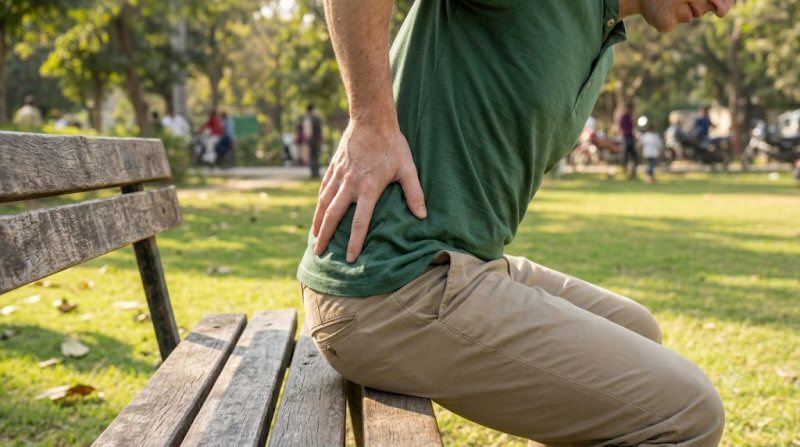
The jab arrives as you stand up from the chair, not while you are walking. You have been perched on the front edge of the seat, or slid into a slump, and the small bone at the end of the spine has been taking a share of your weight that a squat never asked it to take. A deep rest position used to park the load on the sit bones and the backs of the thighs. A hard chair, a narrow bike saddle, or a long car seat can park it on the tip instead. The tailbone still expects the older arrangement.
The coccyx is the leftover of a tail, three to five small segments fused or partly mobile, curved forward under the sacrum. It is an anchor for the pelvic floor and the gluteus maximus, not a sitting pedestal. When the pelvis rolls backward on a chair, that anchor becomes a pressure point. The ache that follows is usually mechanical. A fall, childbirth, or a rare deeper problem can use the same spot, which is why the pattern of the pain matters more than the nickname.
What This Ache Feels Like
People describe a bruise at the very bottom of the spine, sharper when they sit back and easier when they stand or walk. Rising from a low seat can catch. A long drive is worse than a stroll. Leaning forward onto the thighs often helps, because the sit bones take the load again. Lying on the side is usually fine. Direct pressure, as in a hard stadium seat or a narrow saddle, lights it up within minutes.
It is easy to confuse with neighbors. A one-sided deep buttock ache that travels down the leg is more often the piriformis that still expects a wide step or a nerve, not the coccyx. Low-back ache that is worse with bending and better with walking is usually the lumbar joints or discs. Sit-bone pain on one side after a long run is the hamstring origin, higher and to the side of the midline. True tailbone pain is midline, just above the cleft, and it cares about sitting pressure more than about lifting a bag.
Both a recent fall and a month of bad chairs can feel the same by week two. The useful clue is the seat test. If a cushion with a cutout under the tip, or simply sitting more upright on the ischial tuberosities, drops the pain within a day or two, the load was the driver.
What the Tailbone Was Built to Do
The coccyx is not a failed seat. Jason Woon and Mark Stringer’s anatomical reviews describe it as a small lever: the levator ani and coccygeus attach along it, the anococcygeal ligament ties it to the anal canal, and fibers of gluteus maximus reach its lateral edges. Those attachments steady the pelvic floor when you walk, cough, and rise from a squat. The bone moves a little. That give is useful in childbirth and in a deep fold. It is a poor design for hours of point pressure.
Gordon Hewes mapped human rest postures across cultures and found the deep squat and the sit on the ground far more common than a backed chair. In a full squat the thighs support the trunk, the pelvis stays relatively open, and the coccyx hangs between the legs instead of bearing body weight. The same fold shows up in the hips that still expect a deep fold and in the pelvic floor that still expects walking and a squat. The tailbone’s job in that posture is to anchor muscle, not to be sat on.
A chair reverses the job. Seat pans are often level or tilted back. A slumped lumbar curve rolls the pelvis posteriorly, the sacrum nods, and the coccyx tip points down into the cushion. Jean-Yves Maigne’s sitting radiographs showed that some painful coccyges flex or extend more than their neighbors when body weight arrives. The pain is not mysterious. It is a small bone asked to be a chair leg.
Why a Modern Seat Keeps Loading It
Office chairs, car buckets, and soft sofas all invite the same slide. The pelvis rolls back, the lower back flattens, and pressure migrates from the broad ischial tuberosities to the narrower midline. Mohsen Makhsous and colleagues measured that shift: a slumped sit raises pressure under the sacrum and coccyx region compared with a supported upright sit. A hard edge makes it worse. Perching on the front lip of a stool, or on a wallet in a back pocket, can lever the tip directly.
Cycling is a special case. A narrow saddle that is tilted up, or a rider who sits too far back, presses the coccyx and the perineum rather than the sit bones. Childbirth can sprain the joints between sacrum and coccyx even without a dramatic tear. A backward fall onto the ice is the classic acute cause Maigne and later reviewers, including Patrick Foye and Lesley Lirette, keep returning to. Obesity raises the sitting load. So does a very thin build with little gluteal padding. The mismatch is the same shape in each case: a bone built for anchoring is used as a pedestal.
Postacchini and Massobrio classified coccyx shapes and noted that a more sharply curved or hooked tip is more often painful, partly because it meets the seat sooner. Most people with an ordinary curve still get sore if the sit is long enough and slumped enough. Shape loads the gun. The chair pulls the trigger.
Common Causes
The everyday list is short.
- Hours of slumped sitting, especially on a soft sofa or a chair with a sagging pan.
- Perching on a hard edge, a stadium seat, or a wooden bench.
- A recent fall onto the buttocks, even a mild one that seemed fine the same day.
- A bike or rowing seat that contacts the midline.
- Late pregnancy and the months after delivery, when the joints are more mobile and sitting time goes up.
- A wallet, phone, or tight waistband pressing just above the cleft.
Acute sprain and slow overload feel similar after a week. The fall version often has a clear day-zero bruise. The chair version builds across afternoons and eases on weekends with more standing.
Hidden Triggers
A few amplifiers hide inside ordinary days. A posterior pelvic tilt from tight hip flexors after a sitting job makes every chair a coccyx chair. Constipation and straining tug the anococcygeal ligament, the same tissues George Thiele linked to coccygeal pain when the pelvic floor stays in spasm. That tug is one reason the bowels that still expect a squat and the tailbone show up in the same week. Prolonged cough does a smaller version of the same pull.
Cold stadium seats and long flights add pressure plus stillness. Stress shows up as gripping in the pelvic floor, which yanks on the coccyx from the inside even when the seat is decent. A new firmer mattress is rarely the cause. Sitting is. If the ache is only in bed, look at side-lying pressure or a lumbar problem before blaming the tip.
Less Common but Serious Causes
Most sitting tailbone pain is mechanical. A few patterns are not. A chordoma or another tumor of the sacrum is rare, but it can declare itself as deep midline pain that does not care whether you are on a cushion, often with night pain. Infection after a wound, a pilonidal problem higher in the cleft, or a pelvic abscess can refer to the same region with fever or drainage. A fracture that fails to settle, or a dislocation seen on a sitting radiograph, needs a clinician rather than another cushion. Saddle numbness, new bowel or bladder incontinence, or leg weakness is a spinal emergency, not a chair problem. Pain that arrived with unexplained weight loss belongs in the same “get checked” pile.
When to Worry
Worry less when the pain is clearly sitting-related, bothers you only at the tip, and eases when you stand, walk, or use a cutout cushion. A bruise after a simple fall that improves over two to four weeks fits the ordinary sprain.
Worry more if you cannot sit at all after several weeks, if pain wakes you regardless of position, if there is fever, drainage, or a lump that is growing, or if bowel, bladder, or sexual function has changed. A fall in someone with thin bone, or pain after a cancer history, deserves imaging rather than a wait. One-sided sciatica, groin pain, or a click in the hip is a different joint.
Myths vs Facts
Myth: Tailbone pain means the bone is broken. Fact: Maigne’s series found sprains, hypermobile segments, and rigid painful tips more often than a fresh fracture. A break is possible after a fall. It is not the default.
Myth: You should sit as little as possible forever. Fact: The bone needs less bad pressure, not a ban on chairs. Upright sits on the sit bones, and breaks to stand, are usually enough.
Myth: Cracking it back into place is the fix. Fact: Aggressive manipulation of an acute sprain can irritate it. Gentle movement and load management come first. A clinician-guided maneuver is a later option, not a home project.
Myth: Only people who fell get this. Fact: Postacchini, Foye, and primary-care reviews all describe an idiopathic group whose main exposure is sitting. The chair is a sufficient cause.
How to Give It the Squat Logic Back
You do not need to work from a squat all day. You need the load path a squat used.
Sit on the ischial tuberosities, the two bones under the buttocks, not on the tip. A slight forward tilt of the pelvis, with the ribs stacked over it, keeps the coccyx off the pan. A wedge that is higher at the back can help if it does not shove you into a perch. A coccyx cushion with a rear cutout unloads the tip on long drives and flights. Soft sofas are often worse than a firm chair, because you sink until the tip is the lowest point.
Stand or walk for a few minutes every half hour. Short walks restore the gluteal and pelvic-floor use the coccyx was meant to anchor. If your hips allow it, a supported deep squat hold of twenty or thirty seconds, heels down or heels raised on a book, reminds the outlet how to open without sitting on the bone. Skip it if the knees or the tip protest.
On a bike, level the saddle or tip the nose down a degree or two, and move your sit bones onto the wider part of the seat. A wallet comes out of the back pocket. Heat after a long sit eases the muscle tug. Avoid long sessions of direct massage on the tip in the first weeks after a fall. Pelvic-floor relaxation, not constant squeezing, helps the Thiele-type spasm. Straining on the toilet keeps the ligament angry, so the squat footstool already useful for bowel angle helps here too.
When to See a Doctor
See someone if a fall is followed by pain that blocks sitting after ten to fourteen days, if you are postpartum and the pain is worsening rather than settling, or if cushions and position changes do nothing over two or three weeks. Dynamic sitting radiographs, the method Maigne popularized, can show abnormal motion that a standard film misses. Foye and others note that injections around the joint are an option when load management fails, not the first step. Mention night pain, fever, a growing lump, or any change in bowel or bladder control at the first visit rather than waiting those out.
FAQs
Is a sore tailbone after a long flight normal? It is common, and usually a pressure bruise from a slumped seat, not a fracture. A cutout cushion, an upright pelvis, and standing in the aisle when you can are the practical fixes. Pain that is just as bad lying down needs a different explanation.
Can a chair really injure the coccyx without a fall? Yes. Maigne and later clinical reviews include a large group with no trauma. Posterior pelvic tilt shifts body weight onto a small curved tip. Shape, padding, and hours decide who feels it first.
Should I stretch the hips or rest completely? Relative rest from the offending seat, not bed rest. Walking is usually kind. Hip-flexor and glute work helps if it keeps the pelvis from rolling backward. Aggressive forward folds that jam the tip into the floor are the stretch to skip while it is angry.
Does tailbone pain always mean a pelvic-floor problem? No. Many cases are local joint and soft-tissue overload. A gripping floor can tug the same bone, which is why relaxation and less straining help a subset. Numbness or true incontinence is a separate, urgent issue.
How long does chair-related coccyx pain take to settle? A pure pressure ache often eases within days of changing the seat and standing more often. A sprain after a fall commonly needs several weeks. Pain that is unchanged at a month, or worse at night, should be examined.
Conclusion
The tailbone is a pelvic-floor anchor left over from a tail, shaped for a squat and a stride, not for a slumped hour on a chair edge. Modern seats roll the pelvis back and hand that small tip a job it never had. Sitting on the sit bones, standing up on a schedule, and keeping bike and car pressure off the midline return the load to the bones that can take it. A fall, night pain, or a change in bowel or bladder control is the signal to get it looked at rather than to buy another cushion. The rest of the time, the ache is the coccyx reminding you that it still expects a squat.


