
The deep hip rotator still expects a wide, turning step and time off the chair. Long sitting leaves it quiet and compressed, then a sudden walk can make the buttock ache.
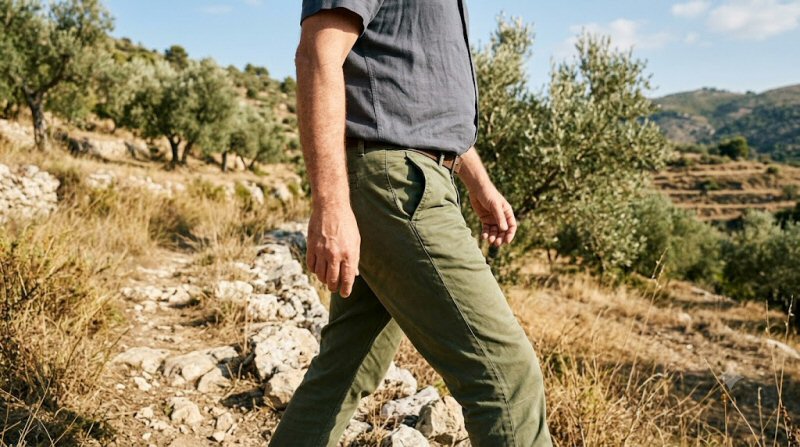
You stand up after a long meeting and the deep part of one buttock feels thick, as if a small stone were parked under the sit-bone. The first steps are awkward. By the parking lot the ache has a dull tail down the back of the thigh, and you wonder if your back has finally gone. Often it has not. The muscle complaining is the piriformis, a short deep rotator that still expects a wide, turning step and hours off a chair seat.
What This Ache Feels Like
The usual story is one-sided. The tender spot sits deep in the buttock, a little out from the tailbone and above the sitting bone, not in the low back itself. Sitting on a hard chair, a wallet, or a car seat makes it worse. Walking can ease it after a few minutes, or it can sharpen it if the step is short and the hip stays turned in. Some people feel a line of ache down the back of the thigh that fades before the knee. Numbness, if it happens, is patchy and brief.
That pattern is annoying and common. It is not the same as a disc pressing a nerve root, which more often sends pain, tingling, or weakness below the knee and into a specific strip of the foot. The two can overlap, which is why a buttock ache that keeps spreading deserves a proper look rather than a stretch video.
What the Piriformis Is For
The piriformis is a small, flat muscle on the front of the sacrum. It leaves the pelvis through the greater sciatic notch and attaches to the top of the greater trochanter, the bony knob on the outside of the thigh. In an upright hip it turns the thigh outward. When the hip is bent, it also helps lift the thigh out to the side. Through the whole stance phase of a step it helps keep the femoral head seated in the socket while the pelvis manages the other leg.
Anatomists have argued for decades about the exact line of pull once the hip is deeply flexed. Donald Neumann’s kinesiology work, building on earlier dissection studies, treats the action as angle-dependent: a muscle that is an external rotator with the hip extended can contribute differently once the hip is folded. That detail matters for chairs. A right-angle sit is not a neutral rest position for this muscle. It is a long hold near the middle of its range, under body weight, with almost no alternating load.
The sciatic nerve usually passes just in front of the piriformis on its way into the thigh. Beaton and Anson’s classic cadaver series found that in a minority of people the nerve splits, and part of it pierces the muscle. That variation is real. It does not mean every deep buttock ache is a nerve trapped in the piriformis. It does mean the neighborhood is crowded: muscle, nerve, and the bony exit from the pelvis share a small space that a chair compresses for hours.
Why It Still Expects a Wide Step
Human walking was never a treadmill lane with the feet parallel and the hips locked forward. Uneven ground, side slopes, turns, and a naturally wider step asked the deep rotators to lengthen and shorten on every stride. Getting up from the ground, squatting to work, and carrying a load on one side added rotation the chair never asks for. The larger gluteal muscles take the obvious work of hills and standing up, which is why a quiet piriformis can hide behind a story that sounds like “the glutes still expect hills and the floor.” The piriformis is the smaller partner that fine-tunes rotation while that bigger work happens.
A day of ancestral loading looked like hundreds of short contractions, brief stretches at the end of a stride, and long gaps with no seat under the pelvis. The modern version is the reverse: eight hours of compression, then a brisk walk that asks a deconditioned rotator to stabilize a hip it has not used all day. The ache often shows up on the walk home, not during the meeting.
The sacroiliac region sits next door. A stride that loads one side and unloads the other is part of what those joints still expect, covered in why the SI joints still expect a stride. When both the deep rotator and the pelvic joint have been parked, the first long walk can feel like the whole side of the pelvis is complaining.
What the Chair Does
Sitting flexes the hip and pins the muscle between the seat and the sacrum. A wallet or phone in the back pocket is a classic extra lump. Legs crossed the same way every afternoon hold one hip in sustained rotation. A low soft seat lets the pelvis roll back, so the thigh turns inward and the deep rotators stay on a quiet stretch. None of this tears the muscle. It just removes the alternating work the tissue was built around, then returns that work all at once.
Clinicians have named the painful version of this neighborhood for a century. Yeoman linked deep gluteal spasm to sciatica in 1928. Robinson described piriformis syndrome in 1947. Pace and Nagle, and later Fishman’s FAIR test, tried to make the exam more specific. More recent reviews, including Hopayian’s, found the label used loosely: many people with “piriformis syndrome” actually have lumbar referred pain, hamstring tendinopathy, or what Martin and colleagues now call deep gluteal syndrome, a broader entrapment picture around the sciatic exit. The practical point survives the naming debate. A deep buttock that hates long sits and likes a gradual walk is usually a load-and-posture problem, not a damaged nerve.
Hidden Triggers
A few ordinary habits pile onto the chair.
- A sudden return to hills, trails, or a long city walk after a sedentary week.
- Driving with one foot planted and the same hip slightly rotated for an hour.
- Side sleeping on a thin mattress so the top hip falls inward all night. Side-sleep ache over the outer hip is often the bursa, but the deep rotator can join in.
- Aggressive figure-four stretches that push a irritable muscle to a painful end range every morning.
- A narrowed step on a treadmill, eyes on a screen, hips never asked to turn.
- Low everyday hip mobility from chairs, the same mismatch described in why the hips still expect a deep fold.
Cold weather does not cause it, but a stiff morning start can make the first blocks feel sharper until the muscle warms.
When to Worry
Most deep buttock aches settle with walking breaks, a better seat, and gradual loading. Get urgent care if you have new bowel or bladder changes, saddle numbness, fever with spine pain, pain after a major fall, or weakness that makes the foot slap or the knee buckle. See a clinician sooner rather than later if pain runs below the knee with numbness, wakes you most nights, follows an accident, or is steadily worsening over days. A first bout of one-sided buttock ache after a long sit is usually not an emergency. A bout that keeps spreading is worth sorting out, because lumbar nerve-root pain and deep gluteal pain are treated differently.
Myths vs Facts
Myth: A deep buttock ache always means the sciatic nerve is trapped in the piriformis.
Fact: Nerve-through-muscle anatomy is a minority variant from Beaton and Anson’s series. Most chair-related ache is muscle and tendon load, sometimes with local nerve irritation, sometimes with a back source. The label is often broader than the evidence.
Myth: A hard figure-four stretch is the cure.
Fact: Gentle motion helps. Forcing a painful end range on an already irritable muscle often flares the next day. Strength through a comfortable range beats a long aggressive hold.
Myth: If imaging is normal, the pain is imagined.
Fact: Ordinary MRI often looks quiet. Filler’s neurography work showed that specialized scans can sometimes see nerve irritation, but most people never need that. A normal scan does not erase a real load problem.
Myth: Rest until it disappears is the safest plan.
Fact: Total rest removes the very contractions the rotator needs. Short, more frequent walks usually beat either a weekend hike or a week on the couch.
How to Give It the Step It Expects
You do not need a new anatomy. You need the old pattern in small doses.
Break sits every 30 to 45 minutes. Stand, take a few steps that are slightly wider than your desk shuffle, and turn as if you were looking over each shoulder while you walk a short loop. The turn is the point. Straight-line steps alone under-use rotation.
Empty the back pocket before you sit. A thick wallet is a focal pressure point on the muscle you are trying to calm. A small lumbar roll or a firmer seat that keeps the pelvis from rolling back is enough for most chairs. You do not need a specialty cushion unless a clinician has suggested one.
On walks, let the arms swing and allow the pelvis a little rotation instead of locking the hips forward. Hills and uneven paths are useful once the ache has calmed, not on the first day back. If the buttock sharpens past a mild warm feeling, shorten the walk and try again later.
A simple load, done calmly: lie on your side with hips and knees bent, heels together, and lift the top knee a short distance without rolling the pelvis back. Ten slow reps, once or twice a day, should feel like work in the outer hip, not a stab in the buttock. Stop if pain refers down the leg. A standing hip hinge to pick up a bag, and a slow sit-to-stand without using your hands, bring the bigger hip muscles back into the day so the piriformis is not the only one on duty.
Skip the daily marathon stretch. If a stretch feels useful, keep it mild and short, and do it after a walk rather than as the first move of the morning.
When to See a Doctor
See someone if the ache lasts more than a few weeks despite walking breaks, if you have true numbness or weakness, if one leg feels unreliable on stairs, or if you have a history of cancer, steroid use, or unexplained weight loss with new spine or pelvic pain. A clinician can separate lumbar referred pain, hip-joint pain, hamstring tendon pain at the sit-bone, and deep gluteal irritation. Treatment might include a short course of targeted loading, and only sometimes an injection if a clear entrapment is confirmed. Most chair-and-stride cases never need that step.
FAQs
Why does only one side ache?
People tend to cross the same leg, carry a bag on the same shoulder, and sit with weight on one sit-bone. The sciatic exit is also slightly asymmetric in some bodies. One side simply got the longer compression and the shorter warm-up.
Can a wallet really do this?
Yes. A thick wallet under one buttock is a known local pressure trigger. Moving it to a front pocket is a reasonable first experiment, not a diagnosis.
Should I stop walking until it settles?
No, unless walking clearly worsens weakness or pain below the knee. Trade the single long walk for several short ones, and add a little width and a few turns instead of speeding up.
Is cracking or clicking in the hip the same problem?
Usually not. A painless click on standing is often a tendon snapping over the hip bone. The piriformis problem is a deep ache with sitting, not a pop.
Do I need a scan?
Not for a first, clearly sit-related ache that is already easing. Imaging is more useful if pain spreads below the knee, strength changes, or the story does not fit a load problem.
Can this become permanent nerve damage?
Sustained compression from a chair day does not work like a severe traumatic nerve injury. Ignoring progressive weakness is the risk worth respecting. Ordinary sitting ache, handled with movement and a better seat, does not slowly destroy the nerve.
Conclusion
The piriformis is a small stabilizer that still expects rotation, a slightly wider step, and time when nobody is sitting on it. Chairs reverse that pattern, then a sudden walk asks for the missing work all at once. A deep one-sided buttock ache after a meeting is usually that mismatch, not a failing back. Give it turns, shorter sits, an empty back pocket, and gradual loading. Let spreading pain, weakness, or saddle numbness change the plan, and get those checked. The rest is a return to the step the hip was already built to take.


