You sit on a porcelain seat that looks like progress. The room is clean. The height is comfortable. And still you wait, lean forward, hold your breath, and push.
That extra strain is not a personal failing. For most of human history, emptying the bowel happened in a deep squat. Hips flexed, knees high, torso folded. The last century swapped that posture for a chair with a hole in it. The plumbing of the pelvis did not get the memo.
Your bowels still expect a squat — or at least a close cousin of one.
What This Mismatch Feels Like
The sitting toilet is so ordinary that the leftover effort feels like “how pooping works.” Common signs of the mismatch:
- You sit longer than you expected before anything happens
- You need a push, a lean, or a held breath to finish
- You leave feeling incomplete and return twenty minutes later
- There is a sense of a kink rather than a straight exit
- Hemorrhoid flares or anal fissure sting after hard straining days
- Raising your feet on a box or leaning into a mock squat suddenly makes the visit shorter
People with otherwise healthy guts notice this. Frequency can look “normal” on a calendar while emptying still feels like work.
The Sling That Holds Continence — and Gets in the Way
Continence is not only a tight anal sphincter. A U-shaped muscle, the puborectalis, slings around the junction of the rectum and the anal canal and pulls that junction forward. The pull creates the anorectal angle — a kink that helps keep stool in when you are standing or sitting upright.
That kink is useful all day. It is less useful at the exact moment you want stool to leave.
In a deep squat the hips flex sharply. The puborectalis lengthens and the angle opens. The rectum and anal canal line up more like a slide than a bent pipe. Sitting on a standard Western toilet flexes the hips far less. The sling stays relatively tight. The kink remains.
Israeli physician Dov Sikirov argued this point across two well-known papers. In a 1989 hypothesis in Medical Hypotheses he called habitual sitting-toilet use a contributor to “primary” constipation — difficulty emptying despite a reasonably regular schedule. In 2003, in Digestive Diseases and Sciences, he asked 28 healthy volunteers to time six bowel movements in each of three postures: a standard-height seat, a lower seat, and a full squat. Squatting produced the shortest time to a sense of completion and the lowest subjective strain, by a wide margin.
The study was small. The direction of the finding has been replicated.
What Imaging Shows When the Hips Fold
Neurologist Ryuji Sakakibara and colleagues used videomanometry — simultaneous X-ray and pressure recordings — in healthy volunteers in 2010. They compared ordinary sitting, sitting with extra hip flexion, and squatting. On defecation, the rectoanal angle opened to about 126 degrees in the squat, versus about 100 degrees on a normal sit. Basal abdominal pressure before the effort was also lower in the squat.
In plain language: more hip flexion, straighter canal, less need to bear down.
Later imaging work in people with functional constipation has pointed the same way. Deeper squat angles tend to increase perineal descent and widen the anal rectal angle during the pushing phase compared with a 90-degree sit. The puborectalis looks less bulky when the hips are folded. The exit is mechanically easier.
Gastroenterologist Satish S. C. Rao, whose group has mapped dyssynergic defecation in detail, has shown that some people paradoxically tighten the pelvic floor when they try to empty — a coordination problem that sitting can unmask. Position will not fix every coordination issue. It does change the starting geometry those muscles work against.
The same pelvic floor that still expects walking and a squat for daily pressure management, a theme covered in why the pelvic floor still expects walking and a squat, is the sling that decides how open the exit is on the toilet.
Why the Modern Bathroom Won
Sitting toilets spread with indoor plumbing, ceramic manufacturing, and a cultural preference for not hovering. They are kinder to stiff knees, recovering hips, and late pregnancy. They are easier to clean. They feel civilized.
None of that changes the angle of the puborectalis.
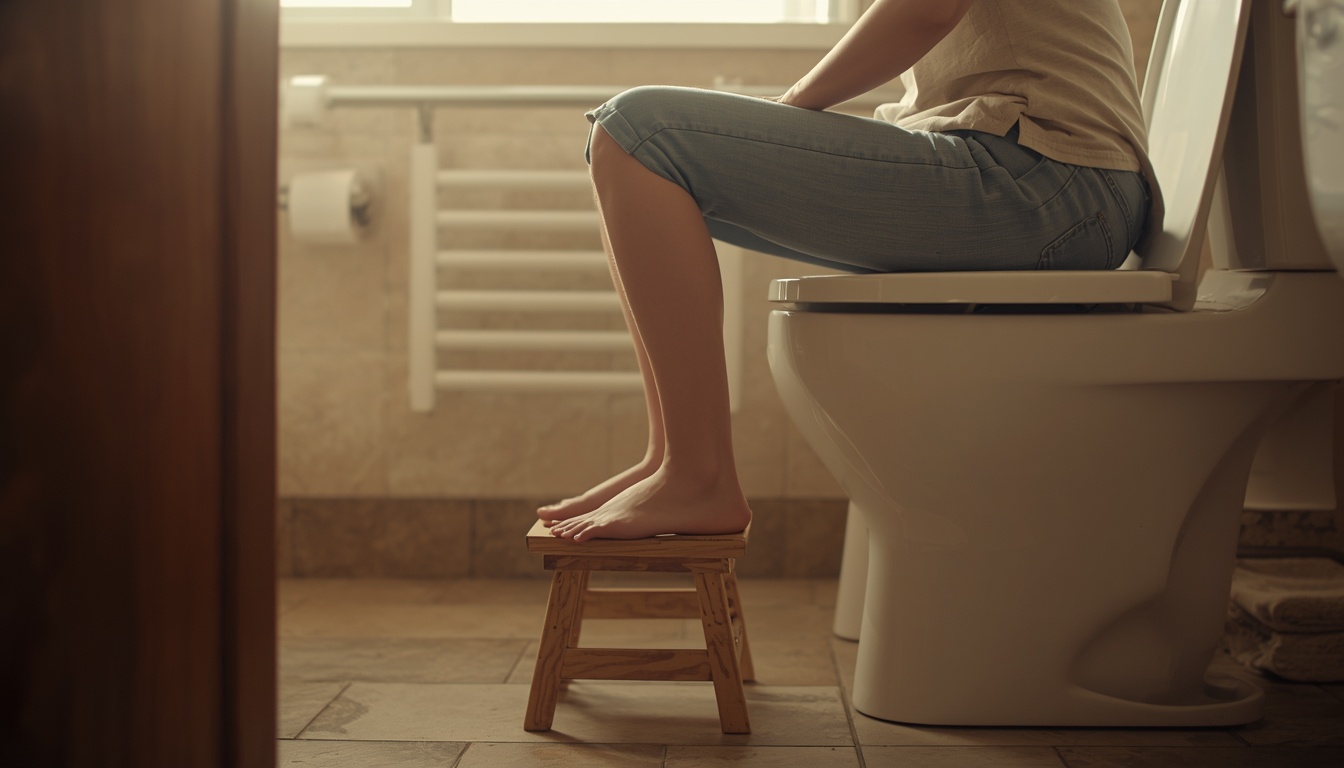
A full floor squat is not realistic for every body in every bathroom. The useful translation is hip flexion — knees higher than hips — not a perfect anthropological recreation. A sturdy footstool in front of the bowl is the modern compromise. You stay on the seat. The femurs fold. The sling gets a hint of the old posture.
A 2019 study in the Journal of Clinical Gastroenterology followed more than a thousand bowel movements with and without a defecation posture modification device (a footstool). With the device, people were more likely to report complete emptying and less likely to report straining. The effect is not magic. It is geometry.
This is the same family of hip-fold the skeleton still uses when you get off the floor, a pattern explored in why the hips still expect a deep fold. The toilet is one more place the fold was designed to appear.
Hidden Triggers That Make Sitting Harder
Posture is one lever. It stacks with others:
- Hard, dry stool from low fiber, low fluid, or iron supplements
- Ignoring the first urge until the rectum has quieted
- Long, distracted sits with a phone, which invite extra strain
- Pelvic-floor tightness from chronic gripping, heavy lifting with breath-holding, or anxiety
- Recent pregnancy, episiotomy, or pelvic surgery
- Pain that makes you cut the visit short
- A colon already sluggish from sitting all day and a large late dinner
- The morning coffee reflex arriving before you have time to answer it well — the gastrocolic surge described in why coffee makes you need the bathroom
Position helps most when the stool is already soft enough to move. A squat cannot push a brick through a kink any more kindly than a sit can.
When Extra Strain Is a Red Flag
Most incomplete, straining visits on a sitting toilet are mechanical and common. See a clinician promptly if you notice:
- Blood that is more than a streak on the paper, or dark stool
- Unexplained weight loss, fever, or night sweats
- A sudden lasting change in bowel habit after midlife
- Pencil-thin stools that persist
- Pain that does not settle after a bowel movement
- A bulge or heaviness that feels like the rectum is coming down
- The need to use a finger to empty (splinting) as a new habit
- Constipation plus vomiting or a rigid abdomen
Those patterns are not “just the toilet.” They need an exam.
Myths vs Facts
Myth: If you go every day, emptying is fine.
Fact: Frequency and completeness are different. Many people go daily and still strain.
Myth: You must squat on the floor to get any benefit.
Fact: Raising the feet so the knees sit above the hips captures a large share of the angle change.
Myth: Straining is the only way a “real” bowel movement happens.
Fact: Healthy emptying is mostly reflex plus a modest rise in abdominal pressure. Heroic pushing is a workaround for a kinked angle or hard stool.
Myth: Sitting toilets caused an epidemic of diverticular disease by themselves.
Fact: Diet, aging, and motility matter more. Position is one plausible contributor to straining load, not the whole story.
Myth: A footstool is a gadget fad.
Fact: The physiology is older than the product. The stool is just a way to fold the hips on a seat that was built too high.
How to Give the Colon the Posture It Expects
You do not need to renovate the bathroom. You need more hip flexion and less urgency theater.
Raise the feet. A stable box or purpose-made stool that lifts the feet 15–25 cm is enough for most adults. Knees should sit higher than hips. Lean the torso slightly forward, elbows on thighs, unrounded neck.
Answer the first solid urge. The rectoanal inhibitory reflex — the internal sphincter relaxing when the rectum fills — is strongest when the signal is fresh. Waiting until the next meeting ends lets the rectum accommodate and the signal fade.
Soften the cargo. Fluid, fruit, vegetables, and oats change stool more than posture does. Position is the last inch. Consistency is the first mile.
Breathe out as you bear down a little. A held breath slams pressure into the pelvic floor. A long exhale keeps the fold from turning into a clamp.
Keep the visit short. If nothing is happening after a few quiet minutes, leave and return when the urge rebuilds. Phone scrolling turns a reflex into a project.
Train the squat elsewhere. Getting on and off the floor, cooking in a rest squat you can actually hold, and walking after meals all keep hip flexion and pelvic coordination from becoming foreign.
After pregnancy or pelvic pain, get skilled help. A pelvic-floor physiotherapist can tell whether you are pushing against a tight sling, a weak sling, or a coordination mix. Position still helps. It is not the entire rehab plan.
Frequently Asked Questions
Is a footstool as good as a full squat?
Not quite as open an angle, but close enough to matter for most people. Studies of foot-elevated sitting show less reported strain and a greater sense of completeness than a flat-foot sit.
What if my knees or hips cannot fold that far?
Use the range you have. Even a small lift is better than dangling feet. People with joint replacements or severe arthritis should stay on the sitting toilet and change stool softness first.
Can children use the same idea?
Yes, with a stable step they will not slip off. Many kids already tuck into a more flexed posture because their legs are shorter relative to the bowl.
Will this cure chronic constipation?
It can shorten and ease visits when the main problem is outlet geometry. Slow-transit constipation, medications, thyroid disease, and pelvic-floor dyssynergia need their own workup. Treat posture as one tool.
Is it bad to read on the toilet?
The problem is time and extra pushing, not literature. If the visit stretches because the screen is interesting, the pelvic floor stays loaded for no reflex benefit.
Do I need this if I already go easily?
No. If emptying is quick, complete, and unstrained on a standard seat, your angle and stool are already cooperating. Keep the habit.
Conclusion
The sitting toilet solved hygiene and comfort. It did not redesign the puborectalis. Your bowel still empties most easily when the hips fold, the sling lengthens, and the last few centimeters of the canal stop fighting the stool.
You do not have to live on the floor. You only have to remember that the chair in the bathroom is a recent invention, and that a small lift of the feet returns a very old angle.
Raise the knees. Answer the urge. Soften what you send. The colon has been waiting for that posture longer than porcelain has existed.