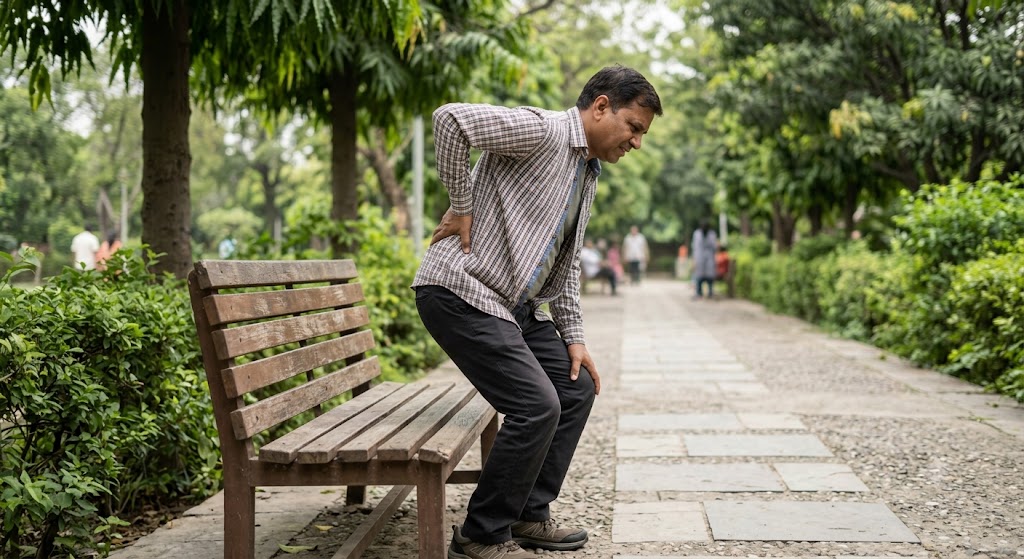
Menisci are living wedges, not spare washers. They still expect walking compression plus a little rotation — the cue Fairbank, Shrive, Walker and Mow mapped — not a chair-locked straight-ahead day.

A meniscus looks like a spare washer between the thigh and the shin. It is not. It is a living, C-shaped wedge of fibrocartilage that spreads load, seals the joint, feeds on motion, and reports strain. Two of them sit in each knee: a more open medial C and a more closed lateral O.
Most of a modern day never asks them to do the job they were built for. Sitting unloads the wedge. A straight corridor never rotates it. A first weekend cut or deep squat then dumps a twist onto tissue that has spent the week as furniture.
Thomas Fairbank, Nigel Shrive, Peter Walker and Van Mow spent decades showing what those wedges do when they are present, and what the joint pays when they are missing or starved of cyclic load. This is not a dare to pivot on a sore knee. It is a map of why menisci still expect twist under compression, and what a straight-ahead seated life does to that brief.
What This Tissue Was Built to Do
Each meniscus is fibrocartilage: collagen hoops that can take hoop stress, a proteoglycan-rich inner zone that can take compression, and a blood supply that is generous only at the outer rim. The inner two-thirds live more like cartilage. They eat by squeezing fluid in and out.
When you stand and walk, the femur rolls and spins a little on the tibia. The menisci translate with that roll. They increase contact area so peak pressure on the tibial plateau does not spike. They deepen the socket so the femur is less free to slide. They help the synovial fluid film. They carry mechanoreceptors that tell the spinal cord the joint is under load.
Walker and Erkman measured how much of the load the menisci share. In extension the lateral meniscus can take most of the compartment load; the medial takes a large share as well. Remove the washer and the remaining cartilage sees a much smaller contact patch and a much higher peak. Fairbank, writing in 1948 after watching knees that had lost a meniscus, described the late radiographic price: ridge, flattening, narrowing. The joint had been asked to work without its spreader.
Shrive and colleagues made the hoop-stress point sharp. The collagen circles in a meniscus convert axial compression into circumferential tension, the way a stone arch converts weight into a ring. Cut the hoop — a radial tear, a sloppy resection — and the wedge can no longer spread the load. Mow’s laboratory then showed that cartilage and meniscus both live on interstitial fluid pressurization. Cyclic compression is not optional decoration. It is how the tissue eats and how it stays slippery.
The outer rim can heal. The inner white-white zone mostly cannot. That geography is why a small stable peripheral tear and a complex inner flap are not the same injury, and why “just take it out” was a more expensive sentence than mid-century surgery first assumed.
Why Twist-and-Load Was the Original Cue
Ancestral days were not plyometric classes. They were:
- Walking on dirt, slope and camber, so each step included a little rotation under body weight
- Turning to look, carry and follow
- Rising from the ground through a deep knee fold
- Hills that changed how the femur sat on the tibia
- Occasional cuts and stops, not eight hours of none and then one
- Nights of unload so fluid could return to the disc of tissue
That pattern is almost a textbook meniscus program. Compression so the hoop can work. A little rotation so the wedge translates instead of being sheared in one locked spot. Variety so one horn is not the only one that ever sees strain. Rest so the inner zone can rehydrate.
Joints still expect motion rather than rest because cartilage and meniscus share the same fluid-feeding rule. Ligaments still expect occasional end-range because the ACL and the menisci are partners: the ligament checks the slide the meniscus is trying to deepen. Knees still expect varied terrain because a camber and a turn are how the medial and lateral washers take turns working.
Englund and Roos later put the population point on the table. Meniscus damage and extrusion are common with age. Not every MRI tear is the pain. But a knee that has lost meniscal function — by tear, by extrusion, by resection — walks a faster road toward the Fairbank changes. The washer was never spare.
What Modern Life Quietly Removes
Chairs are not a poison. They are a missing squeeze.
All-day unload. Sitting takes body weight off the meniscus. The inner zone, which lives on cyclic fluid flow, spends hours as a dry sponge.
Straight corridors. Office floors and treadmills are honest forward motion. They under-dose the small rotations the horns were built to follow.
Then a sudden cut. A first tennis match, a twisted getting-out-of-a-car, a deep squat on a cold Monday. The classic mechanism is compression plus rotation on a planted foot. Tissue that has not been living at that strain meets it all at once.
Deep flexion without a vote. A full squat can pinch the posterior horn, especially medially. People who never fold the knee and then sit on their heels for a long stretch ask the back of the washer for a job it has not practiced.
Weight that never cycles. Body mass is load. Load without steps is a different memo from load with steps. The hoop likes a pulse, not a constant parked compression in one angle.
The early result is not always a locked knee. It is a joint that feels “fine on the sofa and uncertain on the first turn,” a click at a particular angle, a line of ache along the joint after a day that finally included a twist.
Less Common but Serious
Not every click is a torn washer.
True locking — the knee that will not straighten, with a block rather than stiffness — can mean a displaced fragment sitting in the way. That is not a stretch-it-out problem.
A hot, swollen knee after a twist, especially with giving-way, can mean a meniscus tear plus an ACL or cartilage injury. The tissues fail as a set more often than as a solo.
A painless MRI “tear” in a middle-aged knee is often degenerative signal. Operating on signal that is not catching or locking does not reliably beat the natural history Englund’s group described.
Fever, redness that spreads, or a knee that cannot bear weight after a wound is not meniscus mechanics. That is infection until proven otherwise.
Night pain that wakes you, unexplained weight loss, or a knee that is changing shape without a story needs a workup that is not a foam roller.
Hidden Triggers
The meniscus is honest about the week you actually lived.
A long drive, then a twisted climb out of the car, is a classic inner-city version of plant-and-rotate.
A week of sofa rest after a minor sprain, then a “test” cut on the weekend, is the immobilization-plus-sudden-load pattern the collagen labs already measured in ligaments and that meniscus tissue shares.
A new cycling or rowing block that keeps the knee in the same flexion band for hours can irritate a horn that likes translation through a range, not a groove.
Sitting on a folded leg on the floor — the “W” or side-sit that parks one tibia rotated under a femur — can nag a posterior horn in people whose tissue is already frayed.
Rapid weight gain without a matching step count raises compressive load without the cyclic fluid pump.
When to Worry
See a clinician promptly if:
- The knee locks and will not fully straighten or bend
- You felt a pop, swelled within hours, and the joint gives way
- Pain sits on the joint line and catching repeats with the same twist
- Swelling, fever or redness follows a wound or procedure
- Both knees change fast without a clear training story
Those are not “walk it off and hope the washer reseats.”
Myths vs Facts
Myth: The meniscus is leftover packing and you do not need it.
Fact: Fairbank’s knees after meniscectomy already showed the late bill. Modern repair culture exists because the washer spreads load.
Myth: Every MRI tear needs surgery.
Fact: Many middle-aged “tears” are degenerative. Trials in degenerative meniscus disease often find exercise and time close to arthroscopy for pain that is not locking.
Myth: Rest heals a meniscus the way rest heals a bruise.
Fact: The inner zone has almost no blood. Motion that does not catch the tear feeds the tissue; complete unload starves it.
Myth: Squats destroy menisci.
Fact: Loaded flexion is part of the original job. Novel deep flexion on an irritable posterior horn can pinch. Dose and control matter more than the word squat.
Myth: If it clicks it is torn.
Fact: Painless clicks are common. Catching that blocks motion is a different sentence.
How to Give the Washer a Fair Day
You do not need a cutting sport. You need compression that moves.
Walk on ground that is not only a hallway. A gentle turn every so often is the rotation the horns expect.
Stand up from the chair without twisting the planted foot under a turning torso. Move the feet first, then the body. That one habit removes a daily plant-and-rotate.
Visit a comfortable squat or sit-to-stand through the day so the femur is not parked at 90 degrees for ten hours and then asked to fold.
After a quiet week, do not make the first session a pivot sport. Give the hoop a few days of walking and controlled bends first — the same gradual logic tendons still use.
If a clinician has said a tear is stable and not locking, motion that stays out of the catch angle is usually kinder than a brace-and-sofa month.
Strength around the knee — quadriceps and hip — does not glue a torn hoop. It does share load so the remaining washer is not the only structure working.
When to See a Doctor
See a doctor or a sports clinician if locking repeats, if swelling follows a twist, if the joint gives way, or if joint-line pain has lasted more than a couple of weeks and is changing how you walk. Bring the story: the angle, the twist, whether it swelled, whether it truly blocks. That history is often worth more than the first image.
Urgent care belongs to a hot knee, a knee that cannot bear weight after trauma, or a locked knee that will not move.
FAQs
Can a meniscus heal on its own?
The outer red-red rim sometimes can, especially in younger tissue after a stable tear. The inner white-white zone has little blood and rarely knits. “Heal” and “become quiet” are not the same sentence.
Why does my knee click at one angle?
A flap, a plica, a tendon, or ordinary cavitation can all click. A click that also catches and blocks is the one that raises meniscus concern.
Is walking enough load?
For daily nutrition of the inner zone, walking is the original dose. Cutting sports add rotation and shear the tissue also met in small amounts on rough ground — they are not required for health, and they are a poor first dose after a quiet month.
Does extra body weight doom the meniscus?
It raises compressive load. Steps still pulse the fluid. The combination of high load and no pulse is harsher than high load with a lot of honest walking.
Should I wear a knee brace all day?
A brace can help a giving-way knee in a short window. All-day bracing that removes motion also removes the squeeze the tissue eats on.
Why did the pain start after sitting, not after sport?
A parked flexion angle can leave a horn pinched or a joint short of fluid. The first steps then hurt more than the sofa did. That is unload-then-load, not proof the sofa tore the washer.
Is a discoid meniscus the same problem?
A discoid lateral meniscus is a congenital shape difference. It can snap and tear more easily in some people. It is not the same as an ordinary degenerative tear, and it needs its own exam.
Will losing the meniscus give me arthritis for sure?
Fairbank changes are common after total meniscectomy. They are not instant, and they are not identical in every knee. Protecting what remains — repair when it can work, partial resection when it must, and a walking life after — is the modern point of the 1948 warning.
Conclusion
Your menisci were not designed as optional packing. They were designed as living wedges that spread a step, follow a small turn, and eat by being squeezed. Fairbank saw the joint without them. Shrive, Walker and Mow measured the hoop and the fluid. Englund and Roos watched how often the washer frays when the decade is long and the terrain is flat.
A chair-and-corridor life does not snap a meniscus by itself. It leaves the hoop unemployed and then surprised. The repair is not a weekend of cutting drills. It is the old brief, restored in modern pieces: walk, turn a little, fold the knee on purpose, stand without twisting on a stuck foot, and treat a lock or a hot swelling as a joint that needs a person, not a stretch.