The soleus still expects hours of standing and slow walking. Chair days leave it silent, then a long sit dulls the calf pump and the after-meal sugar sink.
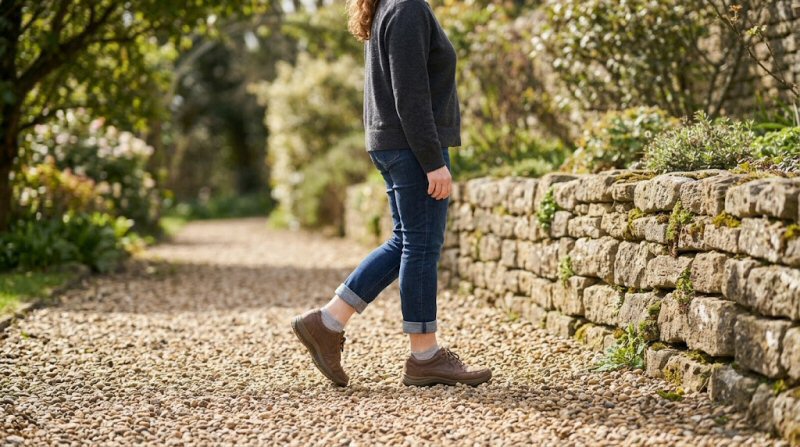
You can feel the bulge of the calf when you rise on your toes. Most of that shape is the gastrocnemius, the two-headed muscle that also crosses the knee. Under it sits a flatter, slower muscle that does a different job. The soleus runs from the back of the shin bones into the Achilles. It crosses only the ankle. It was built to keep you upright and to control the shin as you walk, for a large share of the day.
A chair with the feet supported turns that job off. Electromyography work going back to John Basmajian showed the soleus active in ordinary standing and largely silent once you sit. Hours of that silence are new. The ache after a long sit, the heavy lower legs on a flight, and the slump after lunch are not random. Part of the system that was supposed to be ticking along never got the signal.
What This Quiet Calf Feels Like
It is rarely a sharp tear. More often the lower leg feels unused, then suddenly tired. Standing up after a meeting, the calves feel stiff for the first few steps. On a long drive the ankles feel puffy and the shoes tighter by evening. After lunch the mind feels dull even though the meal was not huge. Some people notice a dull band low in the calf, nearer the Achilles than the knee, when they finally walk up a hill.
That band is easy to blame on the Achilles. The tendon is shared. The workload is not. With the knee bent, as it is in a chair, the gastrocnemius is slack and the soleus is the plantarflexor left on duty. In a chair it is usually not on duty at all.
What the Soleus Was Built to Do
Human walking is a controlled fall. In mid-stance the shin rolls forward over the foot. The soleus resists that roll. Jacquelin Perry’s gait work described this as a plantarflexion moment that keeps the knee from buckling: the soleus holds the tibia back while the thigh stays over the foot. It is endurance work, not a jump. Fiber-typing studies, including those of Michael Johnson and Philip Gollnick, found the human soleus unusually rich in slow oxidative fibers. It can stay on for a long time without the burn of a sprint muscle.
Ancestral days were not a gym session and they were not a locked standing shift either. Hunter-gatherer activity studies, including David Raichlen and Herman Pontzer’s work with the Hadza, show long stretches of slow walking and light loading mixed with rest. The soleus expects that mix: frequent low-level contractions, hills, standing to talk, sitting on the ground with the knees up, then walking again. It does not expect eight hours with the feet planted and the muscle electrically quiet.
The same contractions move blood. The deep calf veins sit inside the soleus. Each step squeezes them. Physiologists have long called the calf the peripheral pump for that reason. When the pump rests, venous pressure in the lower leg rises. That is the heavy, tight feeling, and it is the same system described in why your veins still expect the calf pump.
Why a Chair Changes the Metabolism
Marc Hamilton’s group at the University of Houston has argued for an “inactivity physiology” that is not just the absence of exercise. In a 2022 laboratory study they isolated the soleus with a seated heel raise, knees bent so the gastrocnemius could not take over. The whole-body energy cost looked modest. Locally, the muscle oxidized carbohydrate from the blood for hours, and the rise in blood sugar and insulin after a glucose drink was clearly smaller than in the seated control. Triglyceride handling improved as well.
The point is not a branded exercise. It is the design. A small postural muscle, used often, can clear fuel that larger sprint muscles would rather store as glycogen. Sitting removes that clearance without feeling like a skipped workout. A person can hit a gym in the evening and still have spent the workday with the soleus off. That split matches the after-meal pattern in why your blood sugar still expects a walk after meals: the muscle sink was supposed to be available when the meal arrived, not only at 6 p.m.
The springy push-off is a related but different job, handled more by the gastrocnemius and the Achilles, covered in why your calves still expect hills and stairs. The soleus is the all-day muscle underneath that spring.
Common Times It Shows Up
Desk blocks are the obvious one. Meetings, driving, and flights are the same posture with less chance to stand. Soft shoes and a flat floor remove the small balance corrections that used to recruit the deep calf. A standing desk used as a statue is not a full fix. Karen Søgaard, and occupational studies from Marie-Ève Chiasson and Julie Côté, have shown that locked standing tires the same muscles and raises leg discomfort. The missing input is variation, not a single noble posture.
Evening heaviness is common in people who sit all day and then stand to cook. The pump restarts into veins that have been full for hours. Heat, long socks with a tight band, and dehydration make the swelling more obvious. None of that means the muscle is injured.
Less Common but Serious Causes
Most quiet-calf complaints are load and fluid. A few are not.
A sudden hot, swollen, one-sided calf, especially after a flight, surgery, or a period of real immobility, can be a deep-vein clot. Pain that is out of proportion to a minor movement, with redness or warmth, needs same-day care. An Achilles rupture usually feels like a pop at the back of the heel, then an inability to push off or rise onto the toes. That is an urgent orthopedic problem, not a stiff soleus. New calf pain with chest pain or breathlessness is an emergency.
Night cramps are a separate pattern. True weakness, foot drop, or numbness in a nerve distribution is not a postural muscle asking for steps. Those need a clinician, not more heel raises.
Hidden Triggers
Knee-bent sitting is the main one, because it slackens the gastrocnemius and then asks nothing of the soleus either. Footrests and crossed legs add to the silence. Very cushioned shoes reduce the small sway corrections of standing. A long commute followed by a desk is two silent blocks in a row. Large evening meals after that silence ask the blood-sugar system to cope without the local muscle sink Hamilton’s lab was measuring.
Dehydration and a high-salt day worsen the dependent swelling, so the calf feels like the problem when the fluid shift is the louder signal. Compression that is too tight at one band can do the same.
When to Worry
Ordinary stiffness that eases in a few minutes of walking is the mismatch. Worry sooner if one calf is swollen, hot, or red, if you cannot bear weight, if the Achilles region popped, or if calf pain arrives with chest pain, coughing blood, or sudden shortness of breath. Persistent one-sided swelling, unexplained weight loss, or night pain that does not ease with movement also deserves a visit. A first-time severe cramp with lasting weakness is not a normal soleus day.
Myths vs Facts
Myth: The calf is one muscle, and toe raises cover it.
Fact: The gastrocnemius prefers a straight knee and a quicker load. The soleus works with the knee bent or straight, and it is the endurance fiber. A few bouncing raises do not replace hours of low-level use.
Myth: A standing desk solves it.
Fact: Standing helps the pump turn on. Standing still for hours fatigues the soleus and the feet. Short bouts beat a statue.
Myth: If you exercise after work, the sitting does not matter.
Fact: Exercise is useful. It does not restore the contractions that were missing at lunch. Hamilton’s inactivity work is about that gap, not about replacing training.
Myth: Heavy evening legs mean the heart is failing.
Fact: Dependent fluid after sitting is common and usually local. New breathlessness, chest pressure, or swelling that includes the thighs and face is a different question and needs care.
How to Give It the Day It Expects
Break sitting into pieces. A few minutes of walking each half hour does more for this muscle than one heroic session. Slow walking is enough. The soleus is already built for that pace.
If you cannot leave the chair, bend the knees and do slow seated heel raises, pausing at the top. That is the posture Hamilton used to keep the gastrocnemius out of the movement. Quality matters more than speed. Twenty or thirty unhurried reps during a call is a reasonable start. Stop if the Achilles pinches.
On your feet, shift weight, take a short loop, and use a step or a curb rather than locking the knees. A slight heel drop on a step, slow and painless, keeps the tendon comfortable. Skip aggressive stretches if the back of the heel is already sore.
Shoes with a flexible sole and a little room at the toes let the foot contribute. Very tall heels keep the soleus short. Very soft heels remove the small signals of stance.
After meals, a ten-minute walk is the simplest match to the old pattern. Water helps the evening heaviness. If you stand for work, sit for a few minutes each hour so the muscle is not asked to be a post all day.
When to See a Doctor
See someone if one leg stays swollen, if walking does not ease a new calf pain, or if toe-rise is weak or impossible. Mention recent travel, injury, hormonal contraception, pregnancy, cancer treatment, or a family clotting history. People with known vein disease, diabetes with numbness, or Achilles pain that is worse on the first steps of the day should get that pattern checked rather than loading through it.
FAQs
Is the soleus the same as the calf?
It is the deep part of the calf. The gastrocnemius is the superficial, knee-crossing muscle you see flex. The soleus lies under it, crosses only the ankle, and does more of the all-day standing and walking work.
Does sitting really turn it off?
In supported sitting, yes, for practical purposes. Basmajian’s EMG studies found the soleus active in quiet standing and quiet once the body weight was on a chair. Small fidgets recruit it a little. They do not replace walking.
Are seated heel raises useful?
They can be, if the knee stays bent and the movement is slow. Laboratory work from Hamilton’s group found that this pattern raised local fuel use far beyond what the calorie cost suggested. They are a supplement to walking, not a reason to skip it.
Why do my lower legs swell more on travel days?
Stillness lets venous pressure rise in the deep calf veins. Cabin air and a salty meal add fluid. Walking the aisle and ankle circles use the pump. A single hot, swollen calf after travel should be assessed, not stretched.
Can a weak soleus affect the knee?
It can change how the shin moves over the foot. Perry described the soleus as part of the couple that steadies the knee in mid-stance. Fatigue often shows up as a heavier stride or a calf ache before it shows up as a knee diagnosis.
How is this different from Achilles trouble?
Achilles pain is usually on the tendon or at the heel, often worst on the first steps. Soleus fatigue is a deeper calf ache that eases as you walk, without a pop or a gap in strength. A pop and an inability to push off need urgent care.
Conclusion
The soleus still expects to be on your feet for much of the day, controlling the shin and pumping the calf. Chairs ask it to wait until evening. The result is a quiet muscle, heavier lower legs, and a missed chance to clear some of the fuel from a meal. Short walks, a little seated heel work when you are stuck, and standing that actually moves are enough to match the old job. Sudden one-sided swelling, a pop at the heel, or pain with breathlessness are the signals to stop experimenting and get checked.