
The soleus still expects hours of easy walking, not a chair then a sprint. Quiet calves ache, pool blood, and miss the slow muscle the day was built around.
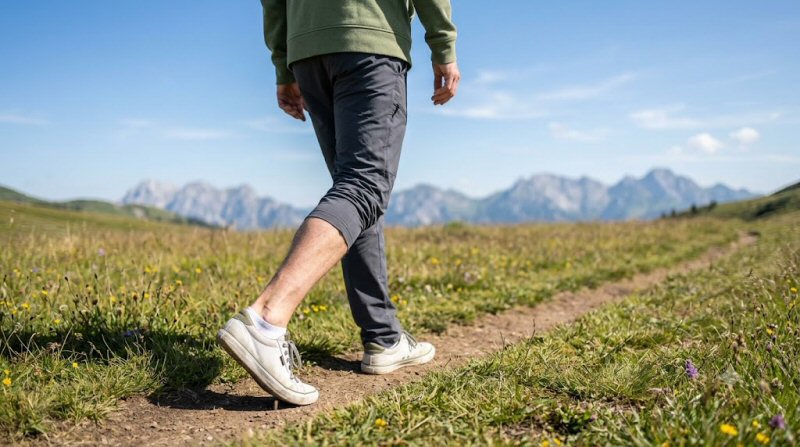
The calf that complains at the end of a desk day is often not the showy one. The gastrocnemius is the bulging, two-joint muscle you see when you rise onto your toes. Under it sits the soleus, a broad, slow muscle that attaches to the tibia and fibula and shares the Achilles tendon. It was built for the unglamorous job: keeping you upright and moving for most of the waking day. A commute, a chair, a car, and an evening sofa give it almost none of that job, then a rushed walk to the train asks it to remember.
That mismatch is ordinary. It is also why a deep, dull ache behind the lower leg, heavy ankles by late afternoon, and a calf that feels “asleep” until the first block of a walk are so common in people who are not injured.
What This Muscle Was For
Human walking is a long, low-gear task. Hunter-gatherer groups studied by David Raichlen and colleagues often cover many kilometers in a day at an easy pace, with frequent short stops rather than one heroic bout. The soleus matches that pattern. Muscle-architecture work by Richard Lieber and others shows a muscle with a large physiological cross-section and relatively short fibers: built to produce steady force, not to sprint. Fiber-type studies put most of the soleus in the slow-oxidative camp, the kind of tissue that can tick along for hours if it is fed oxygen and used often.
Electromyography made the division of labor obvious. John Basmajian’s recordings, and earlier standing studies by J. Joseph and A. Nightingale, found the soleus active during quiet stance while the gastrocnemius stayed relatively quiet unless you swayed or rose onto the toes. The soleus is the postural calf. The gastrocnemius joins in for faster push-off, hills, and stairs — a different brief, covered in why your calves still expect hills and stairs.
Each step also empties the soleal sinuses, thin-walled veins inside the muscle. Physiologists from Loring Rowell to venous researchers such as Andrew Nicolaides have described this calf pump as a peripheral heart. When the soleus contracts and lengthens, it squeezes blood up past the valves. When it sits still, those sinuses are a low-flow pocket. That is the same logic behind why your veins still expect the calf pump.
What a Seated Day Does Instead
Modern soleus use is lumpy. Many adults take a few thousand steps, most of them in two or three clumps, and spend the rest of the day with the ankle near a right angle and the muscle neither shortening nor lengthening much. A few things follow.
The slow fibers lose the low-grade contractions that kept their capillaries open. Bengt Saltin’s work on muscle blood flow showed that perfusion follows local activity. A quiet soleus is a quiet local sink for glucose and a quiet pump for venous blood. Marc Hamilton and colleagues later showed, in a 2022 seated “soleus push-up” experiment, that even small, repeated soleus contractions can raise local oxidative metabolism and blunt the rise in blood glucose and certain blood fats after a meal. The finding is not a prescription to fidget your way out of walking. It is evidence that this muscle is metabolically loud when it is allowed to work, and unusually quiet when the ankle is parked.
Prolonged sitting also leaves the soleal veins still. Clinics see the downstream version as evening ankle swelling and, in higher-risk people, clot risk in the deep veins of the calf. Ordinary heavy legs after a flight or a writing day are usually dependent pooling, not a clot. The distinction matters, and it is covered under when to worry below.
Tendon load changes too. The soleus shares the Achilles with the gastrocnemius. A springy step needs both, as described in why your Achilles still expects a springy step. Hours of no load, then a sudden hill or a new running plan, hand the tendon a weekend it did not rehearse. The soleus portion of the Achilles is a common site of mid-portion overload in adults who jump from sitting to training.
What It Feels Like
People rarely say “my soleus.” They say the lower calf feels thick, the ankle feels heavy, or the first five minutes of a walk are wooden and then ease. Shoes feel tighter by evening. A long stand in a queue burns deeper than a short one, because quiet standing is a low-level soleus hold, not a rest. Night cramps in the calf are a cousin problem: a muscle that spent the day either rigid or idle, then shortened under the covers.
The ache is usually dull and both-sided, worse after uninterrupted sitting, and better once you have walked long enough to warm the pump. One-sided sharp pain, a hot swollen calf, or breathlessness is a different story.
Why the First Block Feels Worse Than the Tenth
A muscle that has been still is not damaged. It is poorly perfused and a little stiff. The first contractions wring out pooled blood, raise local temperature, and recruit the slow fibers that have been off duty. Jacqueline Perry’s gait descriptions put soleus work in mid-stance, controlling the forward fall of the shin. If that control has been replaced by a chair for six hours, the first block is the reintroduction. It should settle, not escalate. Pain that climbs with every minute, or a calf that locks, is not a simple warm-up.
Hidden Triggers
Unbroken sitting is the main one. Others pile on. Heels that never drop, including some stiff dress shoes and very cushioned shoes, shorten the range the soleus uses in stance. A desk that tucks the feet under the chair keeps the ankle bent and the muscle slack. Dehydration and a large salty evening meal make dependent swelling more obvious. A new standing desk without any walking simply trades a slack soleus for a clenched one. Basmajian’s recordings imply that quiet standing is work. It is not the stroll the muscle still expects.
Cold offices vasoconstrict the skin and can make the lower leg feel heavier until you move. Crossing the legs for long stretches adds a local kink to an already quiet pump.
How to Give It the Day It Expects
You do not need a training plan. You need repetitions of easy use.
Break sitting every half hour with two or three minutes of walking, even a hallway loop. The soleus cares more about how often it contracts than about how heroic the outing is. If a meeting traps you, seated heel raises with the foot flat — lifting the heel an inch and lowering slowly — are the motion Hamilton’s group studied. Use them as a bridge, not as a substitute for steps.
Walk at a pace where you could talk. Include a little uneven ground or a gentle hill a few times a week so the muscle lengthens under load, not only holds. A slow lower on a step, heel dropping slightly below the tread, is a simple soleus bias if the Achilles is comfortable. Stop if the tendon pinches.
Save true speed and heavy calf raises for after the easy daily steps exist. Tendon researchers such as Jill Cook have argued for years that load should rise gradually. A soleus that strolls most days tolerates a harder session. One that sits all week does not.
In the evening, a short walk after dinner does double duty for glucose and for the pump. If ankles swell, elevate the legs for a few minutes and avoid sleeping with the feet pointed hard. A light blanket rather than a tucked sheet reduces the shortened position that feeds night cramp.
When to Worry
Seek urgent care for a one-sided calf that is hot, red, and swollen, especially after a flight, surgery, pregnancy, or a period of immobility, or if calf pain arrives with chest pain or sudden breathlessness. Those can be signs of a deep-vein clot or, rarely, a clot that has traveled.
See a clinician promptly for calf pain with numbness in the foot, a cold pale foot, or pain that wakes you and does not ease with a change of position. Ongoing Achilles pain that is worse with the first steps and local to the tendon needs a graded plan, not more ignoring. Bilateral evening heaviness that eases with walking is the common mismatch pattern, not an emergency.
Myths vs Facts
Myth: Calf ache after sitting means you are low on potassium. Fact: Ordinary dietary intake is rarely the cause of desk-day calf heaviness. Stillness and a quiet pump explain more.
Myth: Standing all day trains the soleus. Fact: Quiet standing loads it, but without the shorten-and-lengthen cycle of a stroll the pump and the tendon see a narrower job.
Myth: Strong gym calves mean the soleus is fine. Fact: A few heavy sets do not replace hours of low-grade contractions. Fiber type and blood flow follow the day you actually live.
Myth: Evening swelling is always heart failure. Fact: In an otherwise well person, late-day ankle fullness after sitting is usually local pooling. New breathlessness, chest pressure, or swelling that climbs the legs still deserves a medical look.
FAQs
Is the soleus the same as the calf? It is part of the calf. The gastrocnemius is the superficial, two-joint muscle. The soleus lies deeper, crosses only the ankle, and does most of the quiet standing and mid-stance work.
Why do my lower calves ache even though I do not run? Long sitting leaves the soleus under-used, then a short walk or a queue asks it to hold. The ache is often reintroduction stiffness and a sluggish pump, not a sports injury.
Do seated heel raises count? They count as a useful bridge. Hamilton’s seated soleus contractions improved local metabolism in experiments. They do not replace walking, uneven ground, or the venous pump of a real stride.
Can a quiet soleus cause night cramps? It can contribute. A muscle held short or idle all day, then pointed under the covers, is a common setup for an ordinary calf cramp. Persistent cramps, cramps with weakness, or one-sided hot swelling need a clinician.
How many steps does it expect? There is no magic total. Ancestral days were mostly easy walking spread across the light hours. A practical modern version is frequent short walks rather than one long outing after ten hours in a chair.
Conclusion
The soleus is not waiting for a personal record. It is waiting for the ordinary day it was shaped by: stance, stroll, a heel that drops, a vein that gets squeezed, and load that arrives in small doses from morning to evening. Chairs give it a long silence and then a surprise. Give it the stroll back in pieces, and the heavy lower leg usually has less to complain about.


