
Your rectus femoris is built for the combined hip flexion and knee extension of walking and climbing. Long sitting leaves it shortened and underused. Learn why it still expects those full strides.
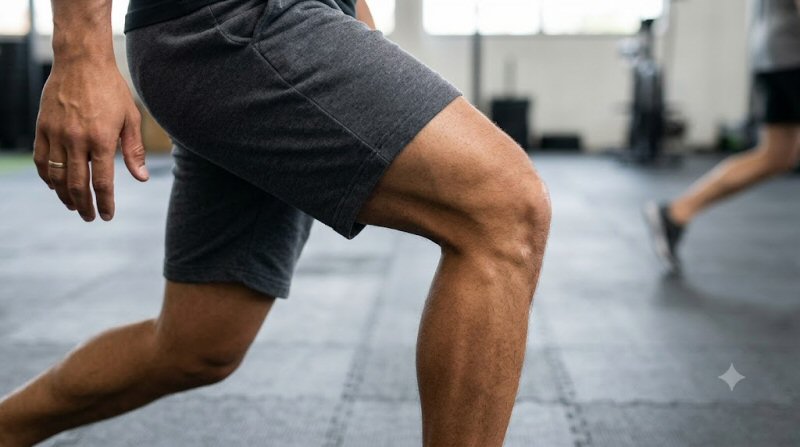
You stand up from your desk after a long stretch of sitting and feel a tight pull across the front of your thigh as you take the first few steps. Or you notice the muscle feels stiff when you climb stairs after a day of mostly sitting. That front-of-thigh sensation is often the rectus femoris, the one quadriceps muscle that crosses both the hip and the knee. It was shaped for the repeated, coordinated strides of walking and occasional climbing, not for hours folded in a chair.
What This Muscle Actually Does
The rectus femoris runs down the front of the thigh. Unlike the other three quadriceps muscles, which only cross the knee, it starts on the pelvis (at the anterior inferior iliac spine and the acetabular rim) and inserts via the quadriceps tendon onto the patella and tibial tuberosity. Because it crosses two joints, it can flex the hip and extend the knee at the same time.
In walking, it typically shows a two-burst pattern of activity. It helps stabilize the knee as the foot accepts weight at the start of stance, then fires again to help swing the thigh forward for the next step. Electromyography studies, including classic work referenced by Basmajian and more recent multi-channel recordings by researchers such as Watanabe and colleagues, show this regional and timing-specific activation during gait. On stairs or slight inclines the demand rises further because the combined hip flexion and knee extension is more pronounced.
Human bipedal locomotion evolved around this kind of efficient, repeated loading. Daniel Lieberman’s research on human gait economy highlights how our pelvis and limb proportions favor economical walking over long distances. The rectus femoris participates in that economy by linking hip and knee motion so the leg can advance smoothly without excessive energy cost.
Why Modern Sitting Changes the Demand
When you sit with the hip flexed and the knee bent, the rectus femoris is placed in a shortened position. Over many hours it adapts by losing some of its available length and by receiving less of the cyclic loading it was built for. The other quadriceps (vastus medialis, lateralis, and intermedius) can still extend the knee from a seated position, but the rectus femoris’s dual role is underused. The result is often a sensation of tightness when you finally stand and take a full stride, or a sense that the front of the thigh “wakes up” only after several minutes of walking.
This is the same pattern seen with other muscles that expect daily variety. Compare it to the way the psoas still expects occasional deep hip flexion or the way the quadriceps still expect stair climbing. Prolonged sitting reduces the natural range and loading those muscles receive.
Common Everyday Triggers
The most frequent trigger is simply long periods of sitting—desk work, driving, or leisure time on a couch. The first few steps after standing often feel the stiffest. Climbing stairs after a sedentary day can highlight the same tightness because the muscle must now produce both hip flexion and knee extension under load. Wearing shoes with elevated heels slightly shifts the demand, but the bigger factor remains the hours spent with the hip flexed.
Rapid transitions also matter. Standing and immediately walking briskly, or going from a long car ride straight into stairs, can make the shortened muscle complain. People who alternate between long sitting and occasional intense activity (a single long run or hike on the weekend) sometimes notice the front thigh more than those who intersperse short walks throughout the day.
Less Common but Worth Noting
True injury to the rectus femoris (strain or tear) is more common in sports that involve forceful kicking or sprinting. In ordinary daily life the feeling is almost always adaptive tightness rather than damage. Nerve irritation from the femoral nerve or lumbar spine can occasionally refer to the front of the thigh, but that usually comes with additional symptoms such as numbness or weakness. If the tightness is accompanied by visible swelling, bruising, or a sudden sharp pain during activity, that is different from the gradual desk-day stiffness described here.
When to Pay Closer Attention
Most front-thigh tightness after sitting is benign and improves with a few minutes of walking and a gentle stretch. See a clinician if the tightness is severe, persists even after regular movement, is associated with knee pain that worsens with stairs, or is accompanied by weakness, numbness, or difficulty bearing weight. Sudden onset after a specific twisting or kicking motion also deserves evaluation. In the large majority of sedentary-lifestyle cases, the muscle is simply reminding you that it still expects the occasional full stride.
Myths vs Facts
Myth: Tightness in the front thigh always means you need aggressive stretching.
Fact: Gentle, frequent movement and short walks often restore comfort faster than long static stretches alone. The muscle responds to the cyclic loading of ordinary walking.
Myth: Only athletes use the rectus femoris.
Fact: Everyday walking and stair climbing recruit it. The mismatch appears precisely because modern life reduces those ordinary demands.
Myth: Sitting permanently shortens the muscle.
Fact: Adaptive shortening is reversible with consistent daily movement. The tissue retains the capacity for length when it receives the loading it was built for.
How to Give It What It Still Expects
The simplest intervention is to break up sitting. Stand and walk for two or three minutes every 30–45 minutes. Those short bouts restore the hip-flexion-plus-knee-extension pattern the muscle expects. Climbing a flight of stairs a few times a day adds useful load without needing special equipment.
A gentle standing stretch can help: hold a stable surface, step one foot back, keep the rear knee soft, and tilt the pelvis slightly until you feel a mild stretch on the front of the rear thigh. Hold 20–30 seconds, then walk. Avoid forcing a deep lunge if the muscle feels protective. Strength work that includes both hip flexion and knee extension (step-ups, controlled lunges, or simply walking on slight inclines) keeps the dual action practiced.
If you drive long distances, plan a short walk at stops. The same principle appears in related patterns such as why the hamstrings still expect you to pick things up—varied, everyday loading prevents the quiet adaptation that prolonged stillness produces.
When to See a Doctor
Consult a clinician if front-thigh tightness is accompanied by true weakness, changes in sensation, persistent swelling, or pain that limits normal walking. Also seek care if the symptom appeared suddenly after trauma or if it fails to improve after several weeks of regular movement breaks. For the common desk-related tightness, most people improve with the simple habit of more frequent short walks.
FAQs
Is it normal for the front of my thigh to feel tight when I first stand up?
Yes. After prolonged sitting the rectus femoris is often in a shortened position. The first few steps restore length and loading, and the sensation usually eases quickly.
Does climbing stairs help or hurt a tight rectus femoris?
For ordinary tightness, controlled stair climbing is useful because it demands the combined hip flexion and knee extension the muscle expects. If stairs produce sharp pain, ease back and emphasize level walking first.
Can sitting all day permanently change this muscle?
Adaptive shortening and reduced endurance can occur, but both are reversible. Daily short walks and occasional stair use restore the loading pattern the muscle was built for.
Should I stretch it every hour?
Movement matters more than frequent long stretches. Stand and walk briefly every half hour; add a short gentle stretch once or twice a day if it feels good.
Is front-thigh tightness the same as hip-flexor tightness?
They overlap. The rectus femoris is one of the hip flexors, but it also extends the knee. Addressing both walking and gentle hip extension movements covers the dual role.
When is front-thigh pain a sign of something else?
If it includes numbness, true weakness, sudden sharp pain after a specific movement, or does not improve with ordinary activity, have it evaluated. Isolated stiffness after sitting is usually the muscle asking for the strides it still expects.
Conclusion
Your rectus femoris is a quiet specialist in the coordinated motion of ordinary walking and climbing. Long hours of sitting leave it shortened and under-loaded, so the first full strides of the day can feel stiff. That sensation is usually a reminder, not a warning. Frequent short walks, occasional stairs, and a few gentle movements give the muscle the cyclic hip-and-knee action it was built to perform. The body still expects those full strides; meeting the expectation in small daily doses is usually enough to keep the front of the thigh comfortable.


